


MUMBAI: Foreign investors who rediscovered their appetite for Indian debt in June have now expanded their interest in equities as well in July. After months of continuous selling, foreign portfolio investors (FPIs) turned net buyers in July, investing $2.59 billion (Rs 24,662 crore) in the first 10 days of the month.This reversal, caused by a firming rupee and a shift in investment direction from semiconductors, represents a sharp change in sentiment from earlier this year, when concerns about valuations, global uncertainty and shifting capital flows led to sustained withdrawals.Unlike June, when foreign inflows were largely debt-driven after the government and RBI eased access to sovereign bonds and removed tax frictions, July saw equities regain favor as well.
Equity investments accounted for $1.6 billion, or more than 61% of total inflows, followed by investments through the full access route of $697 million, and debt under the general limit of $340 million.
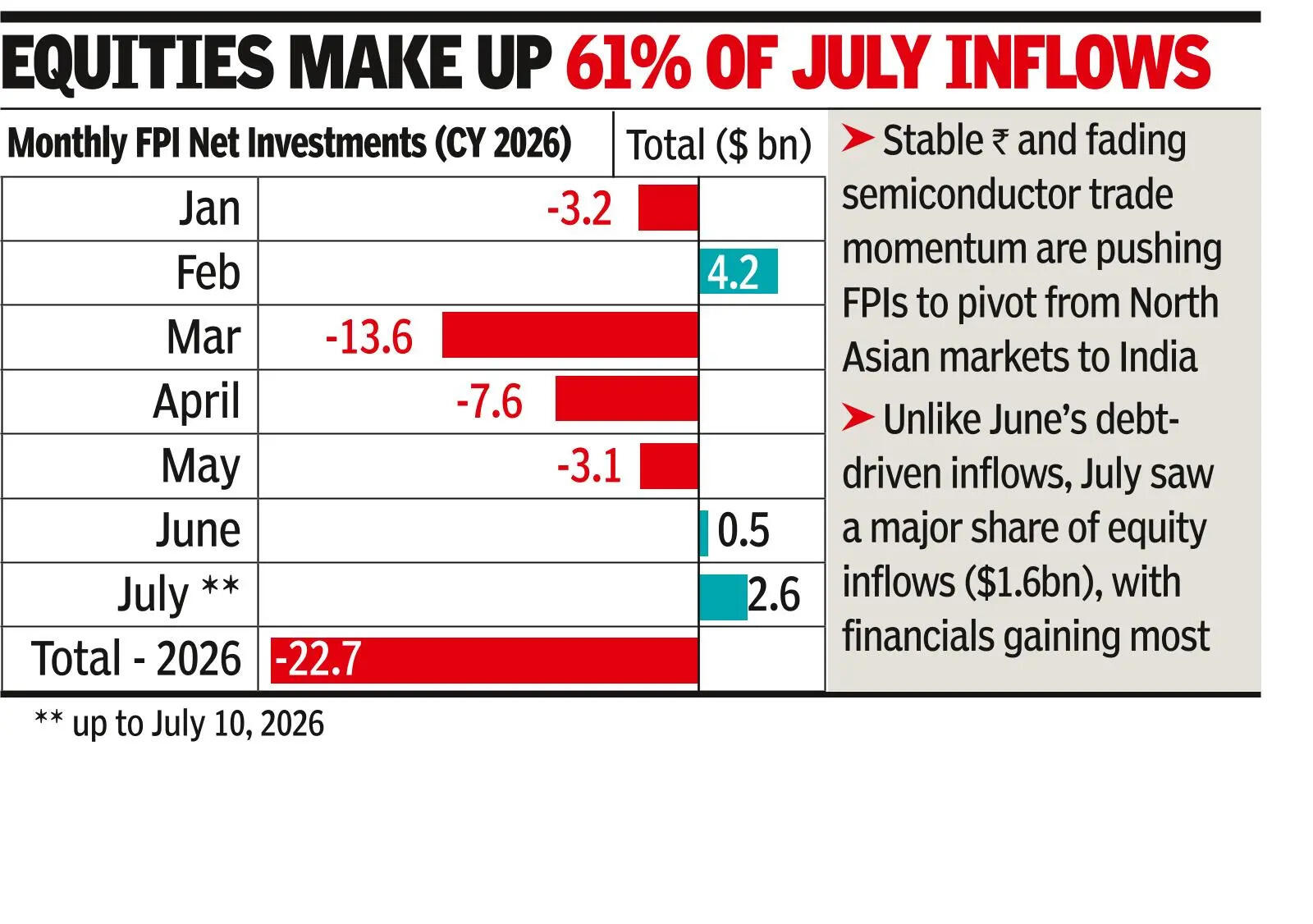
After outflows of $24 billion in March and May, July saw inflows of $2.6 billion.
The transformation has been widespread. From March to May, institutional foreign investors withdrew more than $24 billion from Indian markets, including a record monthly inflow of $13.6 billion in March. June saw an initial recovery, with net inflows reaching $531 million.
July reinforced this trend. Each trading session between July 1 and July 10 recorded positive net inflows, culminating in a one-day investment of approximately $978 million on July 9.The shift was more pronounced in stocks. Foreign investors sold Indian stocks for four straight months through June, including withdrawing more than $5.1 billion in that month alone. However, in July, stocks became the largest destination for foreign capital, attracting Rs 15,157 crore (about $1.6 billion) in the first 10 days of the month.Debt continues to attract investors, although preferences have changed. Inflows through the RPA and the public debt trajectory remained strong, adding to the momentum generated by higher bond purchases in June.According to Suresh Ganapathy, an analyst at Macquarie, a significant portion of inflows comes into financial services. “With Korea and Taiwan being more volatile, any inflows into India will be led by inflows into the financial sector in my view,” he said.VK Vijayakumar, chief investment strategist at Geojit Investments, attributed the improvement to stronger economic fundamentals and a more stable currency.