

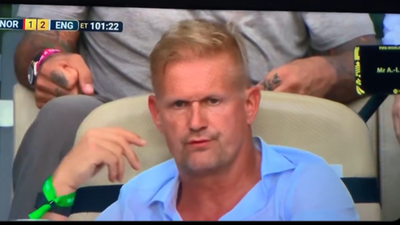
Erling Haaland’s father breaks his silence with brutal five-word message after England ended Norway’s World Cup dream
Alfie Haaland responded to Norway’s dramatic 2026 World Cup quarter-final defeat to England with a clear message on social media, appearing to question the management after his son’s team were eliminated.
His comments came after a match dominated by several high-profile VAR interventions and an equalizer that initially sparked controversy before FIFA later confirmed he had been awarded the award correctly using the connected ball technique. England came from behind to beat Norway 2-1 after extra time in Miami, ending Stal Solbakken’s impressive World Cup campaign despite another outstanding tournament from Erling Haaland.
Alfie Haaland’s five-word reaction
Shortly after the final whistle, former Manchester City and Leeds United midfielder Alfie Haaland responded to Fabrizio Romano’s post about England’s win over X with a short but telling message. “Well done Billingham and the referee.” The post quickly sparked thousands of reactions, with many supporters interpreting it as a criticism of the match management rather than England’s performance.Some England fans accused Haaland Sr of being a sore loser, while others sympathized with Norway’s frustrations after a match full of controversial moments.
One fan responded: “Stay humble and accept defeat.” “You’re a sore loser,” another wrote.
Others defended Haaland’s position, pointing to the events that occurred during the match before FIFA issued its clarification.
A match dominated by the dramatic VAR technique
Norway initially believed that England’s equalizer in the first half should not have been awarded.The move began with a long goal kick towards midfield, with Harry Kane collecting possession before the move developed through Anthony Gordon.
Gordon then passed an excellent through ball into the path of Jude Bellingham, who handled the ball twice before calmly finishing in behind Nyland to level the score at 1-1. Television footage later showed the ball passing close to the overhead Spidercam cable, sparking speculation that the ball had hit the wire before falling in front of Elliot Anderson, who started England’s attack. Former FIFA referee Mark Clattenburg, who serves as an official analyst for FOX Sports, explained during the broadcast that if the ball had already touched the overhead cable, play should have been stopped and restarted by dropping the ball under the IFAB Laws of the Game. However, FIFA reviewed the incident after the match using the tournament’s contact ball technology and concluded that there was no contact.
FIFA confirmed that the ball’s internal sensor did not show any spike in the “heartbeat” as it passed under the cable, while additional Sneko-style tracking data also did not detect any touch. With no evidence that the ball struck the overhead wire, FIFA confirmed that England’s equalizer had been allowed to stand properly.
Other decisions increased tension
The cable incident was just one of several major officiating moments throughout the quarterfinals. Norway thought they had regained the lead in the second half through Torbjörn Heegem before VAR disallowed the goal after determining that Erling Haaland had committed a foul on Elliott Andersson during the attacking phase. England were also awarded a penalty in extra time for a clear foul on Jed Spence, but VAR overturned the decision after a review.
Alvey also questioned Norway’s offensive decisions
While much of the discussion focused on the refereeing, Alfie Haaland also pointed to a footballing moment that he believes ultimately proved more costly. Alexander Sorloth was criticized for choosing to shoot rather than pass during a promising Norwegian attack. “People will talk about the Spider-Cam controversy. People will talk about the disallowed goal. But for me, the most important moment came when Norway had the chance to kill the game. “Alexander Sorloth had runners around him. He had options. His teammates were screaming for the pass. Instead, he chose to go it alone. “Football is cruel. One decision, one pass, one moment can change the entire tournament. He added: “Norway was brave and should be proud, but when I look at this match, I still think about that attack. It felt like an opportunity to put the nail in England’s coffin.”
Despite Norway’s elimination, Erling Haaland left the tournament with his reputation enhanced after scoring seven goals, including a memorable brace against Brazil in the round of 16. But while FIFA has now settled the debate surrounding England’s controversial equaliser, the quarter-final remains one of the most hotly debated matches of the tournament.