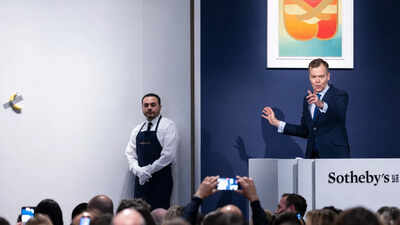
A Sotheby’s auctioneer oversees the bidding on Maurizio Cattelan’s The Comedy (2019) at Sotheby’s on November 20, 2024. Image: Courtesy of Sotheby’s
In a very exclusive, very remote room, a very ordinary-looking wooden mallet descended onto a very ordinary-looking platform and somehow, within a quarter of a second, millions of dollars appeared.At center stage, the reason behind the $6.24 million (Rs 59.42 crore) deal was a banana and a small piece of tape.This is not a fairy tale, although its absurdity may make it so. The concept artwork by Maurizio Cattelan, the comedian, was a banana taped up with tape. Before the auction for this piece began, one of the employees went out to get a banana from a local fruit vendor, because the comedian has never been interested in art.
Its value lies in the play. The fruit rots within days, as fruit does. It has been eaten ever since – twice, by strangers, before it was auctioned, and a third time by its new owner, right on camera, minutes after millions had been paid for it.
What actually circulated was a certificate of authenticity and a laminated instruction sheet on how to tie the next banana.It would be appropriate to see modern and contemporary art as something that has fallen from the high horse on which classical art seems to be burdened. Anyone can do it, so what makes them special? Why do people pay millions for works of art that look like the creation of a small child?
Exhibit A: The man who threw the paint
Jackson Pollock is an artist who barely picked up a paintbrush and became a millionaire.
He laid his paintings flat on the barn floor and dribbled, tossed, and poured faux enamel paint from a can, walking around and sometimes working while he made it.For the longest time, to the “uneducated”, and sometimes even “educated” eye, his art seemed merely out-of-control, framed blots on the wall. But this assumption was complicated in 1999 by a physicist.
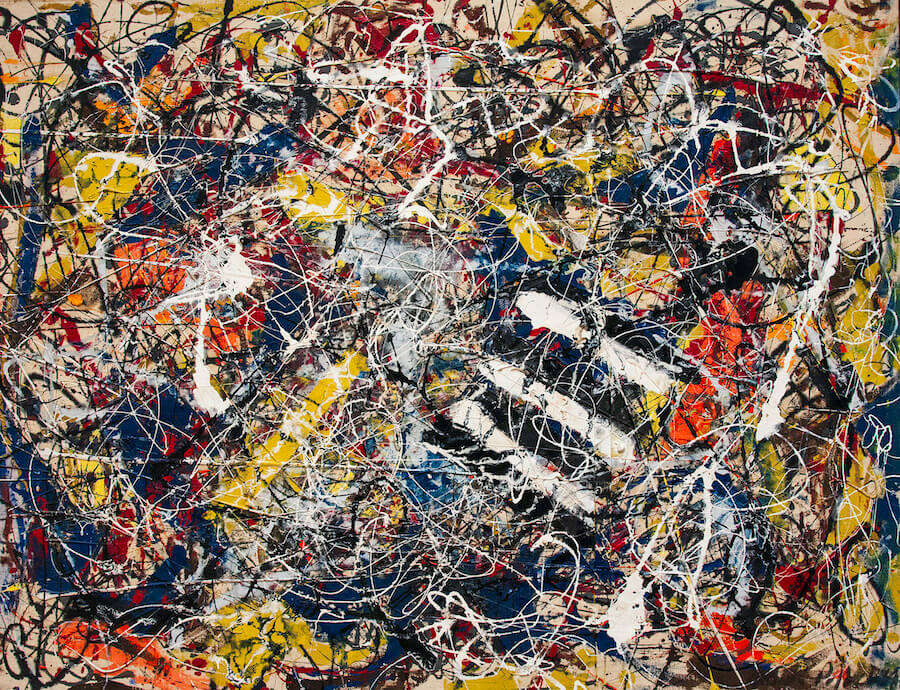
No. 17A, 1948 by Jackson Pollock (Source: jackson-pollock.org)
In 1999, a team led by physicist Richard Taylor analyzed Pollock’s cast paintings and found that they were fractals—patterns repeated at increasingly fine magnifications, the same geometry found in lightning, and the branching of trees—and that the complexity of these fractals had systematically increased over the decade Pollock spent refining the technique.
This result was widely celebrated: here, finally, science had proven what the market had been pricing all along, and there was now a scientific value to the price tag.But theories rarely stand the test of time and peers. Between 2006 and 2007, a separate team of physicists at Case Western Reserve University, Katherine Jones Smith, Harsh Mathur, and Lawrence Krauss, tested the same fractal parameters against a broader set of images, and the results were uncomfortable for anyone hoping that fractals would settle the argument once and for all.Two of Pollock’s paintings documented by the museum failed the fracture test. Meanwhile, the drip paintings commissioned from two amateur artists who had studied Pollock’s technique passed easily. The crude doodles of stars and pebbles, drawn by a physicist in a matter of minutes, meet the same “authentication standards” used to distinguish between original Pollock and fakes.In other words: a fractal signature that was supposedly unique and unteachable to Pollock, could be reproduced by an amateur without training, and was, on occasion, missing from Pollock’s own work.This does not make Pollock a fraud; his value comes from his artistic disconnection from the history of painting. The market’s evaluation of Bullock was never dependent on this evidence. His No. 17A sold privately for $200 million in 2015, a price determined almost entirely by rarity, provenance and decades of institutional canon building, with or without a physicist in the room to ensure fractals.
Exhibit B: The man who cannot be moved
Pollock, at least, has been accused of moving around too much. Mark Rothko’s problem was the opposite: critics accused him of doing almost nothing at all. Stand in front of the late Rothko and what you get are two or three colored rectangles with soft borders, stacked on a wall-sized canvas. One of the easiest pieces to make in an elementary school art class, all you have to do is reduce the size of the canvas.
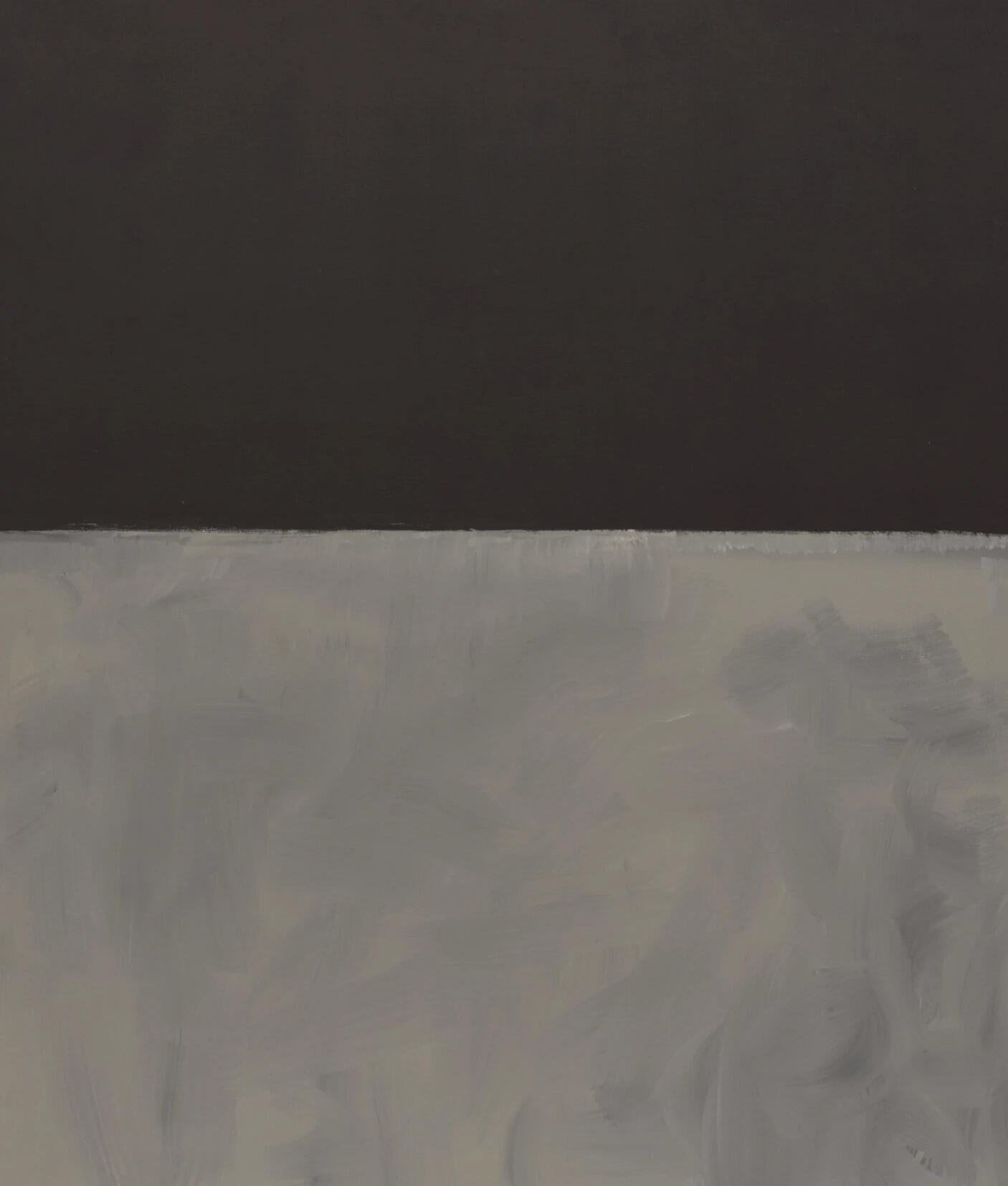
Untitled, Mark Rothko (Source: Museum of Modern Art)
Rothko himself seems to have had contempt for the people who would ultimately pay the bulk for his work.
In 1958, he accepted his first major commission, a series of murals for the Four Seasons restaurant in New York’s Seagram Building, and told the magazine’s publisher exactly why: “I hope to destroy the appetite of every foolish son of a bitch who eats in that room.” He worked on the murals for two years, then refused to hand them over, returned the drawings, and gave the paintings to the museum instead.
He did not want his works to be hung as wallpaper for wealthy people.Six decades later, wealthy collectors still buy his works, only at auction rather than in the dining room, and for much more than a restaurant fee. Seven of Rothko’s paintings have now sold for more than $50 million each. One holds a record $86.9 million.And in at least one case, no one involved could tell if what they were buying was a Rothko at all.In 2004, Domenico De Sole, chairman of Sotheby’s, one of the auction houses that sets these prices, paid $8.3 million for a Rothko he believed was original.
It wasn’t.It was painted by Bai Xinqian, an artist working out of a garage in Queens, for less than $9,000. The only reason that has been discovered is that pigments in paint had not yet been invented when Rothko would have been alive to use them. Until then, this museum had fooled everyone: the Knoedler Gallery, one of New York’s oldest and most respected art galleries; external scientists; Even Rothko’s son, who admitted that he could not rule out that it was real.During the trial, one Abstract Expressionist scholar admitted what may be the single most useful sentence in this entire article: He said, at one point, that all the Rothkos are alike.But for Rothko, his art was supposed to have value only for him and for those who understood it. “I’m not interested in the relationship of color or shape or anything else,” he said. “I’m only interested in expressing basic human emotions – tragedy, ecstasy, doom.”
He wanted his paintings to hang low, and for viewers to stand close enough to feel the color engulfing them rather than looking at it from a comfortable distance.Regardless of which auction house, there is some evidence that he was right. Art historian James Elkins, who researched people who cried in front of paintings, concluded that more people probably cried in front of Rothko’s works than any other painter of the 20th century.
So the case against Rothko was never “there’s nothing there.” It’s more like: Whatever is out there, it’s illegible to everyone and, as it turns out, not entirely legible even to the experts who have spent their careers looking at it.
Exhibit C: The man who cannot be understood
Cy Twombly’s most famous paintings look, at first glance, like an unerased chalkboard. Rings, scratches and scratches are half the problem.In 1994, when the Museum of Modern Art presented him with a retrospective, the curator felt the need to write an article specifically defending him from the obvious accusation.
He titled it “Your Child Can’t Do This.”
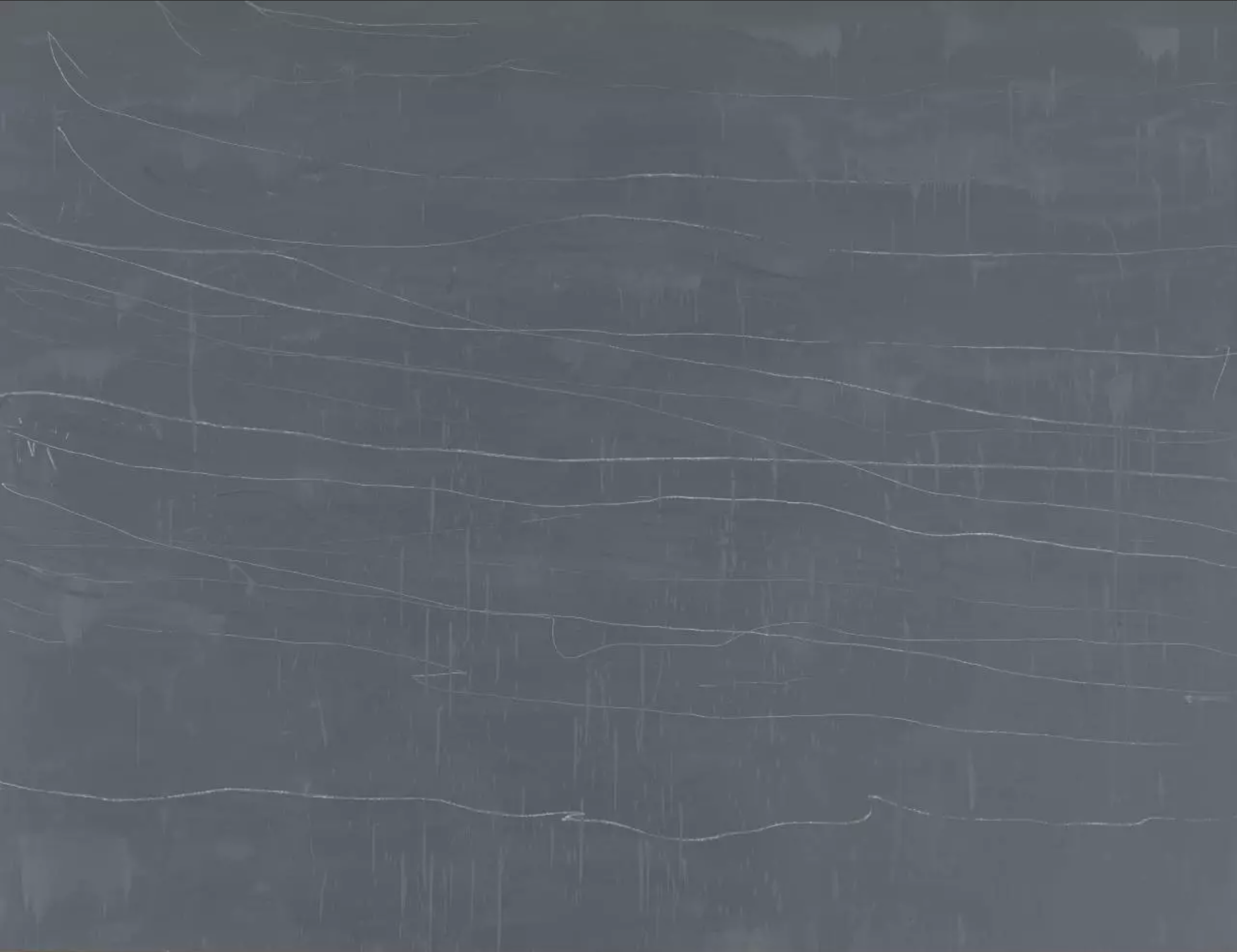
Untitled (New York City), 1968, Cy Twombly (Source: Brandhurst Museum)
Twombly heard the talk Arna often enough to answer it directly: “My line is childish but not childish,” he said. “It’s very hard to fake.”In 2007, at an exhibition in France, a woman named Rendy Sam approached one of Twombly’s all-white paintings and kissed it, leaving a smear of red lipstick. She was arrested and tried in court on charges of “voluntary deterioration of a work of art.”
Her defense: “I just kissed her. It’s a loving gesture.” Her reasoning did not influence the court, and she was fined and required to pay the costs of the restoration. Somewhere in that courtroom, a judge had to formally decide that one set of marks on a canvas was priceless art, and another, smaller, and perhaps more intentional, mark was criminal damage.This is the real trick behind Twombly’s painting, and arguably behind most of the artwork in this piece: It’s not that the marks are meaningless.
This meaning here is nowhere in sight. Twombly filled his paintings with references to Keats, Rilke, and classical myth.One series of drawings is nothing more than the word “Virgil” written over and over again. If you don’t know who Virgil is, the work will be read as a scribble. If you do, it will be read as a debate about memory, war, and how little translation remains in the ancient world. The painting is still the same but now the viewer knows how to read it.Of course, none of this knowledge was what brought Untitled (New York City), crayons and house paints on canvas, to $70.5 million at Sotheby’s in 2015. It sold for that value because there are only about 650 Twomblys that will ever exist, because a rival auction house had just set a similar record a year earlier and everyone in that room knew it, because two of the most trusted names in the history of art (Castelli, Saatchi). They had owned it once, and because bidding against each other in that room was itself a social event, the applause afterwards was not for the painting, but for the sale.
Exhibit D: The man who sold nothing
At least Cy Twombly left something on the canvas. Yves Klein, by the end of his life, had ceased to leave behind anything at all.His early fame came from a unique colour. It is a saturated powder and ultramarine powder that he mixed himself, applied without a brush because he considered the brush action “too psychological,” and patented in 1960 as International Klein Blue. It is the brand’s most literal exercise, a particular shade of blue that, from its legal standpoint, is sold on plates that were otherwise identical, differing only in size.

Monochrome Blue, 1961, Yves Klein
But you would be wrong to think that blue was the pinnacle of his genius. In 1958, Klein emptied an entire Parisian gallery, painted the walls white, and posted the French Republican Guard outside the door. The show was called Le Vide, The Void, and people paid two to three thousand people to see nothing.He took it a step further and found a way to sell anything. Between 1959 and his death in 1962, Klein sold eight “areas of immaterial pictorial sensitivity”—pieces of empty, non-existent space—for solid gold.
The buyers were given a receipt and if they wanted the area to be theirs permanently and irrevocably, they had to burn it, in a ritual on the banks of the Seine, while Klein threw half of their gold into the river in front of them.
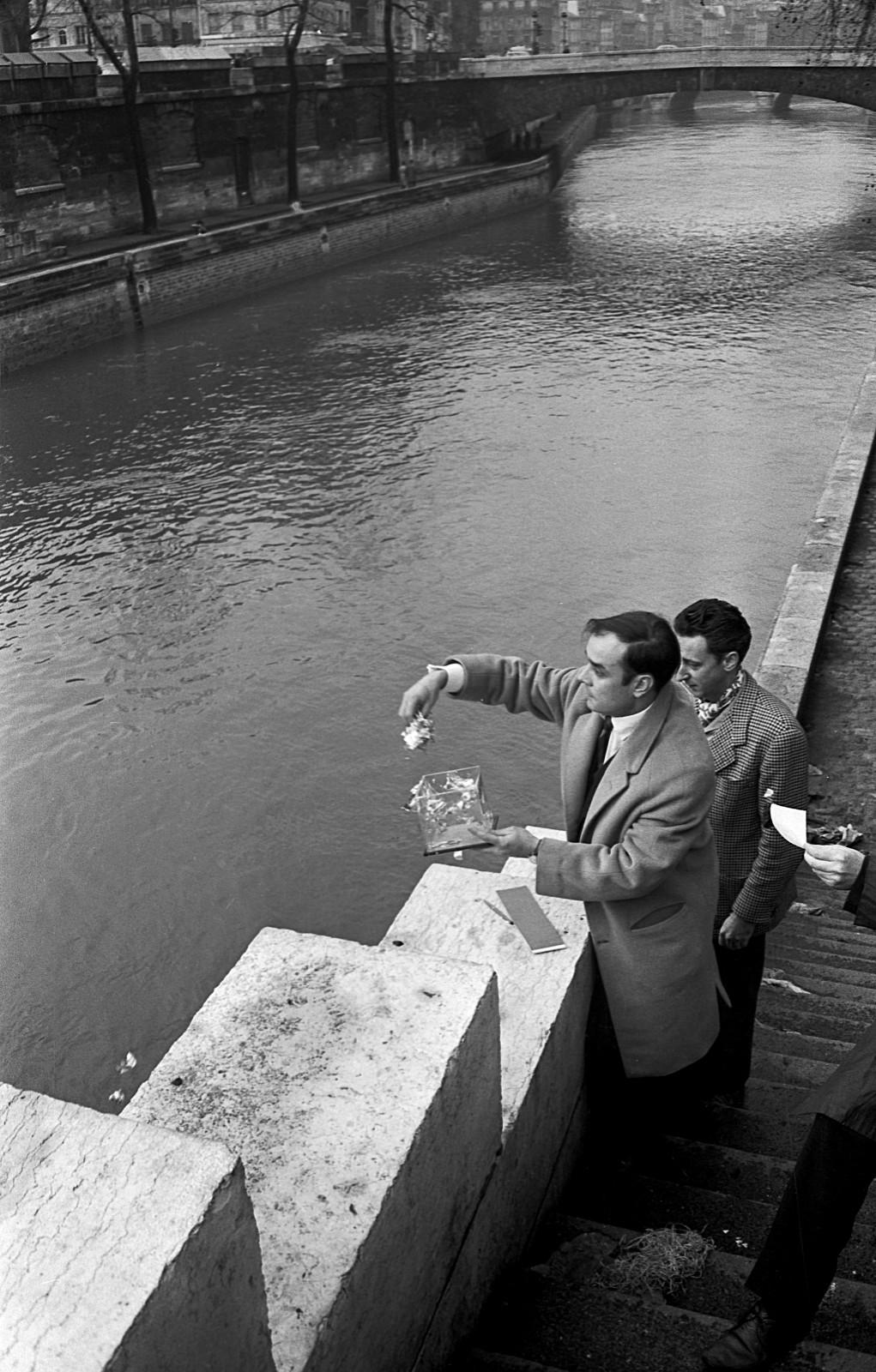
Areas of non-physical pictorial sensitivity (Source: yvesklein.org)
In 2022, one of the surviving unburnt receipts, for an area purchased in 1959 for 20 grams of gold, was sold at Sotheby’s for €1,063,500. Sotheby’s own marketing has compared many to an NFT.Klein didn’t sell anything, because he didn’t want to sell anything. His work is still valued, because the market wants to value it.
Figure E: The Emperor Wearing Receipts
There is an economic term for what actually happens across the four artists and their sales, and it predates each artist in this piece by half a century.In 1899, economist Thorstein Veblen coined the term “conspicuous consumption.” Expenditure that serves no purpose other than to advertise the wealth and prestige being purchased and offered as its own reward. Economists later named the specific class of goods this produces: a Veblen good is one for which demand rises as its price rises, because price is no barrier to purchase.
That’s the point of it.This reframes everything in this piece. “This doesn’t make any visual sense” has never been a market problem to be solved. It may be a feature that is being sold.No one buys a wall-mounted banana because it is a well-made banana. No one buys a Rothko because they have personally verified, against forensic scrutiny, that the brush is authentic, people are in the best position to tell you that too, and someone has admitted under oath that all Rothkos look like him.What is actually bought, sale after sale, is rarity that no one can make, a path to provenance that guarantees itself, and a seat in the room where the hammer falls. The object is approximately transverse. It could be a scribble, a rectangle of color, a piece of fruit, or nothing at all.This is also why the death of an artist is not just sad news for the market. It is an inventory event. The day a great artist dies, their catalog is closed forever, and everyone with a stake in that market knows that even before the obituary is written.The hammer is normal, the platform is normal; The people in the room are not like that. What happened in that quarter of a second was never a judgment on the banana, the scribble, or the empty room. They’re a group of people with more money than they know what to do with, and they agree loudly, in front of each other, how much of a case is worth buying this week. The Emperor knows he has no clothes, but wearing receipts seems good enough.