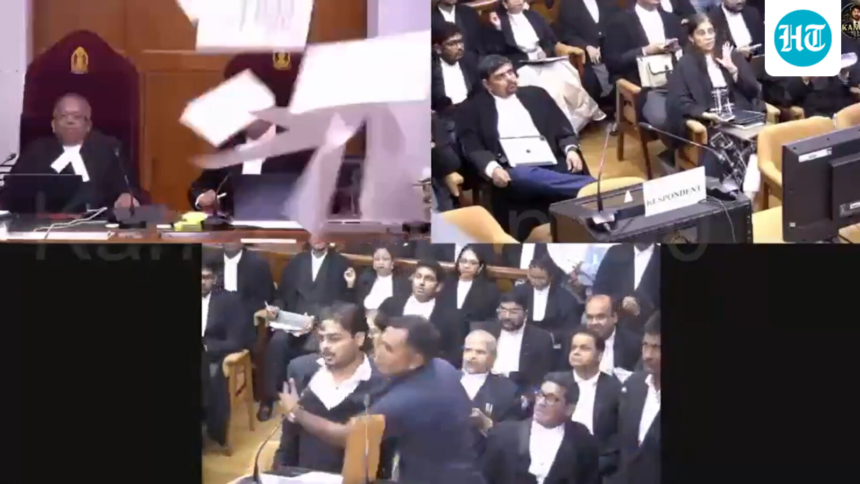
The Supreme Court on Friday witnessed an unusual incident when a person pleading his case used unparliamentary language against the Chief Justice of India (CJI) and threw papers inside the court in a fit of anger. The police arrested him and the court, after noticing his “incoherent” behavior, decided to release him.

The incident took place during the hearing of the case filed by Lucknow resident Prabal Pratap, who pleaded guilty. The court sensed something was wrong when Pratap, who was dressed like a lawyer – black coat and white shirt – started saying, “Mr Judicial Officer, I request you to order the registration of an FIR against ACP (Assistant Commissioner of Police), Vikas Nagar, Lucknow and against Duplex Technologies Services Limited.”
“Are you ordering us?” the bench, comprising Justices KV Viswanathan and Alok Arade, asked.
The petitioner did not respond and continued his statements. “Duplex Technologies runs a cybercrime network across the country,” he said. He added that he had nothing to add, and said: “This is all from my side. Everything is recorded.” He then took a bundle of papers and threw them in the air, using unparliamentary language against the ICJ.
The Delhi Police security personnel who were standing behind him quickly caught him and took him out while the lawyers gathered in the courtroom watched the entire chain of events in utter disbelief and shock.
Case records revealed that Pratap had approached the Allahabad High Court challenging the order of the Special (Martial) Court of Justice, Lucknow, which had directed that his criminal complaint against Duplex Technologies be filed as a private complaint. The Supreme Court rejected this prayer on April 6, after which he approached the Supreme Court in May.
On June 12, his petition was verified and registered for inclusion in the list. Since he appeared in person, in accordance with the 2013 Supreme Court Rules, a registrar in the Judicial Administration Branch contacted him and confirmed that he was qualified to plead in person.
While the petitioner was being interrogated by the police, the bench summoned the registrar concerned to court. “How did you testify that he was fit to argue?” The council asked the official, adding: “I mentioned that I believe he is capable of providing assistance in an appropriate manner.”
As the court official stood ignorant, the bench said, “Are you aware of what happened in court today? Did anyone tell you what happened?” After a brief interaction, the court noted that the petitioner appeared “incoherent” during the court proceedings. Taking exception to the conduct of the petitioner, the bench said: “The petitioner personally in this matter, instead of presenting the issue, made incoherent and unparliamentary statements.” At the same time, the court decided not to continue the case. “However, in view of the above-mentioned condition of the petitioner, we do not propose to take any action against him.”
The court heard the case in absentia and rejected the appeal because there was no reason to interfere with the Supreme Court’s order.
While other lawyers gathered in court expressed their anguish over the petitioner’s behavior, the court noted that the petitioner appeared to be suffering from some mental problems. “We all sympathize with him. As of now, we believe our faculties are sound. Even the registrar said he is qualified to plead,” the bench said.