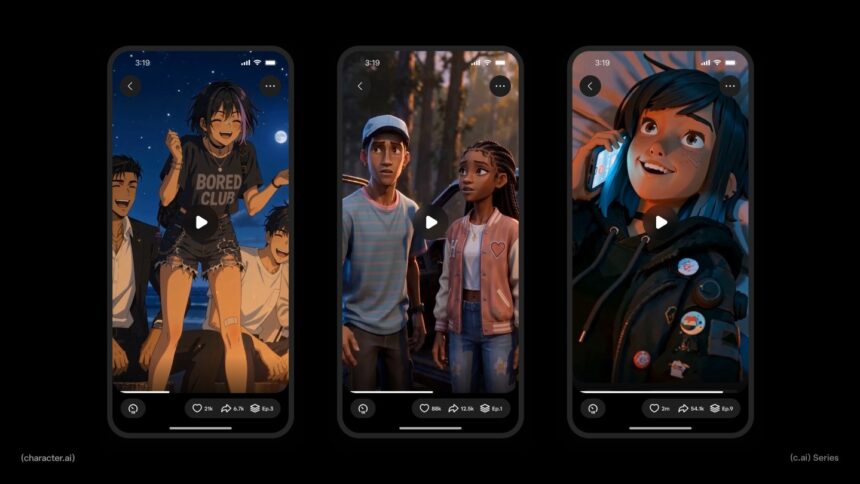
Character.ai, the popular and controversial chatbot company founded by former Google engineers, is expanding its business in a surprising way: launching a micro-drama division.
The company will announce on Thursday that it has created a number of small AI-based animated dramas for its app, hiring Hollywood writers to write the episodes, which are then created using artificial intelligence rather than traditional animation techniques. Artificial intelligence is also deployed after the production of the series to enable users to chat with the characters and even participate in their own fan-style chatbot creations based on them.
A representative for Character.ai declined to provide the names of those working on the vertical video series, but said the company has hired writers and artists with previous credits on projects at Nickelodeon, Netflix, DreamWorks and Blumhouse. (Many creatives in Hollywood are, of course, reluctant to accept AI-related jobs.)
Three strings drop at launch. It includes last summer, About a young woman trying to find out the identity of her summer lover; night game, Where a group of twenty-somethings gather to play a deadly game in a possibly haunted house; and EdenvaleKind of Hunger Games-meets-One ready player The story takes place in the middle of a collective “beta test” of a new MMORPG. In the episodes made available to journalists, this latest offering proved to be the most compelling, with the cleverest concept and most convincing animation.
Microdramas — the youth-oriented fantasy series that have become extremely hot in the past year — monetize their audience by selling more episodes and premium subscriptions. Character.ai, also known as c.ai, believes it can generate additional revenue streams by sharing chatbots and fan fiction elements. (CEO Karandeep Anand said that the possibility of entering a live role-playing episode is still technologically available for at least a year.) Hollywood Reporter.)
AI makes small dramas a natural fit because output in this category tends to be high and production windows are short. Automation speeds this up even further — Anand says c.ai’s timeline requires about 40 days to complete an entire series compared to six months if the company were to animate episodes traditionally. Despite the efficiencies, he says c.ai wants to produce fewer series at a higher quality. “Our goal is not to create an AI machine for Generation Z,” he said. He added that the mini-drama format was accepted because it avoided depicting the doom and anger that dominated the era before artificial intelligence. “Instead of passively consuming social media, users are interacting,” he said.
However, mini-dramas based on artificial intelligence, when tried, have not generally been successful in the United States, where consumers often build a fan base around real-life actors. Influencers in small dramas tend to go against them. Character.ai has not announced any plans to enter the live-action space at this point, focusing on the less-proven area of small-scale anime drama.
Character.ai has proven hugely popular since its official launch two years ago (it was in beta for two years before that) thanks to two Google engineers who founded LLM Google LaMDA. At least 20 million monthly users now create and/or interact with its chatbots, doing everything from asking for advice to playing text games. Most users are under 35, and the number of “personas” – chatbots with unique training data – is in the millions, often created to mimic the traits of favorite Hollywood characters.
Character.ai has also proven somewhat controversial, having been the subject of numerous lawsuits and allegations that its chatbots promote dependency, psychosis, and sometimes even self-harm, with few guardrails or parental notifications. In one notable case, Megan Garcia, a mother from Florida, claimed that her son Sewell Setzer III died by suicide as a result of extensive interactions with multiple bots on Character.ai; The case was settled in January. Two Texas families have also sued the company, Pennsylvania is suing c.ai for the “unlawful practice of medicine” over alleged inappropriate representations and disclosures about its medical chatbots, Missouri Senator Josh Hawley has issued document requests from the company and several tech giants over concerns about alleged harm to minors, and c.ai has been part of a backlash to so-called “chatbot psychosis,” the common term for over-reliance on artificial intelligence companions and personalities.
The move to micro-drama seems like an attempt to diversify a business facing significant headwinds, moving it beyond the kinds of buddy-style intimacies that lead to many of those problems. But Anand says the fit is natural. “We’ve always been an entertainment company,” he said, noting how many chatbots are already based on TV and movie characters.
The company banned users under 18 last fall in an attempt to address social harm concerns. And the little drama is, on the one hand, an attempt to win them back. Users under the age of 18 will be allowed to watch the series but chat functions will be disabled if their age is not verified.
c.ai is valued by many experts at between $500 million and $1 billion, and an outside firm estimates it had $50 million in sales last year, up 66 percent from 2024. The company also has a close relationship with Google — Alphabet in 2024 hired co-founders, Nom Shazier and Daniel de Freitas, and struck a non-exclusive deal for its technology — though the two remain separate entities.
The micro-drama market is dense, with dozens of companies in Los Angeles and beyond, including CandyJar, ReelShort and DramaBox, producing quick-to-consume videos.
Anand said he’s not worried about saturation because of the preferences of the people c.ai currently reaches. “They are already on our platform looking for entertainment,” he said. “This is just a new way to give it to them.”