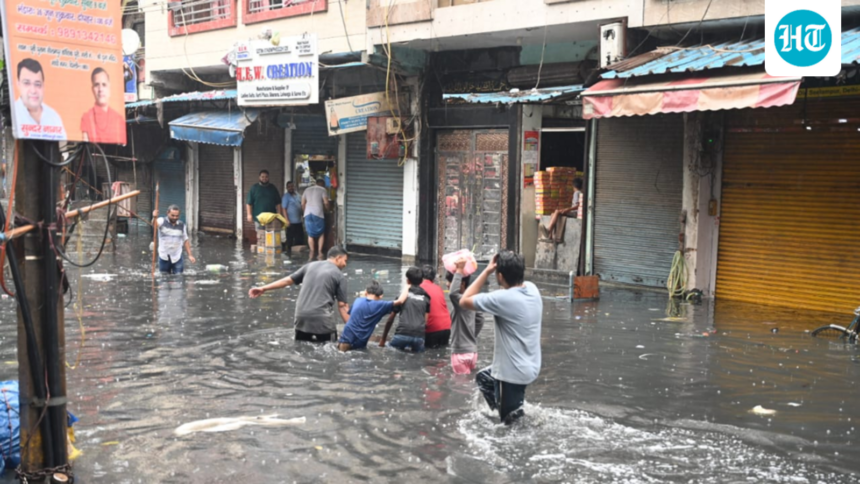
Heavy rain continued to lash Delhi on Thursday morning, even as the India Meteorological Department (IMD) issued multiple red alerts for further rainfall throughout the day amid reports of fallen trees and waterlogged roads. The heavy rains that the capital witnessed a day ago caused waterlogging and traffic jams.
Khajuri recorded the highest rainfall of 160 mm between 8:30 am (Wednesday) and 8:30 am (Thursday), followed by Mayur Vihar (102.5 mm), Delhi University (90 mm), Mehrauli (86 mm), Pusa (83 mm), Lodhi Road (80.2 mm) and Ridge 77.8 mm. Safdarjung, the city’s primary weather station, recorded 72.6 mm of rain during the same period. Most places received a significant portion of rain between 2:30 a.m. to 5:30 a.m. on Thursday. Track rain updates on July 9 in Delhi and National Capital Region (NCR) here
Rainfall up to 15.5 mm is classified as light, 15.6 mm to 64.4 mm is classified as moderate, 64.5 mm to 115.5 mm is classified as heavy, and 115.6 to 204.4 mm is classified as very heavy. Normal rainfall for July is 209.7 mm. So far, Delhi has received nearly half of it (104.12 mm) this month as of Thursday.
“low pressure area”
Amateur meteorologist Navdeep Dahiya has forecast “heavy rainfall” (100mm to 200mm) until Friday due to the low pressure area. In a post on X, he said light to moderate rain will occur with frequent periods of heavy rain. Noida, Ghaziabad, north and east Delhi will be worst affected by the ongoing heavy rains, he added.
The suburb wrote that new rains of 200 mm are possible. He added that central, west and south Delhi and Faridabad could receive 100 to 150 mm and Gurugram between 70 and 150 mm. The suburb was warned against going out unless necessary. He added that there are high chances of waterlogging.
Residents spoke on social media about trees falling and trees falling due to the rain. Two trees fell on Raja Dhir Sen Marg. One resident said: “A tree fell because of the concrete. Now traffic has stopped, and even school buses are unable to move.” Scenes showed trees being uprooted, one of which crashed on the road as it fell.
Images showed vehicles and people wading through several flooded roads on Thursday morning. Waterlogging was reported at Akshardham, Sadar Bazar, Kaushambi, Mehrauli-Badarpur Road and Sangam Vihar.
The Delhi government said the waterlogging situation on all major roads is under control. She added that Chief Minister Rekha Gupta has taken stock of the situation and teams from the Jal Board, Public Works Department and Municipal Corporation are on the ground, ready to deal with any situation. The government said that it is working in full swing to address waterlogging, and all necessary measures are being taken.
Air quality has steadily improved due to persistent rainfall this week. On Wednesday, Delhi recorded an air quality index (AQI) of 59 (satisfactory), the best since September 4 last year, when it was 58. On Thursday (10:05 am), the AQI improved to the ‘good’ category at 49.