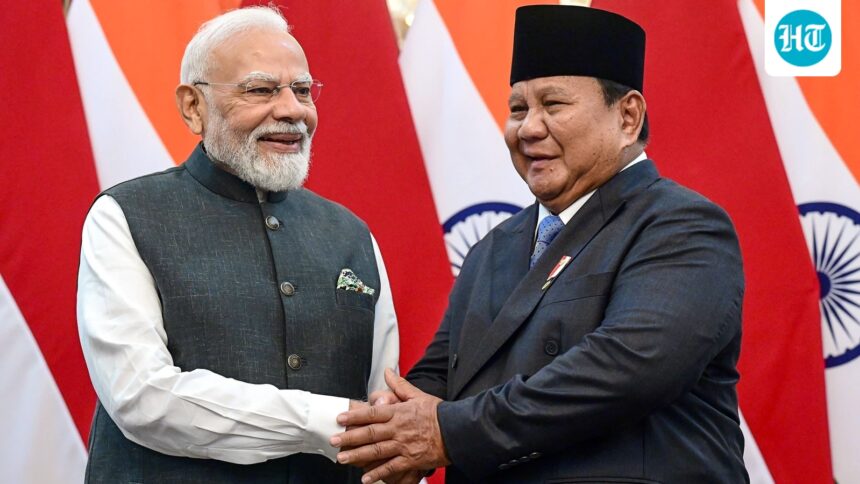
On his way from Yogyakarta to the nearly 1,000-year-old Prambanan temple complex, Prime Minister Narendra Modi shared a stunning aerial view from his helicopter, describing the monument as majestic as he approached the UNESCO World Heritage site alongside Indonesian President Prabowo Subianto on Wednesday.

PM Modi took to X to share a stunning aerial view from his helicopter, writing, “Majestic Prambanan Temple!” As they approached the ancient monument.
https://x.com/narendramodi/status/2074714272790405282?s=20
The flight precedes the official launch of an India-backed conservation and restoration initiative at the sprawling site, marking a major milestone in New Delhi’s cultural diplomacy under its ‘East’ policy.
The foundations of this heritage partnership were cemented on Tuesday, after extensive bilateral discussions between Prime Minister Modi and President Prabowo. The two leaders exchanged a letter of intent on the environmental conservation project, reaffirming their commitment to deepening the comprehensive strategic partnership between India and Indonesia to promote peace, stability and prosperity in the Indo-Pacific region.
Located on the island of Java, the Prambanan temple complex is the largest Hindu temple site in Indonesia and the second largest in Southeast Asia, after Angkor Wat in Cambodia. Spanning approximately 40 hectares, the ancient complex originally housed around 240 temples, and today remains one of Indonesia’s cultural highlights and a testament to the subcontinent’s deep-rooted connections.
This architectural marvel was constructed during the 9th century AD under the patronage of the Hindu Kingdom of Mataram. Historical records indicate that this massive project was initiated by King Rakai Pikatan and completed by his successor Lokapala, to signal the empire’s devotion to Shaivite Hinduism, apparently in architectural contrast to the Borobudur Buddhist temple built nearby by the rival Sailendra dynasty.
At the center of the complex are three towering structures dedicated to the Hindu god Trimurti: Lord Shiva, Lord Vishnu, and Lord Brahma. Constructed of volcanic stone, the central Shiva temple dominates the landscape at an approximate height of 47 metres, displaying classic Hindu architectural design with its soaring towers, symmetrical layouts and ornate gateways.
The outer walls display exceptionally detailed carvings depicting narrative sequences from the Ramayana and other major Hindu epics. These sculptures reflect the extensive religious and cultural exchange that flowed across Southeast Asia centuries ago via maritime trade channels, scientific networks, and ancient trade routes.
The complex was eventually abandoned in the 10th century, a transformation that historians attribute to political reorganization in Java and catastrophic volcanic eruptions from nearby Mount Merapi. Over subsequent generations, intense seismic activity reduced much of the buildings to rubble. Initial rescue work began under Dutch colonial supervision in the 19th century, and was followed by systematic archaeological reconstruction between 1913 and 1953, resulting in the restoration of the main shrines.
In recognition of its deep historical heritage, UNESCO listed Prambanan as a World Heritage Site in 1991. The site is now one of Indonesia’s premier cultural destinations, and provides an exciting window into the archipelago’s diverse religious history.
The new conservation agreement highlights the enduring civilizational ties between New Delhi and Jakarta. By deploying specialized expertise to protect one of Asia’s most important Hindu monuments, the joint initiative breathes new life into centuries-old historical ties while expanding modern strategic, economic and people-to-people cooperation between the two countries.