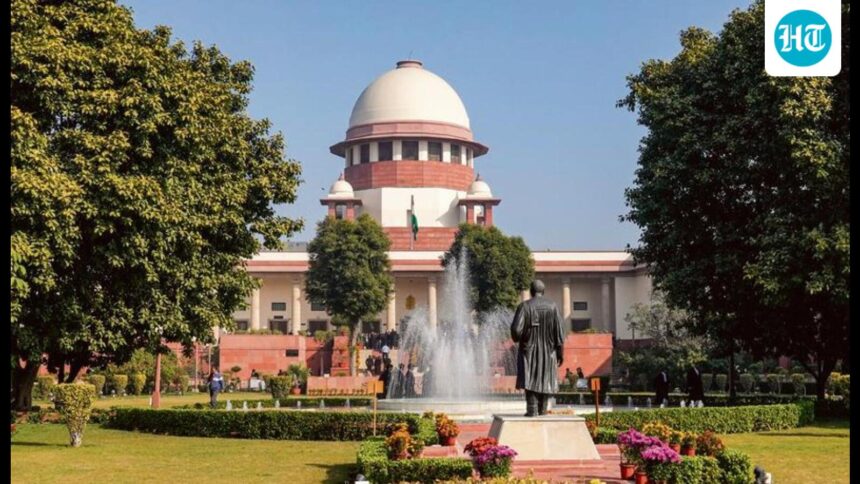
The Supreme Court on Tuesday held that the Indian Banks Association (IBA) had no power to publicly declare that a lawyer had acted inappropriately by including the lawyer’s name in a warning list circulating among banks and financial institutions, ruling that such statements were “unsustainable in law” and encroached upon the exclusive disciplinary domain of the Bar Council.

A bench of Justices PS Narasimha and Alok Aradhe clarified that while banks and financial institutions remain free to discontinue the services of lawyers, the IBA cannot assume the role of adjudicating allegations of professional misconduct by publicly blacklisting lawyers.
“The IBA cannot make a general declaration about the conduct of a lawyer, even if they are at liberty to remove a lawyer from their service,” Justice Narasimha said while reading the executive part of the judgment.
The Court held that although the IBA can establish measures to protect the banking system against fraud and dishonesty, these powers do not extend to assessing the professional competence or negligence of lawyers.
“The IBA can take action in matters of fraud, dishonesty and matters affecting the banking framework, but the authority does not extend to addressing issues relating to the professional judgment and negligence of lawyers,” she said.
“The list of warnings is therefore unsustainable in law,” ruled the court, which declared the practice illegal.
The ruling arose out of a petition filed by a lawyer challenging the inclusion of his name on the IBA warning list dated February 5, 2020, which was circulated among the banks and financial institutions where he was assigned.
The dispute arose out of allegations made by the erstwhile Syndicate Bank, now Canara Bank, that a lawyer, while issuing a search and title report for a property offered as security for a loan, failed to disclose that a portion of the property had already been sold. According to the bank, this omission led to a wrong legal opinion, exposed it to financial risks and facilitated fraud on the borrower.
The lawyer objected to the warning list, claiming that the IBA acted without issuing him prior notice, giving him a hearing, or following the Reserve Bank of India’s 2009 procedural guidelines governing reporting of third parties involved in bank fraud. He said the listing prompted several banks to terminate his employment, causing severe reputational and financial damage.
The Allahabad High Court refused to entertain his writ petition after the IBA questioned its maintainability, prompting the lawyer to approach the Supreme Court.
During the hearing, senior advocate Maninder Singh, appearing as amicus curiae, argued that the actions of the IBA directly violated the fundamental right of a lawyer to practice and that only the Bar Council of India and State Bar Councils had the legal authority under the Advocates Act to investigate allegations of professional misconduct. The Bar Council of India and the Union Law Ministry have supported this position.
Besides deciding the dispute, the Supreme Court also highlighted the working of the regulatory framework for the legal profession. Expressing concern over the effectiveness of disciplinary mechanisms under the Advocates Act, the bench directed the Bar Council of India to undertake a comprehensive review of its disciplinary regime. The court directed that “the union council must conduct an audit of the effectiveness of its disciplinary mechanism.”
The court proposed that the Bar Council establish an institution dedicated to continuing legal education along the lines of the National Judicial Academy. “The Bar Council may also consider establishing a national legal academy for its members such as the National Judicial Academy,” he noted.
It also directed the Bar Council of India to submit a report before the Supreme Court on the steps taken in accordance with the directions and suggestions contained in the judgment.