Logo text
A federal judge narrowed the scope of the lawsuit from horrifying Actress Catherine Corcoran while keeping her breach of contract claim for one percent of the franchise’s profits alive.
Corcoran, who plays Dawn in the 2016 film as one of Art the Clown’s first on-screen victims, reached a backdoor deal for 1 percent of the profits from “Terrifier.” The legal battle centers around what that word covers. Corcoran argued that it includes the entire franchise, including merchandise, broadcast and any related intellectual property. Director Damien Leone and his production company Dark Age Cinema have confirmed that this only applies to the original film.
On Friday, U.S. District Judge Andre Bierut found that the case raises issues of contract interpretation that cannot be dismissed at this stage of the case. This means the question of whether Corcoran is owed a portion of the amount The terrifying 2$15 million and The terrifying 3Box office revenue of $90 million will be determined later.
“There is enough ambiguity about the terms of the contract” to reject the attempt to dismiss the case, Perot wrote.
Among Corcoran’s central arguments in the case: that she began receiving payments in 2022, more than seven years after the deal was reached, suggesting that Dark Age believed it was owed money beyond the two-year period stipulated in the contract. This may indicate that both sides treated the agreement as covering more than the 2016 film.
“The court’s ruling confirms that the substance of Ms. Corcoran’s case remains intact and is reasonably defensible,” Devin McRae, the actress’ attorney, said in a statement. “Claims relating to Ms. Corcoran’s contractual rights to 1% of Terrifier Series profits have now been determined and will proceed with discovery.”
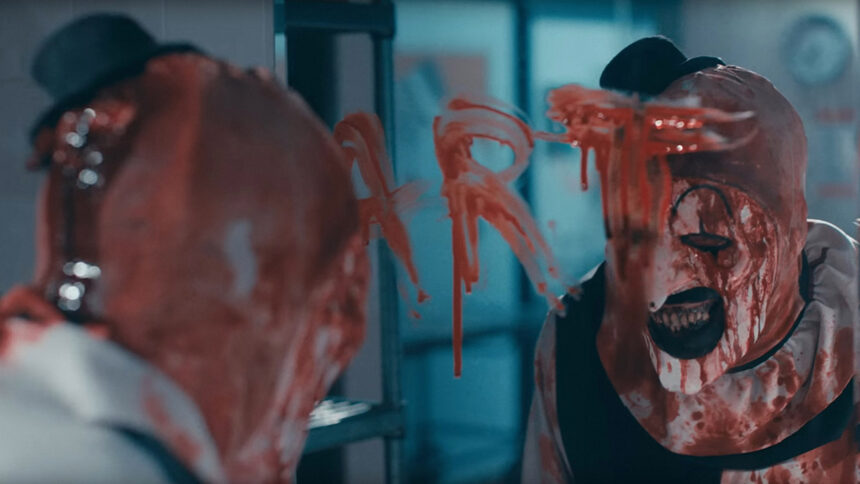
But in Corcoran’s loss, the court dismissed her claim that she allegedly violated California’s revenge porn law due to a nude scene in which Dark Age did not obtain her written consent as required by SAG-AFTRA. She argued that the production did not have consent to exploit images of the scene, a blood-soaked killing that Art the Clown dissects.
Bierut concluded that Corcoran should not expect the material to remain private since she was shooting a film. “Her voluntary presence in a public film that was filmed for more than ten hours invalidates her position that the defendants should have known that she had a reasonable expectation of privacy,” he wrote.
“We appreciate the court’s careful review of the pleadings, which resulted in the dismissal of the vast majority of plaintiff’s meritless claims,” Lyon’s attorney, Larry Zerner, said in a statement. “Damien Leone and Phil Falcone conducted themselves professionally throughout the production of Terrifier, and Plaintiff’s attempt to turn her role as an actress into a claim under California’s revenge porn law was untenable from the beginning.”
The court “merely concluded that certain claims require more factual detail under federal pleading standards and granted us leave to amend to add those facts — which we intend to do soon and look forward to presenting the full factual record as the case progresses,” McRae said.
The lawsuit details alleged harsh working conditions. To mitigate blood pooling in her head while she was suspended by her ankles, Corcoran filmed the scene in 40-second increments over the course of 10 hours, placing a platform underneath her at some points so she could lie horizontally.
In the decision, the court also dismissed claims of promissory fraud and unfair competition, among others. Corcoran will have the opportunity to amend her claims.