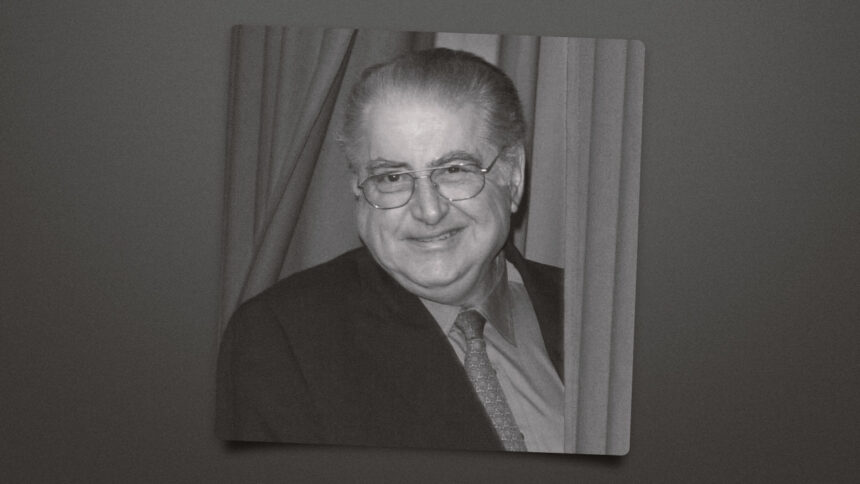
Moritz de Hadeln, the prolific film festival director who presided over Locarno, Berlin and Venice over a career spanning decades, has died. He was 85 years old.
De Hadelin, who received the title of “Mr Film Festival” from his biographer and Zurich Film Festival CEO Christian Jungen, died on Saturday, July 4, in a hospital in Nyon, Switzerland, near his home. Jungen L confirmed Hollywood Reporter The Swiss suffered complications after a recent medical procedure.
Born in England in 1940, De Hadlen made his first forays into the industry as a documentary photographer and photographer. He directed his first feature film, If PeleIn 1963, and his second film, Ombres and miragescame soon after in 1966. He was a film editor in Zurich alongside Yves Allégret, and worked as an assistant director at CCC Film Studios Berlin. In 1969, de Hadeln and his wife Erika von dem Hagen founded the Nyon International Documentary Film Festival (known as the Visions du Real Festival today) which he ran until 1979. Erika took over and led Nyon from 1981 to 1993.
De Hadeln’s career began in 1972, when he was president of the Locarno International Film Festival, and is said to have heralded a new era of international recognition for the event. During his time in charge at Locarno, de Hadeln performed outdoor shows in Piazza Grande and presented numerous side events.
Seven years after taking charge of Locarno, de Hadeln was invited to chair the Berlinale from 1979 and make it the first festival in the world to use computer technology to process its data. During the turbulent political landscape of the early 1980s, he was praised for bringing together East and West Berlin in the film festival, and with Becky Probst, he founded the European Film Market. When the Berlin Wall fell in 1989, de Hadeln seized the opportunity to transform the Berlinale into a major venue for international films in Europe. In 2000, he moved the event to Potsdamer Platz. Among the greatest motion pictures that premiered under de Hadeln’s direction during his 20 years in Berlin: rain man (1988), Fitzcarraldo (1982), In the name of the Father (1993), Central station (1998) and Magnolia (2000).
After 21 years as president of the Berlinale, de Hadelin worked his magic in Venice. From 2002 to 2003, he is described as having modernized the festival’s infrastructure, and reinventing its reputation on the world stage. He worked closely with Biennale president Franco Bernabei during this period, and was responsible for the first screenings of the Biennale Magdalene sisters (2002), Femme fatale (2002), Return (2003) and 21 grams (2003).
His time in the spotlight has not been without controversy, including in 2018 when de Hadeln wrote an opinion piece in the Swiss daily newspaper. Die Feltwish Defending disgraced movie mogul Harvey Weinstein. He described Weinstein as one of the few Hollywood producers who truly loved movies, and said the backlash against him was “disgusting.”
Naturally, de Hadelin has served on a large number of international juries throughout his career, including in Karlovy Vary, Venice, Moscow, Montreal, Turin, Tehran, Damascus, Kiev and Yerevan. He was a member of the European Film Academy. His wife died at the age of 77 in 2018.
“Big names like Gina Lollobrigida, Ang Lee, and Steven Spielberg – along with a few scandals – have marked the career of Moritz de Hadeln, a world-famous pioneer in the world of film festivals,” says Youngen’s book description of de Hadeln’s colorful life. “He directed festivals in Berlin, Venice and Locarno and founded the Documentary Film Festival in Nyon. He introduced Western audiences to Chinese and Soviet cinema, among other things, often navigating diplomatic negotiations and political power struggles in the process.”