The international industry program of the Karlovy Vary International Film Festival (KVIFF) kicked off on Monday with a focus on new film projects in development, including a spotlight on selected bizarre stories.
In collaboration with the Midpoint Institute’s Midpoint Focus Queer Program, a program that supports filmmakers exploring queer narratives, KVIFF Industry Days showcased four of these films in the works, spanning a range of genres and geographies.
Take a closer look at the four film projects showcased on the KVIFF Industry Days stage on Monday.
Noseko
Directing debut
Writer and Director Information: Laudika Yandangii Hamutenya, a Namibian filmmaker from Ohangwena whose work explores identity, masculinity and belonging in contemporary Africa.
Producer: Jeremy Palanke
Production company: Woooz Pictures (France)
Language: Oshiwambo
Genre: Action, Drama, Strange Romance
Countries: Namibia, France

summary:
Nikumba, a 21-year-old performance artist, is trying to recreate a childhood dance she once performed with her aunt, which is believed to summon physical ancestors. She hopes this work will reconnect the now Westernized Owambo culture with its spiritual roots. Instead, she is transported to a pre-colonial village, where she encounters the beauty and trauma of a way of life very different from her own. There, she falls in love with Noseko, a young woman who embodies a sense of queer freedom within her culture. But this world holds contradictions: Noseko has been chosen to be sacrificed as a companion to a dying king. As Nuusiku accepts her fate, Nekomba struggles to save her, forcing her to confront the violence of a past she once romanticized.
Creator statement:
“Nosekowhich means “Inside the Night” or “Born of the Night” in Oshiwambo, is a deeply personal meditation on memory, longing, and the danger of romanticizing the past. As an eccentric filmmaker from Oshiwambo, raised between tradition and modernity, I am drawn to the tension between reclaiming and questioning culture. Through Nikumba’s journey, the film explores a pre-colonial world that was both beautiful and troubling, where belonging and exclusion coexist. As she seeks spiritual truth, she encounters practices that challenge her ideals, including the sacrifice of the woman she loves. Noseko wonders whether we will ever truly feel free in the past we glorify, and whether modern ideas, often Western-influenced, especially about queerness, have also created a necessary space for us to exist. Ultimately, it is a reflection of culture as something evolving, not static.
Salamlik
Writer and Director Information: Director Jiri Carlsson is a Swedish director and screenwriter who has directed short films and two episodes of the Netflix series Young royal family Season 3; Writer Khaled Al-Ismail
Producer: Frida Martensson
Production company: Verket Produktion (Sweden)
Languages: Arabic, English, Spanish, Swedish
Genre: Drama
Countries: Sweden, Denmark
Stadium highlights:
“When I was in Damascus one night, it was war xxxxxx “To the edge of our apartment,” Ismail shared. “My boyfriend wasn’t afraid to die. We were afraid of never seeing each other again, of not being together. We were also afraid of…everyone and queer people.” [would] We forgot our story… so we grabbed our phone and started taking pictures of ourselves and recording a kissing video. Really, in that moment, we wanted our love to continue.”
“When Khaled shared this story with me, I immediately connected with the shared queer experience of searching for love, freedom, and finding a place in the world to call home,” Carlson told the audience. He explained that the end of the film will take viewers to “New Year’s Eve 2011, at the dawn of the Arab Spring, the night that… [th etwo] We first meet each other, filled with young love and this great hope for freedom and a possible future.

summary:
In Damascus, two men hide under their bed, not afraid of death, but afraid of dying separately. After years of separation, Firat (37), a writer exiled in Sweden, travels to Cordoba to reunite with Pierre (27), the love of his life he left behind when he fled the war in Syria. Firat hopes to rekindle the love they once shared. But Pierre arrives guarded carrying a secret that will change everything. Over the course of a tense and intimate weekend, memories of their relationship begin to resurface: their goodbyes, their shared home, their beloved dog, the demonstrations for freedom, and the night they first met at the dawn of the Arab Spring, when love and freedom were still possible. As the past and present close in around them, they must face the truth: their love is still alive, but they are no longer the people they once dreamed of being free together.
Creator statement:
“Firat and Pierre are caught between what they once were and what exile has transformed them into. Firat lives in Sweden and Pierre in Canada, but neither fully belongs to the life they have built. They reunite in Spain, carrying different versions of the same loss. Cordoba bears this tension in its stones. Built by ancient Syrians, it is the closest living echo of a no longer existing home as they knew it. The city reflects displacement, beauty and loss, making it the only possible setting for this story. The film’s events unfold across two timelines: A reunion in present-day Cordoba and a love story in Damascus told in reverse. The structure reflects how trauma works: we return obsessively to the last moment, then uncover what came before. As Cordoba heads toward farewell, Damascus returns toward the night they first met, when there was still a sense of freedom and future, of what remains when love remains but lovers do not.”
Skeeter
Writer and Director Information: Dylan Metro is an openly gay independent filmmaker based in London, Ontario, Canada.
Producer: Taylor Nodrick
Production company: Ghoul Nexus (Canada)
english language
Genre: Strange horror
Country: Canada
Stadium highlights:
Metro description Skeeter As a “weird psychological horror exploring true Canadian events”. After all, the project is set in “Canada’s largest gay resort in the 1990s that became a refuge for people with HIV and their loved ones.” But there’s more: “Local residents became terrified that gays would be in town, because they feared mosquitoes would bite the gays and fly across the lake and infect them with AIDS.” Oh!
He added: “By reclaiming this type of monster through body horror, we reveal that bias and misinformation can spread like a virus and be distorted into our personal opinions.” Skeeter It gets all the buzz it needs to bite.

summary:
Davey (27), a charismatic dancer, takes care of his sick roommate Joe. Joe, 31, was an outspoken gay activist, but was in and out of hospital, suffering from numerous HIV complications including memory loss. After losing several friends to AIDS, Davey fears Joe may be next. Seeking to escape this fate, Davey brings his chosen family together to spend a final weekend at a remote lake cabin in the woods. The group arrives at the lake during mosquito season, sparking panic among the local lake residents, fearing that Davey’s friends will expose them to HIV from a mosquito bite. In the isolation of the cabin, the group tries to find some peace, but when Joe disappears into the woods, the group must decide where to find help, and experience how far they will have to go for the people they love.
Creator statement:
“to Skeeterthe story emerged from my investigative research into 2SLGBTQIA+ archives in Canada, diving into real-life accounts of what it was like to be gay on the front lines of the AIDS crisis in the 1990s, and how the gay community cared for each other and fought to survive, to live life to the fullest. Between the funerals, marches, parties, and community organizing, I want their victories to be celebrated, and their struggles to be remembered. to SkeeterI have I was drawn to exploring the classic horror trope of “death by a monster in the woods” to critique it and turn it on its head. The mosquito becomes a vessel that symbolizes the relationship between the buzz of the characters’ internal fears of death and their external fear of being seen as a menacing monster.
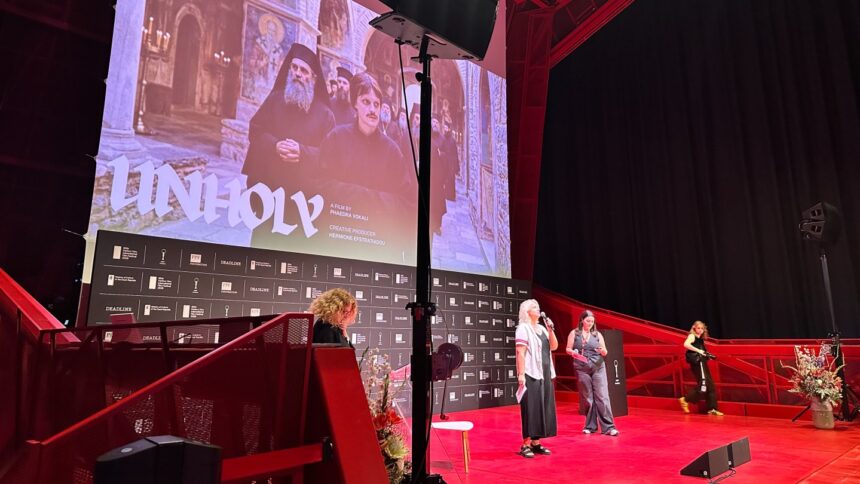
unholy
About the writer and director: Phaedra Vokkali, former editor-in-chief of Cinema Magazine, Head of Programming at the Athens International Film Festival and Director General of the Hellenic Film Academy, now turns her attention to her first feature film.
Producer: Hermione Efstratiado
Production company: Foss Productions (Greece)
Language: Greek
Genre: Comedy
Country: Greece
Stadium highlights:
“I grew up in a conservative, religious family,” Foukali said, highlighting that the film is set on Mount Athos in northern Greece, a 130-square-mile autonomous monastic state that is “the largest exclusion zone for women in the world.” She described it as “a place that will not change in another thousand years.”
“We are not allowed to film on the actual peninsula,” Efstratiadou explained, but this is the first feature film ever to be shot around Mount Athos.

summary:
Erin has spent her life saying yes to everyone. Until her father—the man who left them long ago to become a monk—falls off the map along with her life savings. Irene’s solution? She shaves her head, buys a mustache, and practices her deepest “blessings, bro.” Her destination? Mount Athos: The only place on Earth where women and female animals have been banned for more than a thousand years. Her boyfriend comes over because he’s terrible at saying no. Her estranged sister and her friend invite themselves into the mayhem. This Fellowship of Drag begins to wreak havoc on the backwater country that mimics the Middle Ages. Within the labyrinthine cloisters, Irene finds not only a missing father, but the absurd rulebook of patriarchy itself. To get her money and her life back, this people pleaser must finally become the woman they never expected.
Creator statement:
“unholy He uses high concept to ask: What happens when women stop following the rules? Mount Athos, where women have been banned for a thousand years, becomes the perfect setting for Irene’s rebellion. The film mixes comedy, drama and mystery, and reflects the journey of its hero, who refuses to sit still: he steals from heist movies, then wanders into the forest where time slows down. It borrows the rhythm of screwball comedy, then pauses for quiet confession. It turns laughter into silence and then opens up into something tender. This is not genre bending per se. It’s the only way to tell a story about a woman who was never allowed to be fully herself. My personal history with Orthodox Christianity informs each frame, as does my belief that liberation is funnier, messier, and more sacred than any sermon.