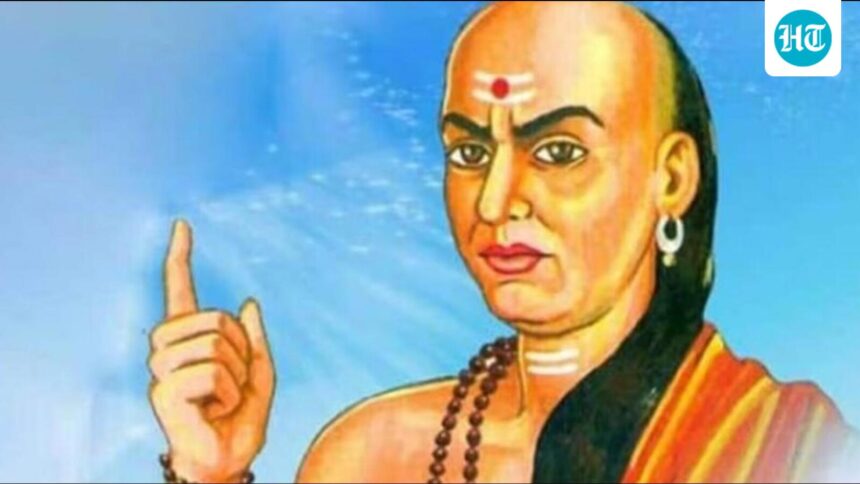
Few individuals in India’s long history have exercised such a profound influence on the fate of the subcontinent as Chanakya, also known as Kautilya or Vishengupta. If Chandragupta Maurya was the sword that forged India’s first great empire, Chanakya was undoubtedly the mind that conceived it. His life reminds us that ideas, when combined with determination and political will, can change the course of history.

Who exactly was Chanakya? Historical certainty is elusive. Most scholars agree that he lived during the 4th century BC, roughly between 375 and 283 BC, although exact dates remain uncertain. He belonged to an era of tremendous political ferment. Alexander’s conquest of northwestern India in 326 BC revealed the weakness of the fragmented kingdoms of the subcontinent. The mighty Nanda dynasty ruled Magadha, but fell out of favor, burdened by accusations of oppressive taxation and arbitrary rule. Chanakya entered this fractured political landscape with a vision far greater than that of any contemporary ruler.
Tradition identifies him as a Brahmin scholar associated with the famous Takshashila University. Educated in the Vedas, economics, diplomacy, and philosophy, he possessed not only scholastic brilliance but also an extraordinary understanding of human nature. Legend has it that after being publicly humiliated in Nanda’s court, he took a solemn vow to overthrow the dynasty. Whether this event is historically verifiable is less important than what happened next: the emergence of one of the most remarkable partnerships in political history.
Chanakya encountered the young Chandragupta Maurya while the latter was still a mysterious youth. Different traditions differ about the circumstances of their meeting, but they all agree on one fact: Chanakya recognized the boy’s extraordinary potential. He became not just Chandragupta’s mentor, but also his strategist, mentor and political architect. According to one tale, young Chandragupta began eating a thali of hot khichdi by placing his fingers in the middle, thus burning them. Chanakya, who was watching closely, gave him the invaluable advice that haste often leads to self-defeat. If one has to reach the center, let one start at the edges.
Chanakya’s achievement lay not only in helping Chandragupta overthrow the Nandas around 322 BC, but also in building a permanent imperial framework through the creation of the Mauryan Empire, which eventually extended across most of the Indian subcontinent. It was India’s first true territorial empire, bringing under a single political authority regions that had long remained divided. The importance of this achievement cannot be overstated. At a time when Europe was still fragmented into competing city-states and kingdoms, India produced a developed imperial state with an elaborate administrative machinery.
The intellectual basis for this achievement is found in the Arthashastra, one of the greatest works ever written on politics, governance, and economics. The title itself is revealing. ‘Artha’ refers to material well-being and statecraft and not mere wealth, while ‘shastra’ means a systematic treatise. The work addresses almost every aspect of government: taxation, law, intelligence gathering, diplomacy, war, agriculture, commerce, urban planning, mining, irrigation, and public finance.
Is Arthashastra the first major work on politics in world history? Chinese civilization produced the writings of Confucius and Sun Tzu in roughly the same broad period, while the Greek philosopher Plato wrote The Republic, and Aristotle composed Politics. However, in contrast to these works, which often explore ideal cases or philosophical principles, Kautilya’s treatise is a comprehensive guide to practical judgment. It combines political theory with administrative details, financial management, military organization, and foreign policy in a way unparalleled in the ancient world. In this sense, this book remains among the oldest treatises on statecraft ever written, and certainly one of the most comprehensive.
Contemporary readers are often astonished by Chanakya’s realpolitik. Politics was viewed as the art of ensuring the stability and prosperity of the state. Espionage, deception, and calculated alliances had their place, provided they served the larger interests of the kingdom. This has led many to compare him with Niccolò Machiavelli. But the comparison is Western arrogance. Machiavelli wrote nearly eighteen centuries later, and while The Prince focuses primarily on gaining and maintaining power, the Arthashastra is equally concerned with economic development, public welfare, and institutional governance. Indeed, Kautilya repeatedly asserts that the happiness of a ruler lies in the happiness of his subjects – a stark reminder that even his hard-line realism was grounded in a commitment to good governance.
Arthashastra has its own fascinating history. For centuries, the work virtually disappeared from public knowledge. Although parts of its ideas survive in later texts and traditions, the complete manuscript is believed to be lost. It was only in 1905 that the Sanskrit scholar R. Shamasastri manuscript at Oriental Research Institute, Mysore. He published the Sanskrit text in 1909 and its English translation shortly thereafter, presenting to the world a masterpiece that had remained hidden for centuries. Its rediscovery transformed scientific understanding of ancient India, revealing a civilization whose political thought was as sophisticated as its achievements in philosophy, mathematics, and literature.
In an age when the achievements of Indian civilization are increasingly being rediscovered, Chanakya deserves to be recognized as one of history’s greatest political thinkers, the brilliant strategist who turned an ambitious young man into an emperor, and the architect of an enduring vision of statecraft whose significance still resonates more than two millennia after it was first conceived.
(Pavan K Varma is an author, diplomat and former Member of Parliament (Rajya Sabha). Views expressed are personal)