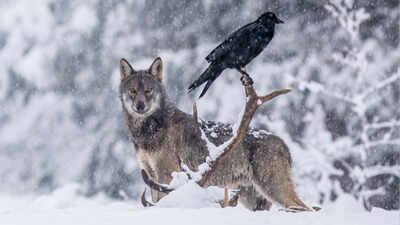
Scientists believe that crows follow wolves for food. They were wrong. Crows predict them
For decades, biologists believed that crows found their next meal by tracking wolves across the landscape until they killed the predators. A new study conducted in and around Yellowstone National Park suggests that birds use a much more sophisticated strategy.Instead of constantly tracking wolves, crows seem to remember where wolves are most likely to make a kill and fly directly to those areas, often covering great distances without following predators at all.The findings are based on two and a half years of GPS tracking, and suggest that crows build mental maps of hunting hotspots and use memory to predict where food is most likely to appear.“They can fly for six hours non-stop, directly to the kill site,” said Dr. Matthias Loreto, first author of the study.
Tracking crows from a scavenger’s perspective
To understand how ravens locate carcasses, researchers tracked 69 ravens, 20 wolves and 11 cougars in and around Yellowstone over a period of two and a half years.The project achieved more than 646,000 GPS locations of crows, along with tens of thousands of locations of wolves and cougars. The researchers compared those movements with confirmed predator kills to learn how they find food.What they discovered challenges a long-held assumption.
Instead of spending their time pursuing wolves across the landscape, the crows returned again and again to areas where killings were more common. Birds often arrive at carcasses with remarkable consistency, even after spending long periods away from wolves.“We all assumed that birds had a very simple rule: Just stay close to the wolves,” said Dan Staller, a biologist at Yellowstone.He added: “We didn’t know what crows were capable of, because no one had ever put them in the center, and no one took the scavenger’s point of view.”
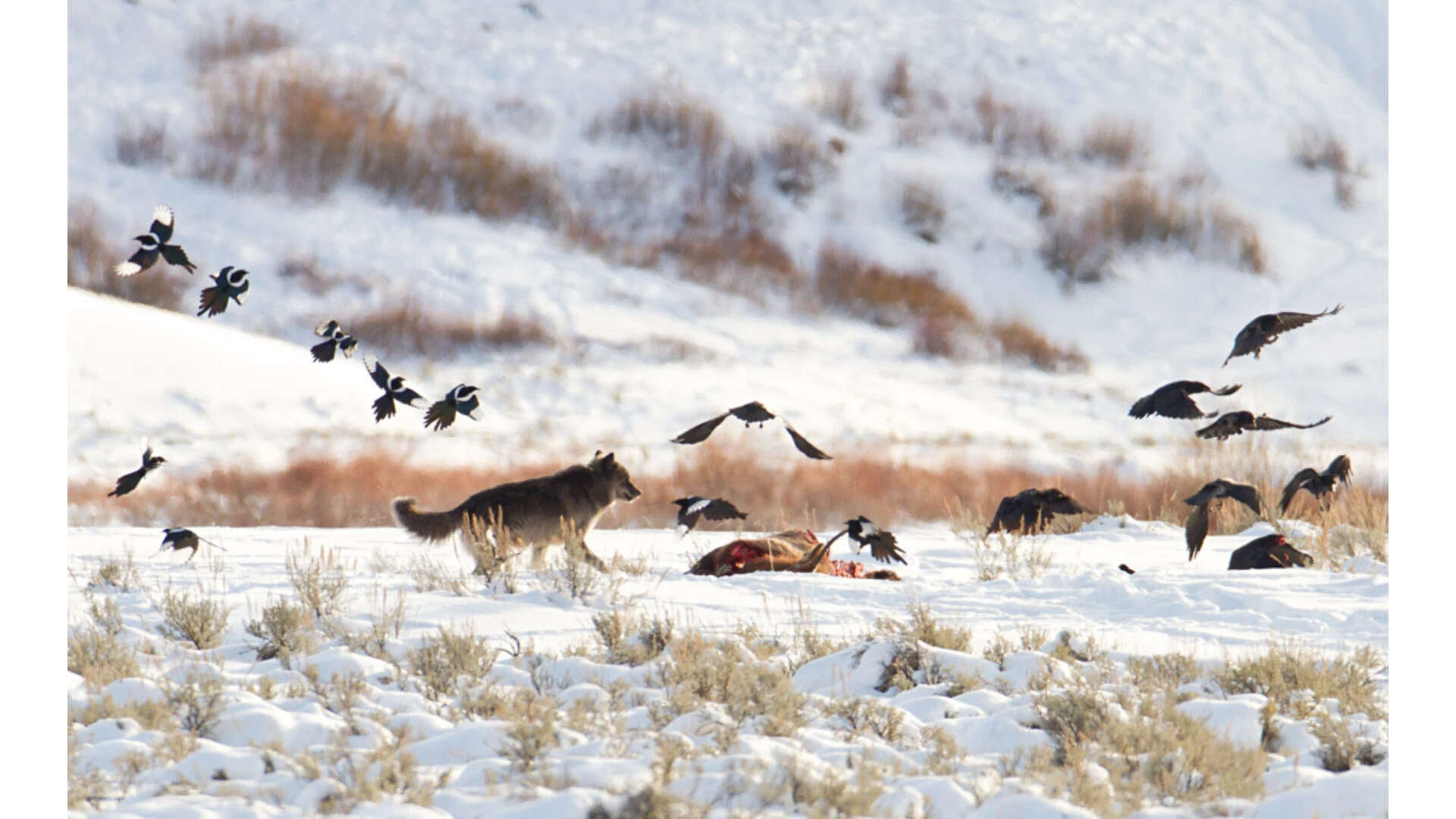
Wolves and crows
Following wolves was surprisingly rare
Although crows can follow wolves, the study found that this almost never happens over long distances.During the entire study, researchers recorded only one clear case of a black crow following a wolf for more than a kilometer and for more than an hour. In that case, a wandering crow traveled alongside a wolf for a distance of about four kilometers over two hours.Instead, most birds relied on memory rather than constantly keeping wolves in sight.Some crows flew directly to areas where carcasses were likely to appear, covering a distance of up to 155 kilometers in one day. Others spent weeks or even months away from wolves before returning to familiar feeding grounds.A GPS-tagged crow tracked wolves for 48 different days, while the gap between visits ranged from an average of 15 days to 363 days across all birds tracked.
A mind map of where the food is likely to be
Researchers say this behavior makes sense because wolf kills are not evenly spread throughout Yellowstone.Individual kills may be impossible to predict, but as months and years pass, wolves tend to hunt successfully in the same places, including open valleys, flatlands, and snow-covered areas near streams and roads.These patterns appear to help crows build a mental map of the landscape.“We already knew that crows can remember fixed food sources, such as landfills,” Loreto said.“What surprised us was that they also learned in areas where wolves are more common.
A single kill is unpredictable, but over time, some parts of the scene become more productive than others, and crows seem to use this pattern to their advantage.Researchers believe that crows still rely on immediate clues once they approach. They may notice wolves moving, hear howling, see other scavengers, or respond to the behavior of other crows.But…memory appears to guide the birds’ first decision about where to start searching.
Why are wolves better guides than cougars?
The study also found that crows are more closely related to wolves than to cougars.During the first seven days after the animal died, GPS-tagged crows visited 48.5% of wolf kills, but only 24.8% of mountain lion kills.Researchers say the difference reflects the hunting habits of the two predators.Wolves hunt in packs, usually in open areas, often leaving large carcasses exposed.Cougars hunt alone, often in forests or rugged terrain, and usually cover their prey with leaves, grass, or soil, making it difficult for scavengers to locate and access it.
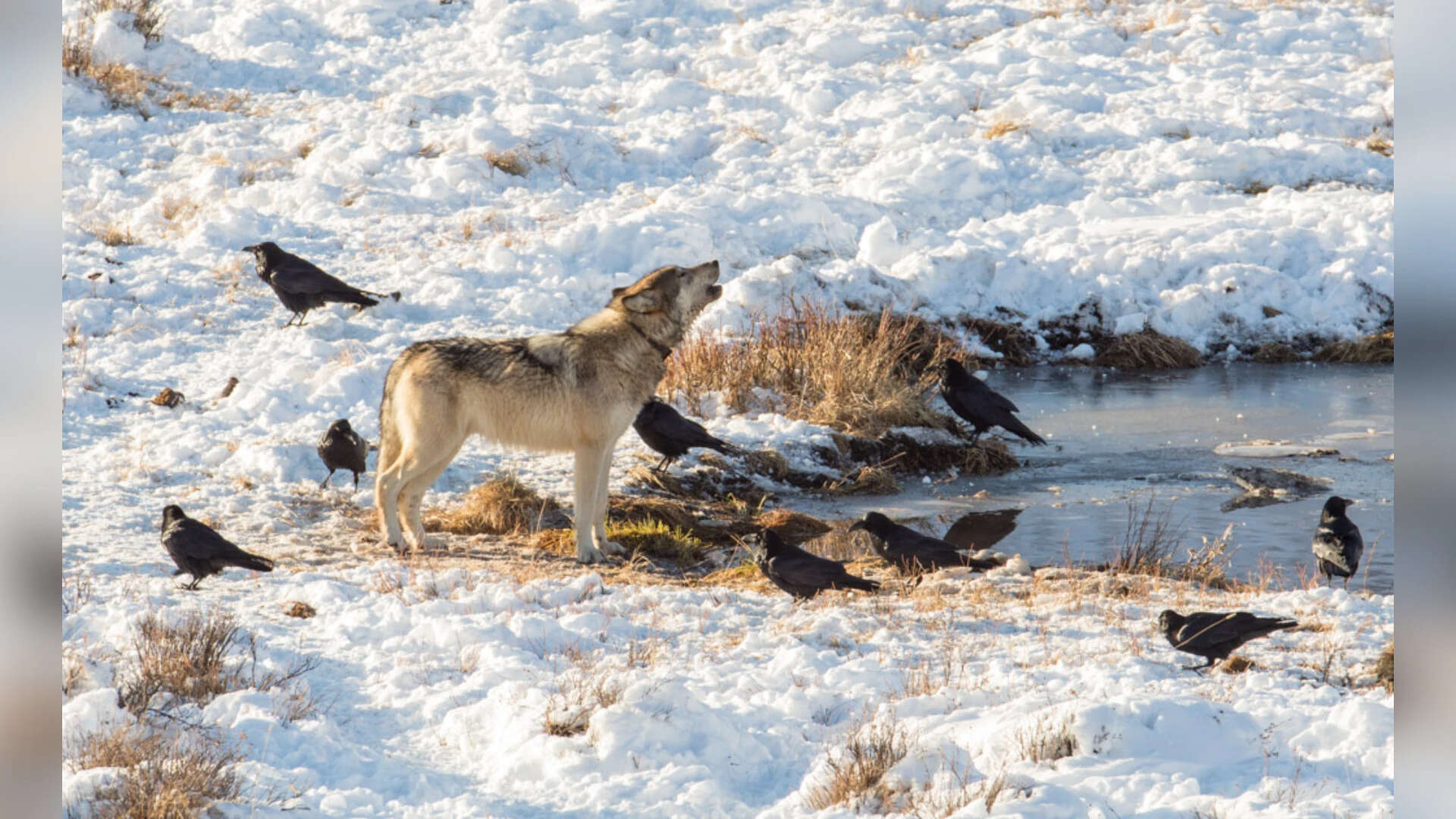
Wolves and crows
Catching smart birds
While wolves in Yellowstone have been fitted with GPS collars for years, ravens have presented a different challenge.The researchers first had to catch and tag the birds before they could begin tracking their movements.“Crows are so interested in the landscape that they don’t fall into traps easily,” Loreto said.To avoid arousing suspicion, the research team concealed the traps with items that naturally blend in with the surrounding environment, including discarded trash and fast food packages near the camp sites.“Otherwise, the crows will suspect something is off and won’t approach it,” Stahler said.
Changing what scientists know about crows
Crows are already known to be some of the most intelligent birds in the world. They store food for later, remember where they have hidden it, steal from other animals, and can respond to what other creatures know or can see. Previous studies have indicated that these creatures are capable of forms of future planning that were previously thought to be limited to great apes.The new research adds another skill to that list.Rather than simply remembering individual food caches, birds appear to be able to learn the hunting patterns of other species across enormous landscapes and use that knowledge to decide where to forage.“Crows can cover great distances by flying, and they seem to have a good memory, so they don’t need to constantly follow wolves in order to take advantage of predators,” Loreto said.Lead researcher Professor John M. Marzloff of the University of Washington said the findings reshape scientists’ understanding of how to locate food.“What our study clearly shows is that crows are flexible in where they decide to forage. They do not remain restricted to a particular group of wolves. Thanks to their acute senses and memory of previous feeding sites, they can choose from many foraging opportunities everywhere.
“This changes the way we think about how scavengers find food, and suggests that we may have underestimated some species for too long.”the study, “Crows anticipate wolf kill sites across wide ranges,” It was published in the magazine sciences By researchers Matthias Claudio Loreto, Christina B. Beck, Douglas W. Smith, Daniel R. Stahler, Loren E. Walker, Martin Wikelski, Thomas Müller, Kamran Safi, and John M. Marzloff.