

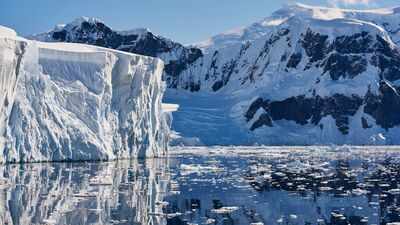
For decades, Antarctica has been treated as a kind of frozen time capsule, a place where evidence of Earth’s deep past is preserved, undisturbed, beneath layers of ice that have built up over millions of years.
According to the study published in the journal Nature Geoscience, scientists have now discovered something remarkable within this buried record: a massive fan-shaped geological structure stretching across a large area of East Antarctica, completely hidden from view beneath the ice.The researchers named it the East Antarctic Fan-Shaped Basin Province, or EAFBP. It connects a number of previously separate subterranean basins into a single continent-wide system, and in doing so, it reshapes how scientists understand the breakup of the ancient Gondwana supercontinent and how the Antarctic ice sheet might behave as the planet continues to warm.
A landscape hidden under more than three kilometers of ice
More than 99% of Antarctica’s rock surface is buried under ice, in places more than three kilometers thick. This makes direct geological fieldwork very difficult in most parts of the continent.To overcome this, researchers turned to a combination of remote sensing tools: ice-penetrating radar, gravity readings, magnetic surveys, seismic data, and digital models of the Earth’s crust beneath. By piecing together these data sets, an international research team of scientists observed something that no one had fully linked before: a group of troughs that all appeared to flow outward from roughly the same point near the South Pole, much like the edges of an open hand fan.
Connecting the largest buried basins in Antarctica
Some of the individual pieces of this structure were already familiar to scientists. The Wilkes Basin and Aurora Basin have been studied for years, as has the basin that includes Lake Vostok, the largest known lake sealed under ice anywhere on Earth.This discovery changes the way researchers interpret the underground landscape of East Antarctica. They appear to be pieces of a much larger tectonic structure, shaped by the same geological forces operating across the region simultaneously.
This reframes how researchers read the underground map of East Antarctica, not as scattered basins with separate histories, but as parts of a single event spanning the continent.
Image credit: Canva
How did this giant fan form?
The main explanation researchers believe for how this structure formed is a process called distributed rotational extension. It occurs when part of the continental crust extends outward from a central anchor point instead of dividing cleanly along a single fault line.
Instead, the crust breaks apart in multiple directions simultaneously, opening a series of wedge-shaped troughs between the fault zones.Researchers describe it almost like spreading fingers on a hand, or opening a folding fan, with each part moving away from the center, carving out V-shaped depressions as it moves. Scientists studying the structure believe it may be among the largest and most well-preserved examples of this type of crustal expansion.
The legacy of the breakup of Gondwana
The discovery also feeds into a much older story: the slow breakup of Gondwana, the supercontinent that once joined Antarctica with Australia, Africa, South America and India.This disintegration began about 180 million years ago. Antarctica and Australia remained together longer than most other parts, eventually separating about 70 million years ago. Researchers now suspect that a fan-shaped basin system may have played a role in this separation, weakening the crust in this region enough to facilitate eventual splitting.
The exact timeline remains uncertain, but the structure appears to preserve a long stretch of crust associated with the slow disintegration of Gondwana.
Image credit: Canva
Challenging the view of East Antarctica
East Antarctica has long been considered one of the most geologically stable and least active pieces of Earth’s crust, a craton that has remained largely stationary while the rest of the world’s plates moved around it.This discovery complicates that picture. The size and complexity of the fan-shaped province suggests that East Antarctica has undergone more intense crustal deformation in its past than previously thought.
Somewhere under the ice, the scars of those upheavals linger, hidden and unread, until now.
Why is this discovery important today?
The structure is not just a relic, it still shapes what happens on the surface today. The features of this buried rock influence how ice moves across the continent, directing the flow of glaciers and fast-moving ice streams above them.Because the behavior of ice is closely linked to the landscape beneath it, mapping structures like these provide scientists with better raw material for modeling how the Antarctic ice sheet will respond to rising temperatures, which in turn directly feeds into projections of global sea level rise.Rather than closing the book on the geological history of East Antarctica, this discovery opens a new chapter of it. Researchers still don’t know exactly when the fan-shaped structure formed, or specifically what combination of forces led to this large-scale expansion across the crust. Filling these gaps will likely require more detailed seismic surveys, refined geological modeling, and ongoing mapping of the terrain hidden beneath the ice.
Right now, the fan-shaped basin province of East Antarctica serves as a reminder that even one of the most remote and studied places on the planet still has enormous secrets hidden beneath its surface.