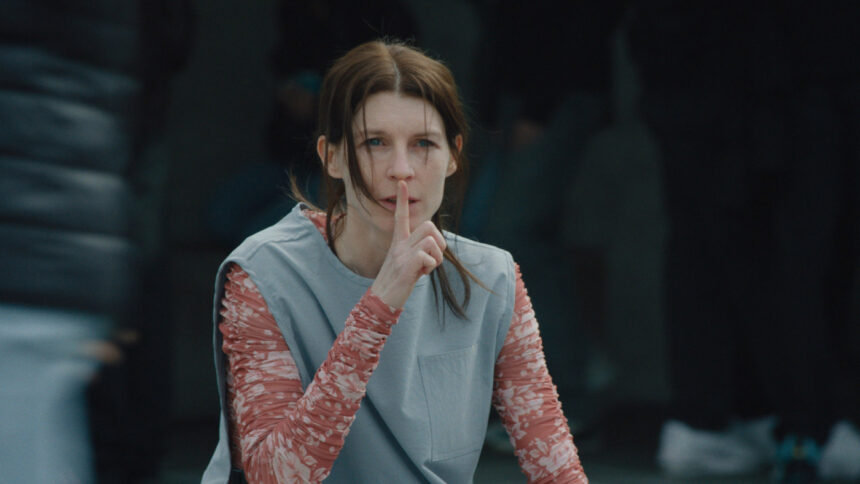
If you’re intrigued by the idea of a social drama that doesn’t follow all the tropes you might expect based on past cinematic conventions and experiences, Happy family It is yours. After all, Swiss director and writer Jan-Eric Mack’s feature debut features a contradictory main character, specifically a single mother who doesn’t quite fit into the categories of black or white, good or evil.
Complexity rather than preachiness is the watchword. Additionally, the film enjoys mixing genres, surprising with thrills that many would not expect.
Happy familywhich will have its world premiere on Saturday, July 4 at the 60th Karlovy Vary International Film Festival (KVIFF), also breaks new ground in another way. It is the first ever Swiss film to participate in the Czech festival’s Crystal Globe competition.
The film revolves around Nikki, a mother with two children who works two jobs, but has no money, and explores themes such as poverty and social inequality. After a fire burns down the family’s home and turns their lives upside down, her children are placed in foster care. After being banned from contacting them, Nikki takes on a new identity to stay close to them.
Mac co-wrote it Happy family With Anna Shins, Nikita Afanasijou and Eva Kienholz. Shenz also stars as Nikki, and the cast also includes Julia Jentsch, Bettina Stucki, Michael Neuenschwander, Alireza Bayram, and Martina Apostolova.
The film’s cinematographer is Younis Roy Emer, and its editor is Benjamin Futter. Produced by Martin Goss and Peter Reichenbach. Happy family A production of C-Films AG, in cooperation with DCM and in co-production with SRF Schweizer Radio und Fernsehen and SRG SSR, with support from Zürcher Filmstiftung, Bundesamt für Kultur, Valais Film Commission, Film Commission Zurich, Focal Stage Pool and Swissimage. DCM Film Distribution has Swiss rights, while Bendita Film Sales handles international sales.
Mac has previously created short films such as Opposite MeccaThe film’s events revolve around a man who faces the maze of Swiss bureaucracy when he prepares to bury his Muslim wife. He also co-directed the historical spy series. Davos 1917.
Ahead of the film’s world premiere in Karlovy Vary, Mac spoke to THR About inspiration for Happy familythe desire to surprise audiences and spark controversy, and why complexity and hope are essential ingredients.
What inspired Happy family? Can you explain why you wanted to show a side of Switzerland that the world doesn’t usually see?
The Covid-19 crisis has suddenly put poverty in Switzerland in the spotlight, with long queues forming at food banks. People from the middle class onwards were affected. This was the first spark of Anna’s research. We later discovered that a large percentage of those affected can be described as the “working poor,” that is, people who live below the poverty line despite having jobs. Many of them are single mothers due to structural defects. We wanted to investigate why this happens.
It was a topic that no one talked about, but it was very important for us to highlight what people should know and show the other side of Switzerland.
What can you share about the research you and Anna conducted?
We are a family. We have two children and, of course, we always have family politics around us, and that’s how we came across care and related topics. In Switzerland, having children is a very private matter, and public support is very limited. Switzerland is one of the last countries in Europe when it comes to supporting families.
Over the course of two years, we conducted extensive research and spoke with single mothers living in poverty, as well as with representatives of NGOs and government agencies. In this process, we found that most of the problems are systemic in nature.

Given your experience with TV series, did you and Anna consider making this a series during your development? Happy family?
No, we had a feeling from the beginning that we wanted to make a film. We loved the idea of having this opportunity to talk about the film with the audience, share perspectives on the topic and meet people to start a conversation. A feature film seemed to me to be the right form to tell this story, and it gave me the artistic freedom to develop my own style.
Happy family It mixes social drama with genre elements, especially thrillers. What’s the thinking behind it?
With this subject matter, you’d expect a social drama, but we really liked the idea of mixing genres. So, besides the social drama, you have elements of suspense and, most importantly, some kind of humor that you can deliver to the audience.
We tell the story from the strong perspective of this mother, Nikki, and from her perspective, there’s a lot of animosity. As she grows more desperate, Nikki takes greater risks, thus increasingly placing her children in a conflict of loyalty. Both of these factors lead to tense — but also funny — moments.
While watching the movie, I kept feeling like you were pulling me in and making me feel a certain way, just for me to change my mind and feelings. It was uncomfortable not “knowing” how you felt about everyone and everything, but I also felt really engaged and perhaps closer to real life…
We were interested in having a conflicted main character that makes you ask yourself what you’re going to do, as I said. The viewer must constantly question their moral perspective because we wanted to cover the full complexity of this topic. Officials have to make very difficult decisions, and we tried to understand both sides in order to discuss a structural problem.
Maybe this is why Happy family It was an experience for me that was very different from politics in many parts of the world where social issues lead people to blame one person or entity. We often seem to like to say that either it’s all the mother’s fault, or it’s all the government’s fault! Have you tried to show that both can be partly true at the same time?
Blaming someone is usually not part of the solution. Of course, both sides usually have to move. But in the end, in our research, we clearly found that single mothers are often victims of this system, and this has to do with its cultural and structural backgrounds, with politics, and so on. Switzerland needs to change a lot, in our opinion. This is the responsibility of the entire society. Things are changing, but very slowly.
So, what are your hopes for the film?
It’s a big goal to expect a film to change politics, but helping people understand and be emotionally moved is my number one goal. I want them to be able to connect with this mother and the other people involved in this story, so that in the process they can open their hearts and minds to these topics.

How did the co-writing process work with Anna and the other two writers?
Anna was actually the main writer. I started this project, and since we are a couple, the film has lived with us for about five years. During this process, we added two co-writers to the project. The four of us wrote it, which is very unusual, but we are very close. Later, Anna needed to change her perspective from an analytical point of view as a writer to an emotional point of view as an actor to become the main character.
Tell me a little about the casting of the children and the care that went into protecting them in light of some of the heavier themes in the film. Happy family!
We had a great selection, and about 500 kids applied. We started with online casting first, then we had 80 live actors, and then a second round. So it was a very long process to find these two kids. We knew they were going to be acting for about 18 days of shooting, which is quite a lot. And I couldn’t be happier to have found them both.
The girl was 10 years old, while the boy was 6 years old when we shot the film. This is a big difference at this age. We did a lot of training and workshops before filming. It was important for them to understand the situation and deal with their emotions. It was a very gradual and slow process of getting them into their characters. Trust and fun were key, and as a director, I don’t like to manipulate in any way, and I don’t do that with kids either. So we had open discussions.
How did you end up cursed? and that, Happy family?
We actually found that very early in the writing process. This term is used in many languages and describes the ideal that we question. We love dialectics. And the title has this contradictory feeling, which the movie does too, so we felt like it worked.
What was it like creating your first feature film and then having it premiere in Karlovy Vary, as the first major Swiss film ever?
It is a very great honor and a pleasure to have the film premiered in Karlovy Vary, especially in the main competition. So, we were speechless and really looking forward to it.
It was also special because, coincidentally, Anna is half-Czech, and speaks the language. This makes it even more special for us. It feels like things are coming full circle one way or another.