

In the early years of the twentieth century, conservation in the United States was still taking shape as a profession rather than a philosophy. Forests were mapped, species counted, and lands divided into managed areas, with the confidence that nature could be regulated if only enough data were collected.
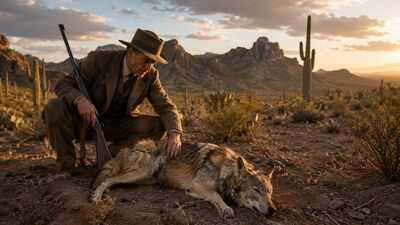
Among the young men who entered this system was a forester who was trained at Yale and sent to the American Southwest. He arrived with the customs of his time, including the gun, and his belief that removing certain animals was part of maintaining the “health” of the landscape.On one such field mission, he shot a wolf on a cliff in Arizona. What followed was not a celebration of control, but a moment of hesitation that he later struggled to describe clearly.
The animal’s death seemed to interrupt something that had never been in doubt, leaving him feeling like the rules he was working by weren’t perfect.
routine US Forest Service The task of controlling predators has become a permanent moral reflection
The forester was Aldo Leopold, who was still working within the early U.S. Forest Service mindset that treated predators as problems to be solved. Wolves were routinely removed to protect livestock and game animals, and few in his circle saw any contradiction in this approach.
On that day in Arizona, the shot came quickly, almost accidentally, as part of routine work in the badlands.He later wrote about standing over the animal afterwards. The details that stayed in his mind were not artistic or scientific, but visual. The wolf’s expression seemed to change in the final moments, which he described as a fading of intensity rather than a mere absence of life. It was not framed at the time as a discovery, but rather as an inconvenience that remained without immediate explanation.
In later years, he would return to the memory often, as if trying to determine what exactly had changed in that brief exchange between hunter and hunted.
Early conservation mentality in the American West
At the beginning of his career, conservation in the American West was still closely linked to resource management. The land was to be protected for use, not for its own benefit. Forest Service policy focused on timber, grazing, and game populations, where predators were often viewed as interfering with a system that could be balanced by regulation.Leopold worked within this structure, contributing to surveys and land assessments across the Southwest. His early writings reflected the common language of control of the time, in which wildlife was often divided into categories of beneficial and destructive. However, field experience has gradually complicated these divisions. He began to notice that removing a single species had effects that went beyond immediate expectations, changing vegetation patterns and the behavior of other animals in ways that were not easy to correct.The shift was slow and not sudden. This came about through repeated observation and not through a single intellectual interruption.
Early shift from land management to environmental understanding
By the 1920s, discussions about environmental conservation began to broaden. Wilderness conservation is no longer entirely theoretical. Areas such as the Gila Wilderness have been set aside, in part by arguments that Leopold himself helped advance while working as a forester and later as an academic.His work began by moving between technical forestry and something closer to ecological interpretation. He wrote about land as an interconnected system, where soil, water, plants, and animal life cannot be treated as separate management concerns. This was not a common language at that time. The prevailing assumption still leans towards optimal land use rather than land sharing.However, his position was not firm. Early writings supported predator removal in some contexts, especially when livestock losses are involved.
Later, he reconsidered that position, not as an abstract correction, but as a response to what he saw on the ground. For example, deer populations can increase beyond the land’s ability to support them if predators are removed, leading to deterioration of vegetation and ultimately decline of the herd itself.
How a change in perspective has reshaped human relationships with the natural world
The essay that later became widely read, often referred to by the opening phrase “Thinking Like a Mountain,” was based on this reconsideration.
He did not present an argument in the modern sense, but rather a shift in perspective. The idea was simple in broad terms: ecosystems do not behave as isolated units, and interventions that seem helpful in the short term may lead to instability elsewhere.Leopold’s writings in this period moved away from instruction and closer to reflection. He began to describe land not just as a resource, but as a community of interconnected parts.
Human beings were placed within this society rather than above it, a position that conflicted with much of the political language of the time.Some of these ideas were later absorbed into environmental science where more formal methods for studying food webs and population dynamics developed. However, at that time, it was still expressed through observation and measurement rather than established theory.
The emergence of a “compromise” between wild nature and human design
In the mid-1930s, Leopold purchased a worn-out farm in Sauk County, Wisconsin.
The land had been heavily worked and then abandoned, leaving thin soil and uneven recovery. There was little sign of productivity in the traditional sense.The familial approach was gradual. Trees have been planted in large numbers, including pines, oaks and other native species. Wet areas have been left to recover naturally where possible, while other parts have been actively reforested. It was not a project with fixed results so much as a long reform process that unfolded year after year.The site became a practical example of his ideas about land stewardship. It’s uncontrollable in the strict sense of the word, and it’s not exactly wild either. Something in between, shaped by human effort but not entirely governed by it.
The academic years that helped define a new environmental consciousness
Leopold’s academic work at the University of Wisconsin provided a platform for his later writings. He produced articles that combined field observation with broader thinking about land use and responsibility. They were later collected in the Sand County Almanac, published posthumously.The writing did not follow a strict argument structure. Instead, the book moved through seasonal observations, small incidents, and longer reflections on environmental change. Ideas such as the “Earth Community” emerged in this period, suggesting that ethical considerations could extend beyond human society to include soil, water, plants, and animals.His influence gradually spread. Some readers took up the work through the Forest and Wildlife Department.
Others encountered it through the emerging environmental movements of the mid-twentieth century. The language was not active in its dialect, but it provided a way of thinking that set limits to man’s power over the earth.
Leopold’s death and the continuing legacy of his environmental thought
Leopold died in 1948 while assisting in efforts to control a fire on a nearby property. He was in his early sixties. The land restoration work he began with his family continued after his death, both on the Wisconsin farm and through projects undertaken by his descendants and collaborators.Over time, his earlier experiences, including killing a coyote in Arizona, came to be read in the light of his later thinking. He has not abandoned the practice of wildlife management entirely, but he has become increasingly aware of its broader consequences. The change in perspective was framed not as a rejection of his profession, but rather as an expansion of its boundaries.What has remained constant throughout his writing is a concern with relationship rather than domination. The Earth, in his later view, was not a backdrop to human activity, but rather a shared system in which human actions were a part Just one of many actions.