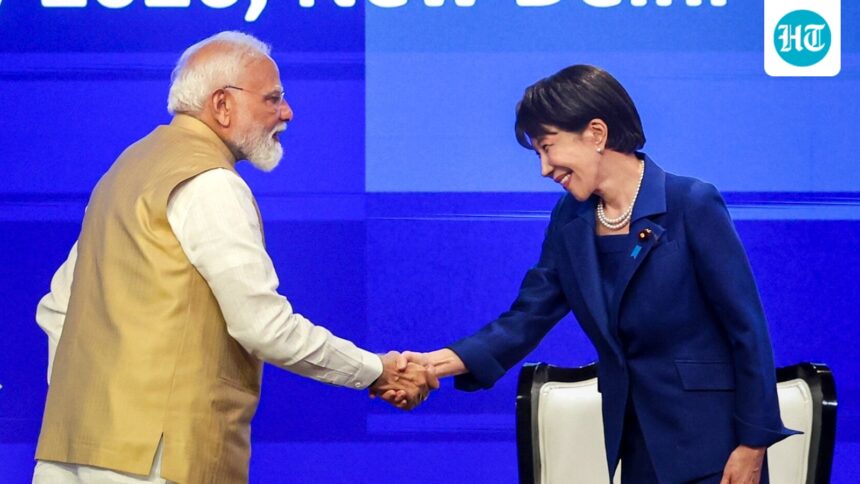
Prime Minister Narendra Modi and his Japanese counterpart Sanae Takaishi struck a warm personal chord while unveiling an ambitious roadmap to deepen Indo-Japan relations during the 16th annual summit in New Delhi. Describing the India-Japan relationship as a “partnership of strategic convergence and trust for shared growth, prosperity and resilience”, the two leaders said the phrase reflects “the essence and progress of our partnership”. The camaraderie between the two leaders was also on full display when Takaishi revealed that Modi called her his “beautiful younger sister,” adding that they agreed to take the relationship forward “like brother and sister.”

Beyond this playful exchange, the summit highlighted what both sides described as a “mutually complementary relationship” in an increasingly uncertain global environment, where cooperation includes defence, economic security, technology, energy and regional stability.
Here are the five biggest takeaways:
1. The strategic partnership gets a new impetus
The two leaders reaffirmed their commitment to strengthening the special strategic and global partnership between India and Japan, identifying defence, security, economic resilience, technology, innovation and people-to-people exchanges as the three core pillars of future cooperation. They described India and Japan as “natural and indispensable partners” amid growing geopolitical uncertainty.
Read also: Artificial intelligence, defense and healthcare: What was discussed in Modi’s meeting with Japanese Prime Minister Sanae Takaishi
2. Defense cooperation moves to a higher level
India and Japan have agreed to deepen military cooperation through more naval exercises, increased maritime domain awareness, cooperation in defense equipment and technology transfer. The two sides also announced that the next 2+2 Ministerial Meeting will be held in Tokyo later this year, and welcomed progress on the UNICORN defense communications project.
3. Economic security and technology take center stage
Recognizing vulnerabilities in global supply chains, the two countries adopted a Joint Declaration on Economic Security Cooperation focusing on semiconductors, critical minerals, clean energy, pharmaceuticals and information technology. The leaders also launched a new AI cooperation framework aimed at promoting reliable digital infrastructure and responsible AI.
4. Energy and infrastructure remain key areas of focus
The summit saw a renewed focus on clean energy, including biogas, hydrogen and ammonia projects, along with cooperation on strategic oil reserves. Japan also reiterated its commitment to the pioneering high-speed rail project between Mumbai and Ahmedabad in India and expressed its readiness to support future high-speed rail corridors across the country.
Read also: Foils on submarines: Why Sanae Takaishi’s visit to India is about the economy first
5. Shared concerns about regional security
The two leaders expressed concern about developments in the South China Sea, North Korea’s missile program and terrorism, including cross-border terrorism from Pakistan. They reaffirmed their support for a free and open Indo-Pacific region, stronger Quad cooperation and UN Security Council reforms, while also supporting each other’s bid for permanent membership.
The summit concluded with Takaichi Modi invited to visit Japan next year for the 17th annual summit, signaling that the “brother and sister” relationship will be accompanied by a broader strategic partnership that both sides hope will shape the future of the Indo-Pacific region.