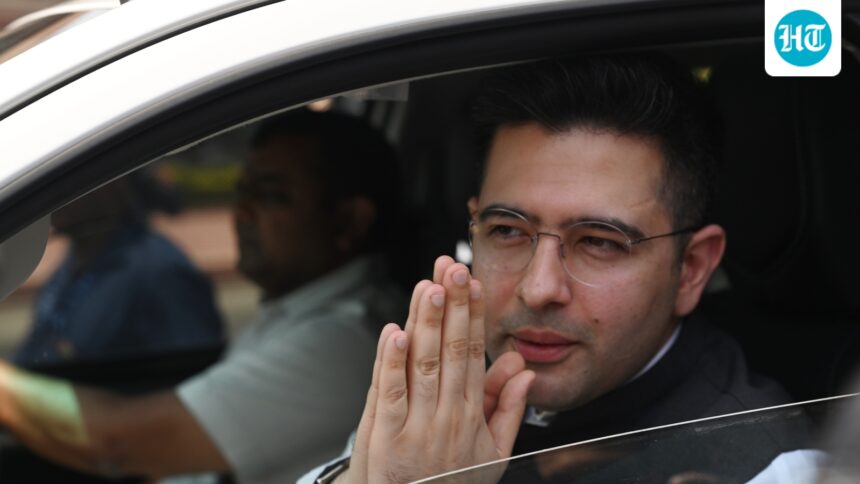
In a major victory for Raghav Chadha, the Delhi High Court on Wednesday ordered the removal of social media posts that allegedly defamed him.

The order came after the Rajya Sabha MP filed a petition seeking protection from circulating defamatory content and AI manipulation against him online. He said in his lawsuit that such publications severely harm his reputation and personal rights.
After the order was approved by a single bench of the Delhi High Court, lawyers representing Chadha referred to the order as a “welcome step”. “Today’s order passed by the single judge of the Delhi High Court is a welcome step as it has directed the removal of defamatory content against Mr. Chadha thereby protecting individuals from regulated defamatory content on social media,” the statement read. Chadha was represented by senior advocate Rajeev Nayar.
Read also | Raghav Chadha seeks FIR against Bhagwant Mann as Sikh Gurus video row escalates: ‘Forensic report fabricated by AAP’
Justice Subramonium Prasad, while passing the order, agreed that the defamatory material highlighted by Chadha crossed the line between legitimate criticism and defamation and ordered its removal.
“Concerted and organized efforts to amplify false narratives”
In their statement following the court’s directives, lawyers representing Chadha said the order “reinforces the fact that freedom of expression cannot be used to conduct organized, paid-for smear campaigns and character assassination.”
During the hearings, they said they presented to the court a “coordinated, paid-for social media campaign,” which they said was run by several professional agencies. The lawyers said this was done to “damage the public image and reputation” of the Rajya Sabha MP.
The lawyer representing Meta stated that many of the screenshots Chadha relied on were press reports or harmless material.
Chadha’s lawyers described the order as an “important step” to ensure swift action against “systematic” online defamation. The statement added: “The materials before the court showed that defamatory posts, by multiple social media accounts and influencers posting paid content, with the involvement of influencer marketing agencies, were spread across multiple social media handles within minutes, reflecting a concerted and organized effort to amplify false narratives and cause irreparable damage to reputation.”
However, the Supreme Court made it clear that the proceedings did not relate to personality rights, a point that will be elaborated upon in the detailed order.
Read also | Story of 2024, Amit Shah’s visit to Punjab: Inside Raghav Chadha and the team’s shift to BJP
“A fine line between defamation and criticism”: what the court previously said
In a previous hearing on the matter, Justice Subramonium Prasad stressed that there was a “fine line” between defamatory content and criticism of a political decision.
“The line between defamation and criticism is very thin, isn’t it? It is very easy to slip to the other side, affecting your right to live with dignity and you cannot violate that aspect at the same time. Your right under Article 19(1)(a) cannot be taken away either,” the court said. The single judge bench then held that though an individual has the right to live with dignity, he also cannot be deprived of the right to freedom of expression under the Constitution.
“It is a comment from an individual criticizing a political decision… As a political leader, can you be sensitive?” Justice Prasad said. The judge orally noted that the material prima facie appeared to be “criticism of a political decision”.
Meanwhile, Chadha Nayar’s lawyer said the posts implying that he was “trading for money” could not be termed as “fair criticism” and said the offending posts “could not have survived even for a day”.
The lawsuit alleged that artificial intelligence and deepfake technology are being used in an unauthorized manner to create and disseminate manipulated content, which constitutes a serious violation of Chad’s legal and constitutional rights.