The Gujarat High Court set aside the family court order and declared the marriage null and void, holding that registration of marriage could not lead to a valid Hindu marriage as essential rituals and ceremonies were never performed.

A division bench of Justice Ilish J. Vora and Justice R. T. Vachani, in a June 23 ruling, allowed the appeal by a UK resident man and held that the family court erred in refusing to act on the defendant’s admission that no legal marriage had ever been celebrated, according to a copy of the 10-page order seen by HT.
“The word ‘ceremony’ used in Section 7 means that the marriage must be solemnized in the proper manner and with the required ceremonies. Unless the marriage is solemnized with the necessary customary rites and ceremonies, it cannot be treated as a marriage celebrated under the law. In the absence of such ceremony, there is no valid Hindu marriage in the eyes of the law,” the court ordered.
According to the court record, appellant said he learned of the alleged marriage only when defendant contacted his parents with a marriage certificate claiming to be his legally married wife.
He stated that he never entered into any formal marriage with the defendant, never performed any Hindu rituals or ceremonies, and never lived with her as husband and wife. He further alleged that while working for a company owned by the defendant’s father, his signatures on marriage documents were fraudulently obtained under the promise of promotion or threat of termination, without his free consent.
During the proceedings before the Family Court, the respondent submitted a written statement admitting that no marriage rites or rituals had been performed, that no legal marriage had been concluded between the parties, and that they did not share the relationship between husband and wife.
Read also: The man pays $36 lakhs to marry a woman he only met over a video call, and regretted it after 9 days
In accordance with the order of the Supreme Court, the Family Court nevertheless held that the presence of a registered marriage certificate raised the presumption of a valid marriage requiring a full trial and rejected the appellant’s application for a decree on admission. After allowing the appeal, the Supreme Court held that the Family Court had made a “serious error” by failing to act on the defendant’s “clear and unambiguous confession”.
“It is submitted that when the defendant herself admitted that no Hindu rituals and ceremonies were performed and that no legal marriage was celebrated, there was no justification for directing a full trial. The court in its order observed that the mere existence of a marriage certificate cannot create a valid marriage when the essential ceremonies were never performed and when the defendant herself admitted this fact on record.”
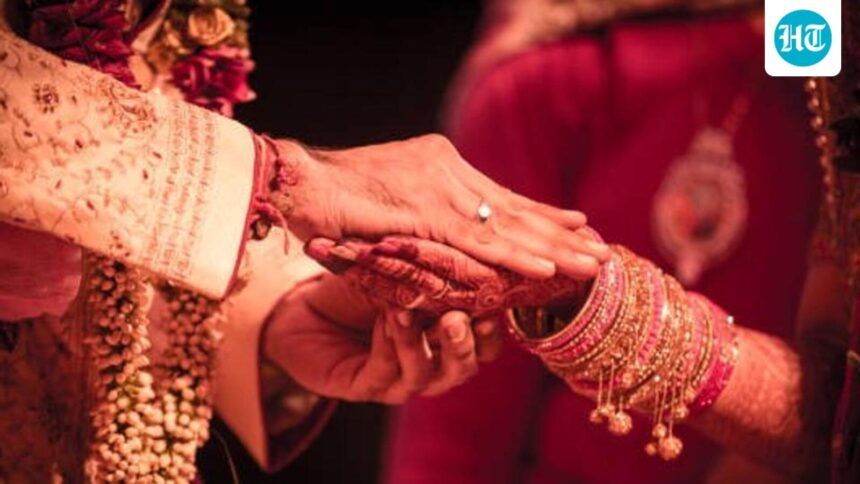
Referring to Section 7 of the Hindu Marriage Act, 1955, the bench observed that when the customary rituals and ceremonies include saptapadi, where the bride and groom take seven steps together before the holy fire, the marriage becomes complete and legally binding only when the seventh step is taken.
Referring to Section 8 of the Hindu Marriage Act, 1955, the bench clarified that registration only facilitates proof of marriage validly celebrated under Section 7 and cannot by itself create the legal status of husband and wife.
“The purpose of registration under Section 8 is only to provide evidence and proof of a marriage that has already been validly celebrated in accordance with Section 7 of the Act. Registration under Section 8, by itself, does not make a marriage valid or legal if the essential ceremonies required under Section 7 are not performed,” the court ordered. She added that if a marriage does not actually occur, “any registration or certificate issued will have no legal effect and will not create the legal status of husband and wife between the parties.”
The Supreme Court also relied on the judgment of the Supreme Court in Rathnamma & Ors case. v. Sujathamma & Ors., which held that mere registration of a marriage agreement is not sufficient to prove the existence of a valid marriage.
The bench noted that the appellant’s assertions that he resided abroad, was never informed of the alleged marriage and had never slept with the respondent were indisputable. It noted that the Family Court, by refusing to act on the respondent’s confession, “caused injustice to the appellant and prolonged the case without any real benefit.”
After accepting the appeal, the Supreme Court set aside the Family Court order and declared the alleged marriage “invalid ab initio, as no right or liability emanates from such marriage.” The appellant was given freedom to approach the competent authority to cancel the marriage registration and marriage certificate.
In its observations, the court said that Hindu marriage is a sacred sacrament and the foundation of the family.
“Marriage is not merely an occasion for ‘singing and dancing’ or ‘wining and dining’. Marriage is not a business transaction. It is a formal and constitutive event through which a man and a woman enter into a relationship as husband and wife for the purpose of building a family in the future,” the court observed.