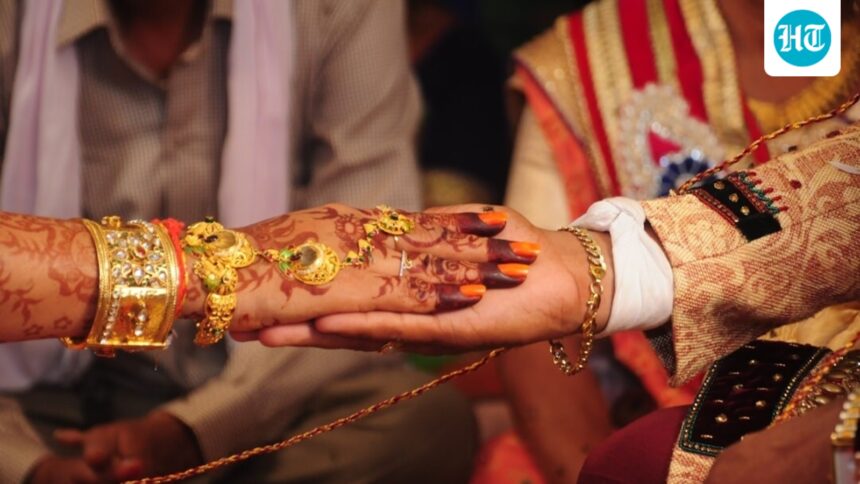
The Gujarat High Court has ruled that registration alone cannot prove the validity of a Hindu marriage if customary rituals and ceremonies, such as ‘saptapadi’, are not performed.

Customary ceremonies, despite their geographical and cultural differences, are believed to purify and transform an individual’s spiritual existence, the SC said in its June 23 order.
It issued the ruling while deciding an appeal filed by a man residing in the United Kingdom challenging the decision of the Family Court that refused to declare the alleged marriage between the two parties invalid.
While quashing the family court order passed in November last year, a bench of Justices Ilish Vora and R T Vachani said in its order, a copy of which was made available on Monday, that performing essential ceremonies like Saptapadi is the foundation of Hindu marriage.
The court noted that ceremonies like ‘saptapadi’ – the groom and bride taking seven steps together in front of the holy fire – provide marriage with spiritual, social and legal status as a sacrament and samskara.
The case concerns the appellant Kaushal Sonar, who requested that the marriage between the parties be declared null and void. He said that he resides in the United Kingdom while the defendant resides in Ahmedabad.
Sunar told the court that he only learned of the alleged marriage when the defendant approached his parents and handed them a marriage certificate claiming to be his legal wife.
He claimed that he never entered into any marriage with the defendant, never performed any Hindu rituals and ceremonies, and never lived with her as a spouse. He also claimed that his signature on the marriage documents was fraudulently obtained without his free consent.
The Supreme Court observed that when the respondent woman unequivocally admitted before the Family Court that no rituals or marriage ceremonies were performed between the parties and that the two did not share the relationship of husband and wife, the Family Court committed error by rejecting the petition filed by the appellant.
The SC referred to Section 7 of the Hindu Marriage Act, which talks about celebrating Hindu marriages according to customary rituals and ceremonies, such as Saptapadi, to make the marriage complete and binding.
The court said that since the rituals and ceremonies of marriage were not performed, the basic and fundamental condition of Hindu marriage is absent in the present case.
“In Hindu tradition, a wife is considered one half of her husband (ardangini), while at the same time she is recognized as an individual with her own identity and as an equal partner in marriage. Under Hindu law, marriage is considered a sacrament or samskara. It forms the basis of a new family,” the court noted.
“Hindu marriage is a samskara and a sacrament, and it should have its rightful place as an institution of great importance in Indian society. Therefore, we urge young men and women to carefully consider the institution of marriage before entering into it and understand the sacred nature of this institution in Indian society,” the report noted.
She said marriage is “not just an occasion for singing, dancing, wining and dining” or a business transaction, but rather a “solemn and foundational event” for a man and woman to enter into a relationship and build a family for the future.
The Supreme Court further noted that “Marriage is sacred as it creates a lifelong, dignified, equal, consensual and healthy union between two persons. It is also viewed as an event that helps an individual achieve salvation, especially when the prescribed rituals and ceremonies are duly performed.”
He added that customary ceremonies, despite their geographical and cultural differences, are believed to purify and transform one’s spiritual existence.