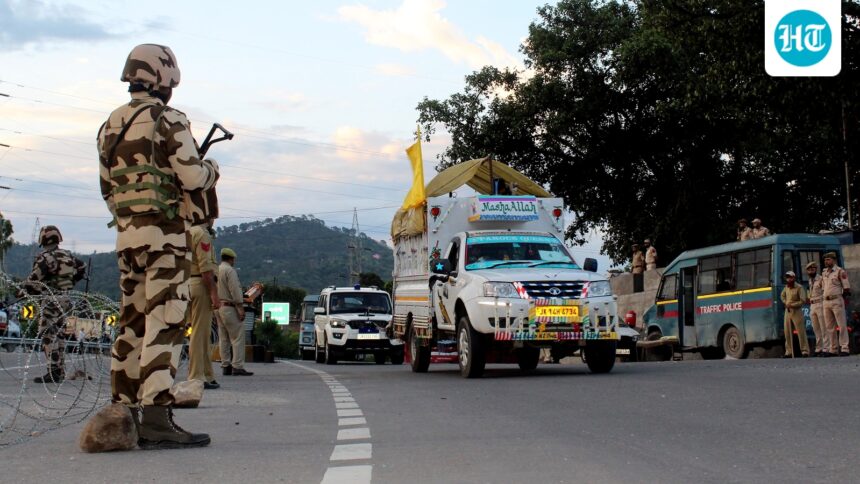
Jammu: Elaborate arrangements have been made, including enhanced security and accommodation for around 55,000 pilgrims, for the annual Amarnath Yatra, and the first batch of devotees is scheduled to be launched from Bhagwati Nagar base camp here on July 2, the Jammu and Kashmir administration said on Tuesday.

Lieutenant Governor Manoj Sinha, who is also the president of the Shri Amarnath Shrine Board (SASB), will launch the first convoy at 4 am, officials said.
The 57-day pilgrimage to the 3,880-metre high Amarnath cave shrine will begin on July 3 simultaneously from the traditional 48-km Noonwan-Pahalgam route in Anantnag district and the shorter but steeper 14-km Baltal route in Ganderbal district.
“So far, arrangements have been made to accommodate about 55,000 pilgrims across Jammu district. Comprehensive arrangements have been made for all pilgrims arriving in Jammu district, including accommodation, food and sanitation facilities, so that no pilgrim faces any inconvenience,” Jammu District Commissioner Ramesh Kumar told reporters here.
Flanked by Inspector General of Police, Jammu Region, Bhim Sen Toti, Kumar said healthcare, transportation and security arrangements have also been made to ensure a safe and hassle-free Hajj journey.
“Shri Amarnath Ji Yatra is an annual event. Every year, extensive security arrangements are made for the pilgrimage and this year we are making efforts to provide stronger security cover than before,” Tuti said.
He said that pilgrims arriving in Lakhanpur between 6 am and 8 am will be taken to Jammu under security cover, while those arriving after 8 am will have to stop there due to security restrictions.
“Pilgrims have been directed to travel only on the Jammu-Srinagar National Highway. Movement on alternative routes, including Mughal Road and Dhar Road, will not be allowed for yatra traffic in view of security considerations,” he said.
Small convoys will also operate between Udhampur and Banihal as per a fixed schedule, the IGP said. He added, “Pilgrims were advised to adhere to the stopping times notified by the Traffic Department, which may adjust the schedule depending on weather or road conditions.”
Kumar said shelter centers have been set up from Lakhanpur to Banihal, including government-run housing facilities, temporary shelters and accommodations arranged with the support of civil society organisations.
He said a langar has been set up to provide free meals, while sanitation, healthcare, security and transportation arrangements have been strengthened to ensure smooth movement of pilgrims.
Separate escort convoys will head to the twin base camps at Pahalgam and Baltal, from where the pilgrims will begin their journey to the holy cave shrine on July 3.
Immediate registration of pilgrims will begin on Wednesday at the Tawi riverfront in Jammu, where the registration center has been shifted to minimize inconvenience to city residents. Kumar said the tokens have already been distributed and registration will be done as per the daily quota fixed by the shrine board.
Mandatory RFID tags will be issued for security and tracking at designated centres, including Jammu Railway Station, Bhagwati Nagar, Tawi Riverfront, Udhampur Railway Station, Chanderkot, Banihal, Lakhanpur and Samba. Pilgrims who have completed online registration and e-KYC verification have been advised to collect their RFID cards before proceeding to the base camp.
“Separate registration facilities have been set up for sadhus at Geeta Bhawan Temple and Purani Mandi Temple, while registration for general pilgrims will be done at the Tawi River Front and Mahajan Sabha,” Kumar said.
The district governor appealed to pilgrims to strictly adhere to the guidelines of the shrine council and carry mandatory health certificates. Elderly pilgrims and those suffering from heart or respiratory diseases were advised not to perform Hajj until they obtained the appropriate medical permission.
Pilgrims traveling in private vehicles have been asked to report to Bhagwati Nagar Base Camp by 10 pm on the eve of their scheduled departure to facilitate security checks and mandatory formalities. “They have also been advised to ensure that their vehicles are fully fueled before joining the escort convoy, as any malfunction may disrupt the movement of the entire convoy,” Kumar added.
The authorities also urged drivers to avoid fatigue and driving under the influence of alcohol, keeping in mind the difficult mountainous terrain along the Jammu-Srinagar National Highway.
The department issued a traffic advisory for non-Yatra vehicles and said that nearly 2,100 toilets have been installed along the Yatra route.
Explaining the registration process, Kumar said pilgrims can register through three approved methods – online through the official Shrine Board website after e-KYC, pre-registration at around 165 designated bank branches across the country, and spot registration subject to daily quota. A symbolic system to regulate the rush was also introduced during the early days of the yatra.
To facilitate pilgrims’ waiting for their scheduled appointment, the administration, in collaboration with the Ministry of Tourism and Jammu Municipal Corporation, has arranged sightseeing bus services to religious and tourist destinations around Jammu.
In response to reports of a stampede during the token distribution, officials denied such an incident occurred, saying there was only a short rush on the first day as pilgrims searched for the early tokens.