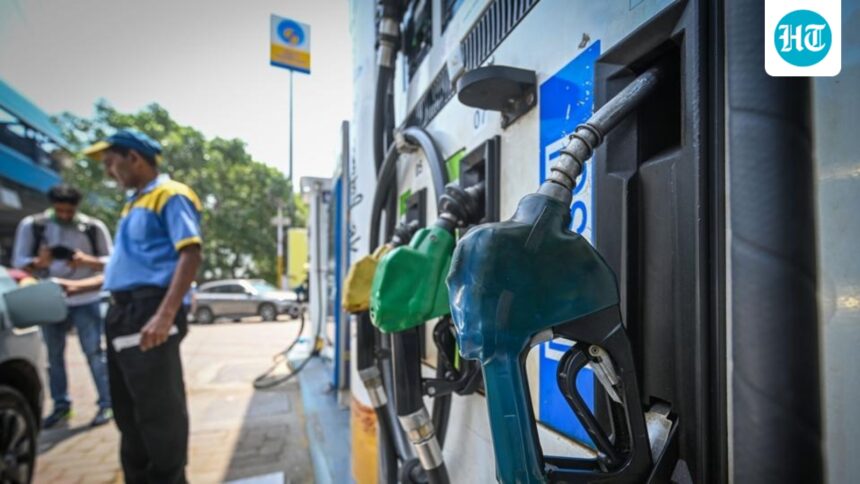
The Supreme Court on Tuesday ordered status quo in a matter related to increased allocation of ethanol supplies to oil marketing companies by the Karnataka High Court.

A district court of Justices M M Sundresh and Shil Najo, while hearing the petition filed by Bharat Petroleum Corporation Limited (BPCL), ordered status quo in the matter. The oil marketing company had objected to the earlier order directing it to increase ethanol allocations for 2025-26.
BPCL, represented by Attorney General R Venkataramani, said the Supreme Court order could destabilize the national policy of blending 20 per cent ethanol and petrol, news agency PTI reported.
India is certainly following an ethanol blending programme, where 20 per cent ethanol is blended with petrol, popularly known as E20 fuel.
What did the government side say to the Supreme Court?
Attorney General R Venkataramani, representing the government, told the Supreme Court that the ethanol blending program is an ongoing experiment and that the impact of the policy will be more evident by next year, according to India Today.
Ethanol supply contracts were concluded in October 2025, Venkataramani said.
The ethanol allocation process came to an end on October 17, 2025, and allocations were sent to 378 suppliers for a total supply of 1,050 crore liters of ethanol, of which 680 crore liters had already been supplied by them by June 18, the chief legal officer said.
While Venkataramani talked about rolling out E-20 on a trial basis, there were no government records indicating a timeline. In return, the government proposed raising the ethanol blend to new limits.
The blending program has already become a controversial issue in the country, as people increase damage to old vehicles and reduce fuel efficiency.
Meanwhile, the government dismissed these concerns, saying there was no evidence linking blended gasoline to mechanical damage.
What did the Karnataka High Court order say?
The matter began when an ethanol manufacturer approached the Supreme Court to challenge a reduction in the allocation of ethanol supplies.
The distillery said the plant has a production capacity of 9.9 lakh litres, but only 3.92 lakh litres has been allocated in 2025-26, according to LiveLaw.
The oil marketing companies opposed this policy, saying that if the oil marketing companies took into account the petitioner’s petition, it would require a change in the government’s policy itself.
The Karnataka High Court sided with the distillery and directed Bharat Petroleum Corporation Ltd, Hindustan Petroleum Corporation Ltd and Indian Oil Corporation Ltd to consider enhancing ethanol allocation for 2025-26.
Is there a timeline for the government’s E-20 plan?
The government revised the National Biofuel Policy in 2022 and announced a gradual blending of ethanol into gasoline.
The goal was to increase the ethanol blend to 12.06 percent in 2022-2023, 14.6 percent in 2023-2024, and 17.98 percent in 2024-2025 through February 2025.
The government has already achieved the target of 20 per cent ethanol blending.
However, the official policy is that no decision has been taken on increasing ethanol blending to more than 20 per cent, but union ministers Nitin Gadkari and Hardeep Singh Puri have suggested that the ethanol content can be raised to 85 per cent.