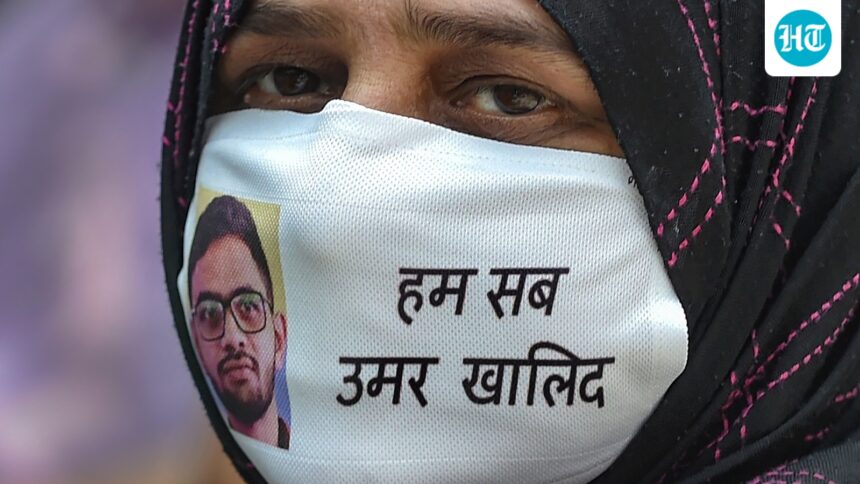
Student activist Omar Khalid said years in prison had stripped him of “humanity” and, at times, “reason”, while accusing the Narendra Modi-led NDA government of presiding over a society where hatred and misinformation have become normalized.

In his first interview since his imprisonment in 2020, he gave The Guardian Through family members and friends due to the restrictions imposed on his imprisonment, Khaled described the psychological impact of spending nearly six years in Delhi’s Tihar Jail without being tried.
“You even hear murmurs about yourself from fellow prisoners with whom you ate meals, calling you a terrorist behind your back,” Khaled said. “This propaganda dehumanizes me in people’s eyes.” The Guardian. “Humanity is a privilege that is not given to people like me.”
Speaking about his years behind bars, the 38-year-old said the public image built around him often overshadowed who he was as a person.
“When you are reduced to an image, whether negative or positive, it becomes difficult to maintain not only your humanity, but sometimes even your sanity,” he said.
Read also: Omar Khalid and Sharjeel Imam file fresh bail petitions in a Delhi court
“Even those who sympathize with you, or portray you as someone bigger than you, forget that I am a human being with my share of weaknesses, fears, and flaws. These long years in prison have wreaked havoc on my mind and body and exacerbated all of these fears within me.”
Khaled was arrested in September 2020 under anti-terrorism laws after being accused of being a “major conspirator” in the 2020 elections. Riots in Delhi and planning for “violent regime change”. Khaled has consistently denied these allegations. The Bharatiya Janata Party (BJP) has maintained that the judicial process in India is independent and that his trial has nothing to do with politics.
Khaled said The Guardian This imprisonment did not change his views on the political climate in the country.
He expressed his concern about what he described as “the normalization and glorification of hate speech and the language of genocide.”
“The process of India’s transformation into a post-truth society is nearing completion,” he said.
“I feel isolated”
The former Jawaharlal Nehru University student leader also criticized what he called the silence of political opponents and sections of civil society over the imprisonment of activists and opponents.
“Six years later, I have to say I feel really disappointed and even isolated,” he said. “The silence of opposition parties, civil society groups and celebrity activists who have made their careers dependent on grassroots movements encourages this regime to pursue more dissidents.”
Despite the years he spent in prison, Khaled said he refused to renounce his conviction. Recalling his message during the CAA protests in 2019, he reiterated the philosophy that guided his activism.
“We will not respond to violence with violence. We will not respond to hate with hate. If they spread hate, we will respond with love.”
Khaled’s new request for bail
Weeks ago, a Delhi court issued notice to Delhi Police on fresh bail applications filed by Omar Khalid seeking bail in the larger Delhi riots conspiracy case.
Additional Sessions Judge Sumedh Kumar Sethi of Karkardooma Courts listed the pleas for hearing on July 4.
Khalid, in his bail application, cited a change in circumstances, highlighting the May 18 judgment by a bench of Supreme Court Justices BV Nagaratna and Ujjal Bhuiyan while granting bail to Syed Iftikhar Andrabi, a resident of Jammu and Kashmir, in a narco-terrorism case being investigated by the National Investigation Agency (NIA).
The Supreme Court expressed “serious reservations” about the reasoning adopted earlier this year in the January 5 judgment, stating that it failed to properly apply the binding principles laid down by a larger three-judge bench in Union of India v. K. A. Najeeb (2021), which recognized that prolonged imprisonment and trial delays can override statutory restrictions on bail under Section 43D(5) of the UAPA. The court also objected to the trend that Khaled and Imam may not renew their bail petition until after the interrogation of protected witnesses or after one year, whichever comes first.