

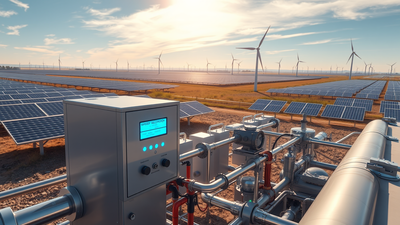
India has set up a pilot hydrogen production facility that uses heat from a nuclear reactor, rather than the traditional electricity grid, to generate clean hydrogen.The facility, set up by the Atomic Energy Department at the Indira Gandhi Atomic Research Center in Kalpakkam, Tamil Nadu, uses high-temperature heat from a fast breeder test reactor to split water into hydrogen and oxygen through an indigenously developed process, marking an important step in nuclear-assisted clean energy research.
What is the thermochemical cycle of copper and chlorine?
To understand the importance of this development, it is important to note how hydrogen is typically produced. The most widely used method today is steam methane reforming, which relies on natural gas and high heat to extract hydrogen from fossil fuels, resulting in what is known as gray hydrogen with significant carbon emissions.A cleaner alternative is electrolysis, which uses electricity to split water into hydrogen and oxygen.
When powered by renewable energy sources such as solar or wind, the process produces green hydrogen with no direct carbon emissions.However, scientists have also been developing a third pathway for decades, the thermochemical cycle of copper and chlorine (Cu-Cl). Developed locally by the Bhabha Atomic Research Center (BARC) in Mumbai, the process does not rely on electricity as a primary input. Instead, it uses high-temperature heat, such as that generated by a nuclear reactor, to drive a series of chemical reactions involving copper and chlorine compounds that are constantly recycled within the system.
Through this closed cycle, water is split into hydrogen and oxygen, while copper and chlorine compounds are reused. The process does not involve burning fossil fuels and does not produce any direct carbon dioxide emissions.
A faster and cleaner way to produce hydrogen
Scientists have particularly encouraged this development not only because it eliminates carbon emissions, but also because of the potential efficiency advantages. While electrolysis can also produce clean hydrogen when powered by renewable energy, it involves multiple energy conversion steps, each of which results in losses.In contrast, the Cu–Cl thermochemical cycle allows heat to be used directly to drive chemical reactions, bypassing the need to first convert heat into electricity. By eliminating this intermediate step, the process has the potential to extract more hydrogen from the same amount of energy input.The cycle operates at around 500°C, a relatively moderate temperature compared to other thermochemical methods that require much higher heat levels and are therefore more difficult to deploy on a large scale.
Fast breeder reactors, such as the Fast Breeder Test Reactor (FBTR) at Kalpakkam, are capable of providing heat in this temperature range, making this approach more technically feasible for real-world application.
Kalpakkam reactor key to demonstrating new hydrogen technology
The Fast Test Reactor (FBTR) at the Indira Gandhi Center for Atomic Research (IGCAR), Kalpakkam, has been a mainstay of India’s nuclear research program for decades. It is a sodium-cooled fast reactor and uses liquid sodium as a coolant instead of water, enabling it to operate at higher temperatures than conventional reactors.
This makes it particularly suitable for providing the process heat required for the copper-chlorine (Cu–Cl) cycle.The FBTR has also contributed significantly to the development of fuels, materials and related technologies under India’s three-phase nuclear power programme, which includes the 500 MW Modular Fast Breeder Reactor, currently undergoing advanced development at Kalpakkam, as a pioneering second phase.According to the Department of Atomic Energy, the newly opened hydrogen facility is a technology demonstration designed to validate the process under real operating conditions, generate performance data, and support further optimization before potential expansion. The project is the result of a joint effort between BARC and IGCAR, which involves years of research, engineering design, manufacturing and pre-commissioning testing.
What is “pink hydrogen” and what is its importance?
The hydrogen produced at the facility is often referred to as “pink hydrogen,” a term used for hydrogen generated using nuclear power as the primary source, with no direct carbon emissions. It is classified alongside green hydrogen, produced from renewable energy, and blue hydrogen, derived from natural gas with carbon capture, as one of the clean paths to hydrogen production.What sets pink hydrogen apart, and what the new Cu-Cl facility demonstrates, is the potential of nuclear power to provide a continuous, weather-independent source of clean hydrogen.
Unlike solar and wind energy, which are intermittent and dependent on weather conditions, nuclear reactors operate around the clock.As a result, the heat-based nuclear hydrogen system can produce hydrogen 24/7 without interruption, providing a stable and reliable supply. This consistency is especially important for industries that require continuous and widespread availability of hydrogen.
Feeding heavy industries with hydrogen
Industries that rely heavily on hydrogen today, including fertilizer production, oil refining, and steel manufacturing, are also among India’s largest sources of carbon emissions.
Fertilizer plants alone use large amounts of hydrogen to produce ammonia, and most of this hydrogen is currently derived from natural gas.If thermal-based nuclear hydrogen production could be scaled up at competitive costs, it could provide these sectors with a viable path to decarbonization without requiring major changes to their core industrial processes.Hydrogen is also being explored as a potential fuel for heavy transportation, including trucks, ships and possibly trains.
In these applications, hydrogen offers an advantage over batteries due to its higher energy density per kilogram, making it more suitable for long-distance operations and heavy loads where the weight of the battery becomes a constraint.A stable, low-carbon supply of hydrogen produced continuously using nuclear power could therefore play an important role in accelerating India’s broader decarbonisation efforts.
From energy to hydrogen: India’s nuclear vision grows
India’s nuclear power program has long been guided by a long-term vision that extends beyond electricity generation. The three-phase programme, designed by Dr Homi Bhabha, aims to eventually tap into the country’s abundant thorium reserves for fuel.Integrating hydrogen production into this framework expands the role of nuclear energy, moving it from mere power generation to clean fuel production. According to Ajit Kumar Mohanty, Minister of Atomic Energy, this development reflects India’s growing capabilities in advanced nuclear technologies and demonstrates that nuclear energy’s contribution to a sustainable future can extend beyond conventional reactor applications.