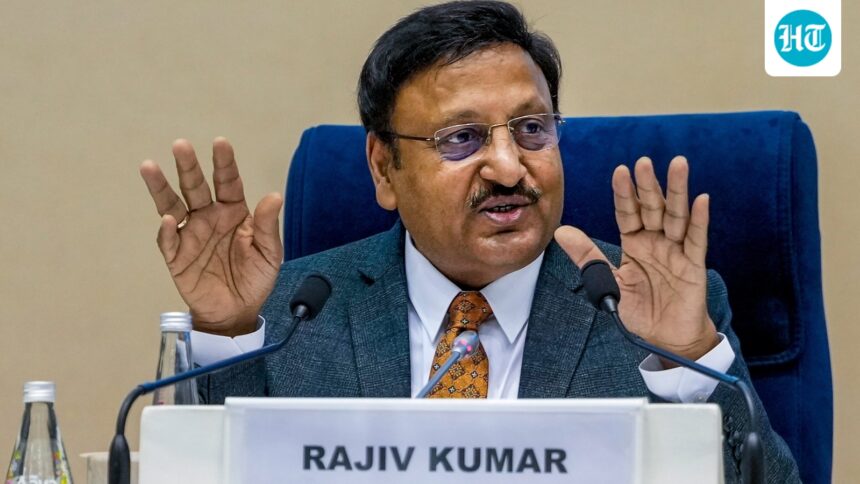
Rajeev Kumar, who was serving as Chief Election Commissioner of India, has been appointed by HDFC Bank as its new Chairman for a period of four years. Known for leading major banking reforms that strengthened India’s public sector banks, he later served as Chief Election Commissioner (CEC) who also oversaw the 2024 Lok Sabha polls, where the largest number of voters participated.

Rajeev Kumar has a finance background and also served as Secretary, Department of Financial Services from 2017 to 2020.
What is Rajeev Kumar’s new role at HDFC?
HDFC Bank has approved the appointment of Rajeev Kumar as an Independent Director of the bank for a period of 4 years, effective today, June 30, 2026. He will also become a part-time Chairman for a period of 3 years after the RBI approves the appointment.
The bank said in a statement to the National Stock Exchange that the appointment as an independent director “is subject to the approval of the bank’s shareholders.”
Rajeev Kumar will replace Atanu Chakraborty, who resigned suddenly over ethical concerns in March. “Certain events and practices within the bank, which I have observed over the past two years, are not consistent with my personal values and ethics,” the former bureaucrat said while stepping down from his position.
Who is Rajeev Kumar?
Before being appointed as the new Chairman of HDFC. Rajeev Kumar held two key roles – Secretary of the Department of Financial Services (2017-2020), and the 25th Chief Election Commissioner of India before he was replaced by the incumbent CEC Gyanesh Kumar.
While holding the chief financial role until 2020, Rajeev Kumar helped strengthen public sector banks, which were suffering from several problems at that time.
“Through direction and decisive policy implementation, Mr. Kumar has led a comprehensive clean-up of public sector banks’ balance sheets by mandating transparent recognition and provision of NPAs and by enforcing accountability among borrowers under the Insolvency and Bankruptcy Code framework,” part of Kumar’s profile on HDFC Bank’s website reads.
The bank also credited Rajeev Kumar for cleaning up bad loans, implementing the ‘4R Strategy’ for recognition, resolution, recapitalization and reforms, working against illicit financial practices, and helping public sector banks return to sustainable profitability.
“Fraud checks, specialized monitoring above $250 lakh crore, IT-based risk scoring on 34+ factors replaced soft signals with loose controls, built into lending by large consortiums often comprising more than 25 banks. Suddenly, ambiguity had a cost. “A complete reset of the relationship between creditors and debtors with a loud and clear message that money must be lent wisely and debtors must repay,” she added.
HDFC also revealed that Kumar has no relation to any other directors or key management personnel of the bank PTI I mentioned.
Rajiv Kumar’s tenure in the CEC
By the end of Rajiv Kumar’s tenure as Chief Election Commissioner, the Opposition had often accused the Election Commission of favoring the BJP. However, in his remarks as the outgoing poll chief, Kumar said the Election Commission of India has been made a “scapegoat” by those “who are not ready to accept the election results”.
“The Commission, as an institution, often finds itself unfairly accused by those who are unwilling to accept election results,” said Rajiv Kumar. “Among the pressing concerns is the growing tendency to target election officials in the wake of electoral contests. It is seen as a convenient scapegoat.”
He also dismissed allegations of EVM rigging and manipulation of electoral lists as baseless, noting that “processes cannot be judged by results.”
(With inputs from PTI and ANI)