While the Aam Aadmi Party (AAP) is also intensifying its outreach to Hindu voters ahead of the 2027 Punjab Assembly elections scheduled to be held in about seven months, party president Arvind Kejriwal has announced a series of religious and cultural initiatives. These reforms include redevelopment of temples, expansion of pilgrimage routes, and Ramayana-themed programmes, even as the party engages in parallel controversies over Sikh religious institutions.

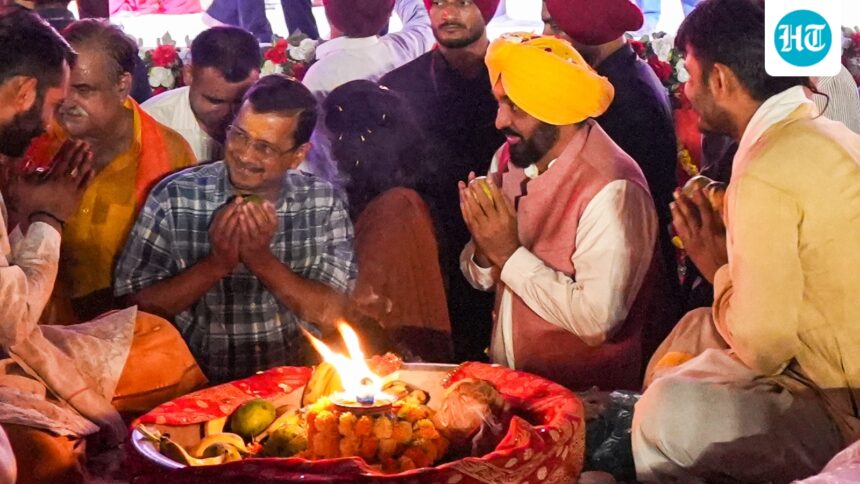
Kejriwal made the announcements during his three-day visit to Punjab while participating in the Punjab government’s ‘Ek Shaam Bhagwan Shiv Ke Naam’ (Religious Discourse on Lord Shiva) programs in Jalandhar, Amritasar, Gurdaspur and Batala.
He claimed that no previous government had organized devotional gatherings of this scale and announced that the program would now be expanded to all 22 districts of Punjab.
5 promises from Kejriwal
Of the five promises shared by AAP as separate short videos on its social media handles, the former Delhi chief minister announced $Redevelopment of Kali Mata temple in Patiala at a cost of Rs 80 crore, saying the project will be completed by September.
“I think it will become one of the biggest temples in north India,” he said.
Speaking in Amritsar, he said that the Bhagwant Man government is also planning to build a grand temple dedicated to Mata Janaki (Sita), Luv and Kush (sons of Lord Ram and Sita) next to the Bhagwan Valmiki temple at Ram Tirath in Amritsar. The place is traditionally associated with Valmiki – the sage who authored the Sanskrit epic Ramayana chronicling the life of Lord Ram – Sita, Luv and Kush.
“I returned from Ayodhya just yesterday after praying to Lord Ram at Ram Mandir. Today, I am extremely happy to make this announcement. This is not just good news for the people of Amritsar but also for my devotees Bhagwan Ram and Mata Janaki across the world,” the AAP chief said.
The other major announcement was the expansion of the Punjab government’s Mukh Mantri Tirath Yatra Yojana. The program is open to people of all faiths and covers pilgrimage destinations associated with multiple faiths, including Sikh shrines, Hindu temples and the Ajmer Sharif Dargah for Muslims.
Kejriwal announced three additional Hindu pilgrimage circuits – Salasar-Khatu Shyam in Rajasthan, Haridwar-Rishikesh in Uttarakhand, and Mathura-Vrindavan in Uttar Pradesh – which are expected to begin around August 1, with the government estimating that about 1.5 lakh pilgrims will travel on the new routes.
“Travel, food, accommodation, darshan – everything is free and paid for by the Punjab government,” Kejriwal stressed.
Kejriwal also announced that the Ramayana-based theater production ‘Humare Ram’, starring actor Ashutosh Rana, will be staged across Punjab from August 1. He said the cost of the ticket $8000 when he saw it in Delhi. “The play will be free for the people of Punjab. I urge everyone to watch it – it is an excellent production,” he said.
At a program in Gurdaspur, Kejriwal said the Bhagwant Mann government has done more for Sanatan Dharma than previous governments in Punjab.
Mann says hatred never takes root in Punjab
CM Bhagwant Mann used the Amritsar platform to emphasize communal harmony as well.
Describing Amritsar as a city that gives the world a message of humanity and brotherhood, he said Punjab is a land where “whatever seeds you sow grows, but the seeds of hatred never take root.”
He said that people in the state celebrate the martyrdom day of Ram Navami, Gurpurabs, Hanuman Jayanti, Guru Ravidas Jayanti, martyrdom day of Guru Tegh Bahadur and Eid together.
The number of Sikhs in Punjab is about 58%, and Hindus 38%, and its population is smaller than Christians and Muslims.
Part of the pattern
This outreach comes in the wake of a broader campaign by Kejriwal towards sections of Hindu voters in Punjab in recent weeks.
Earlier this month, he accused the Enforcement Directorate of the BJP-led Center government of harassing “Hindu traders” in Punjab through raids. The merchant community of Punjab is largely urban and Hindu. Opposition parties criticized these statements, claiming that he was trying to give an economic issue a sectarian color.
This awareness also coincided with Kejriwal’s campaign on the alleged misappropriation of donations at the Ram temple in Ayodhya, where he demanded action against those responsible and directly attacked the governments of Prime Minister Narendra Modi and Yogi Adityanath.
Punjab politics in recent years have centered on agricultural issues, regional identity and Sikh institutions, but the state’s electoral arithmetic also gives significant weight to Hindu voters, who play an influential role in many urban and semi-urban constituencies, including the Abohar-Fazilka belt, and parts of Amritsar, Jalandhar, and Ludhiana; In addition to Pathankot, Batala and Hoshiarpur; Besides, Patiala and Mohali are closest to the state capital, Chandigarh.
Why timing is crucial
With the BJP seeking to consolidate its voter base after its split from its ally Shiromani Akali Dal, and the Congress seeking to focus on urban voting as well, the AAP’s expansion is unfolding against an increasingly competitive political backdrop ahead of the 2027 Assembly elections, which is expected to be at least a four-cornered contest.
The AAP regime is already facing pressure over its anti-desecration legislation of Sikh scriptures, for which the Akal Takht has summoned all Sikh MLAs who supported the law that was passed unanimously earlier this year. The Sikh Interim Authority has no objections to harsh penalties such as life imprisonment, but noted that the law “interferes” with religious beliefs and authority. On Monday, the Takht leadership, including the Jathedar, Giani Kuldeep Singh Gargaj, held a hearing with all Sikh MLAs and gave them one month to amend the law.
This controversy has been accompanied by controversy over a video allegedly showing CM Bhagwant Mann in a manner seen as hurtful to Sikh sentiments, a charge Mann denied saying the person in the clip was wearing a mask impersonating him.