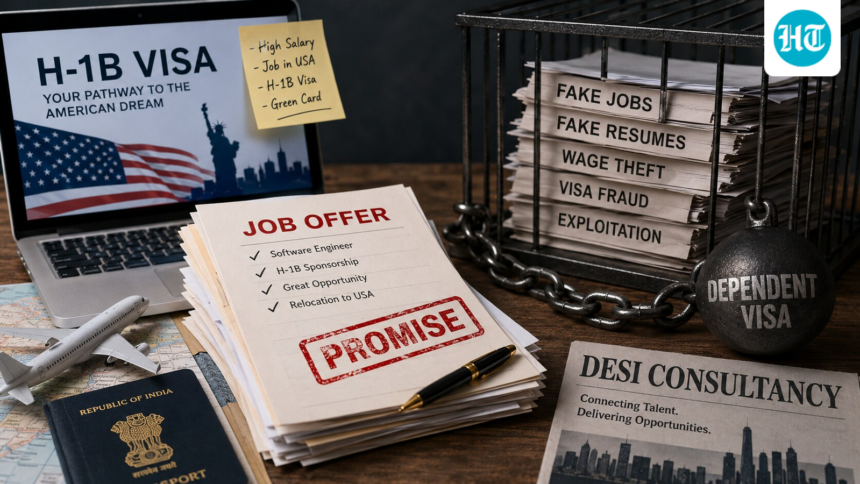
For thousands of Indian students and graduates, the H-1B visa represents a ticket to the American dream — a stable job in tech, a six-figure salary, and ultimately, permanent residency in the United States.

But according to a new book by journalist and film critic Tanul Thakur, that dream often turns into a nightmare involving fake jobs, fake CVs, unpaid wages and threats of deportation.
In his book “The Wild East: Exiled Americans, Enslaved Indians, and the Systematic Abuse of the H-1B Visa Program,” Thakur highlights the world of so-called “specialized consulting firms”—small recruitment firms, often run by South Asians, that operate on the margins of America’s tech labor market.
Unlike large Indian IT companies like TCS or Cognizant, many of these companies do not build their own technology products or services. Their business model revolves around providing workers to large corporations, universities, or Fortune 500 companies through layers of recruiters, subcontractors, and staffing vendors.
The model itself is legal and widely used in various industries. However, critics say some consulting firms are exploiting loopholes in the H-1B system and preying on vulnerable workers desperate to get a foothold in the United States.
Read also: Immigration Lawyer reveals the reasons why Indian H-1B green card holders are drawn towards the UK
The promise: a job, an H-1B, and a green card
According to Thakur, many Indian graduates in the US or aspiring immigrants in India are approached with offers that sound too good to be true.
A recruiter promises an IT job, H-1B sponsorship, a comfortable salary, and sometimes even a path to a green card — often within minutes of speaking to the candidate and without evaluating technical skills or experience.
The problem, workers allegedly later discovered, was that the promised job either did not exist or was contingent on the consulting firm finding a client willing to hire them.
“Many workers arrive in the United States only to realize that they have actually been smuggled out of India with false promises of employment,” Thakur said.
Read also: US envoy Sergio Gore has issued a key clarification on Indians amid Trump’s visa rules
Fake resumes and proxy interviews
One of the more controversial practices described in the book is the alleged use of inflated resumes and proxy interviews.
Recent graduates or professionals from unrelated disciplines are reportedly asked to claim that they possess seven or eight years of experience in specialized technologies in order to make them employable in the competitive US market.
Some workers are allegedly trained for a few weeks before being sent to interviews where someone else may answer technical questions for them.
Once assigned to a client company, they often rely on “on-the-job support” from remote experts who help them perform tasks they were never trained to do.
Crowded apartments and unpaid wages
Exploitation, according to the book, does not end once the workers arrive in America.
Thakur describes instances where multiple workers are housed together in cramped apartments while waiting for projects. Payroll may be delayed for months, reduced without warning or withheld entirely during periods when workers are “on the bench” and not assigned to clients.
Because their legal status in the United States depends on an employer-sponsored visa, many workers feel unable to file a complaint or change jobs.
The fear of losing legal status, deportation or blacklisting often keeps them silent.
Why do workers remain trapped?
Unlike many work visas globally, the H-1B visa is tied to the sponsoring employer, not the worker.
This creates a power imbalance where employees become dependent on the company that controls their immigration status.
“The combination of cheap labor and unfree labor is what makes the system attractive to bad actors,” Thakur says in the book.
Workers who leave their employer risk losing their immigration status unless they quickly find another sponsor.
Connectivity of Andhra Pradesh and Telangana
The book argues that the states of Andhra Pradesh and Telangana emerged as centers of the consulting ecosystem due to long-standing migration links with the US technology sector and the rapid expansion of engineering schools during the IT boom of the 1990s and early 2000s.
However, Thakur emphasizes that visa fraud is not limited to one country or community, and that individuals from all over South Asia participate in the ecosystem.
Calls for reform
The author proposes several reforms, including stricter wage requirements, increased scrutiny of hiring companies and making visas transferable so workers can change employers without jeopardizing their legal status.
It also calls for stronger enforcement against companies that violate labor laws or engage in visa fraud.
The debate over H-1B visas has long centered on whether the program helps America attract global talent or suppresses wages through cheap labor. Thakur’s book adds another dimension to this discussion: the hidden human cost borne by many workers seeking to achieve the American dream.