

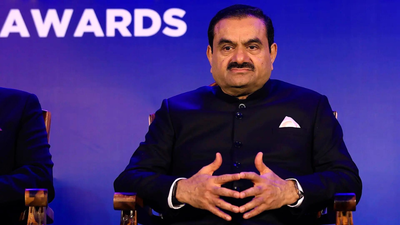
US attorney in Adani case says New York judge’s procedural inquiry is unlikely to derail Justice Department bid to drop charges (Image source: AP)
NEW YORK: A US federal judge’s decision to require a fuller explanation from prosecutors before agreeing to drop criminal charges against billionaire Gautam Adani is a procedural requirement and does not indicate the case is likely to proceed, according to a senior US lawyer familiar with federal criminal practices.“The judge’s order is procedural,” attorney Chris Mann said.Under Rule 48(a), the Justice Department must obtain permission from the court to dismiss the indictment, and judges can ask questions or request additional briefing before ruling. “This in itself is not unusual,” he added.The lawyer added that there is little precedent for a federal court forcing prosecutors to continue pursuing a criminal case once the Justice Department decides it should be dismissed.He said judges “have very little discretion.” “There is actually no modern precedent for a judge forcing the Department of Justice to prosecute a case that the executive branch has decided should be abandoned,” he said.Conducting criminal prosecutions is constitutionally an executive function, and courts have historically given great deference to prosecutorial charging and dismissal decisions.
These comments came after the judge overseeing the Adani case ordered the Ministry of Justice to provide a more detailed explanation for its request to dismiss the indictment.Brooklyn-based U.S. District Judge Nicholas Garaufis said that federal prosecutors’ May 18 announcement that they would no longer pursue the case, which charged Adani with securities fraud and wire fraud stemming from an alleged bribery scheme, did not adequately explain their decision.Mann said the judge’s request should not be interpreted as a signal that segregation is in jeopardy.In the Adani case, the Justice Department filed a summary argument seeking to dismiss the indictment against Adani and others, he said, adding that the judge gave the Justice Department time until July 13 to provide a detailed explanation.“The Department of Justice is likely to do so before this deadline, and in my opinion, this case is more likely to be dismissed within weeks rather than months.
“A judge can do that even without a hearing.”The court prepares a record to ensure that the request is made in good faith and complies with Rule 48(a). Searching for additional information is part of this process.Judge Garaufis’s recent order is a normal part of the court’s performance of its obligations under federal criminal rules to consider the prosecutor’s motion to dismiss the indictment.In his latest letter to the court, Adani cited the many fatal weaknesses in the government’s case. These weaknesses were addressed in several presentations to the government by attorneys that led to the Department of Justice’s motion to dismiss.The lawyer pointed to the recent corruption case involving New York City Mayor Eric Adams as an example. In that case, the Justice Department requested the indictment be dismissed, prompting the presiding judge to request additional clarification and hold hearings before ultimately granting the government’s request.
The court did not force the plaintiffs to continue the case despite examining the reasons for dismissal in great detail.Legal experts say the Adams case highlights that while judges may scrutinize government justifications for protections from abuse, the judiciary’s power to override an executive branch’s decision to abandon prosecution remains severely limited.According to Adani’s June 24, 2026 letter to the court, the case was beyond the reach of US law.
Transactions were conducted only by non-US resident issuers and lenders. All offering documents were drafted, reviewed and approved outside the United States, and the bond offering was governed by English law – placing the issue outside the scope of US securities law under the Supreme Court’s ruling in Morrison v. Morrison.
patriotic.The bribery allegations could not be substantiated: expert evidence from a former senior regulatory official established that the alleged illegal payments coincided with documented, legal and transparent price reductions that Adani Green offered to state energy companies to incentivize them to sign solar contracts – normal commercial concessions, not bribes.The Ministry of Justice’s decision came after a comprehensive and comprehensive review. Adani submitted to the Department of Justice nearly 500 pages of facts, law, expert testimony, and arguments between February and April 2026, including a 118-page letter accompanied by expert reports from a securities law professor at Harvard Law School, and a former SEC commissioner, among others.They also noted that no investor lost any money. The indictment does not allege any investor losses resulting from any of the four transactions. The Notes have matured in 2021 with all interest paid; The 2024 Notes did not default on any payments; The 2021 loan has been repaid in full; The 2023 loan is not in default.