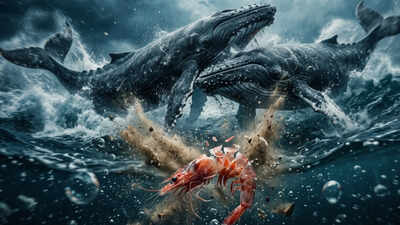
When whales fight, the shrimp’s back breaks.
“When whales fight, the shrimp’s back breaks.”It only takes eight words to describe the reality that has shaped history, politics, the workplace, and even family life.Korean proverb This is what you are looking for (Gorae ssaume saeu deung teojinda) Paints an unforgettable picture: Two massive whales engage in battle, while a tiny shrimp – helpless and uninvolved – ends up getting injured simply for being nearby.Like many proverbs, it says much more than its literal meaning. It is a reminder that conflicts between the powerful rarely remain confined to the powerful. More often than not, the people who pay the highest price are those who have the least influence.Centuries after its entry into Korean discourse, this proverb remains remarkably relevant.
A simple image with a powerful meaning
The proverb is translated literally:“When whales fight, the shrimp’s back breaks.”In Korean, the proverb refers to situations in which… Powerful or influential people fight, while weaker and unrelated people suffer the consequences. It is commonly used when ordinary people become collateral damage in conflicts beyond their control.The contrast between the huge whale and the tiny shrimp is intentional. One represents overwhelming power. The other symbolizes weakness. The shrimp does not participate in the battle, as it simply cannot escape its effects.
This visual simplicity is one of the reasons this proverb has endured for generations.
A proverb rooted in Korean tradition
Unlike many famous sayings that can be traced back to a single philosopher or historical figure, this proverb belongs to a long oral tradition in Korea.Its exact origin is not known, but scientists have documented it for centuries. during Joseon Dynasty (1392–1897)author Hong Man Jung (홍만종) He included the proverb in his works in the seventeenth century Sonogy (旬五志), translated into Classical Chinese as Thank you very much (“When whales fight, shrimp die.”) The existence of this written version indicates that this saying was already well established in everyday speech before it appeared in literature.This is common in Korean proverbs. Many of them originated in casual conversation between farmers, fishermen, merchants, and villagers long before they were written down.
More than politics
This proverb is often associated with international relations because it accurately describes what happens when powerful countries compete.For centuries, the Korean Peninsula has existed among the larger regional powers. As a result, Korean commentators have often cited this proverb to describe moments when conflicts between more powerful countries have put Korea in a difficult situation.
Modern newspaper editorials continue to use it when discussing diplomacy and geopolitics.However, limiting the proverb to politics misses its broader wisdom.It naturally applies to everyday life.Imagine two senior executives fighting over company strategy while employees face layoffs. Think about children caught in the middle of a bitter divorce. Or consider competing companies fighting legal battles that leave suppliers, customers, or small businesses struggling.In any case, the “shrimp” is the one who never asked to be part of the conflict.
Why does the proverb remain?
Many cultures have sayings about the suffering of the weak because of the strong. What makes this Korean proverb so memorable is its vivid imagery.Instead of explaining injustice in abstract terms, he creates a scene that anyone can imagine.You don’t need to understand Korean history to imagine the size difference between a whale and a shrimp. The imbalance is clear.
This is the result.This economy of language is one of the reasons why proverbs have survived through generations. A single image often communicates more effectively than a lengthy explanation.
The philosophy behind this saying
At first glance, the proverb seems pessimistic.But its deeper goal is caution, not despair.He reminds listeners that power has consequences that extend far beyond those who possess it. Decisions made by leaders, governments, CEOs, or even parents reflect outward, affecting people who have little say in the matter.The proverb also encourages empathy.When observing conflict, it asks us to look beyond the obvious winners and losers and notice those who bear the hidden costs. In modern discussions, this idea is often described as “collateral damage,” but the Korean proverb expresses this concept through a memorable image.
It is still relevant in today’s world
Although centuries old, this proverb sounds remarkably contemporary.Economic disputes between large companies can affect thousands of workers.
Trade wars can raise prices for ordinary consumers. Political polarization may divide societies. Even arguments that start on social media can spill over into workplaces, schools, and families.The whales may have changed, but the shrimp remained.This continuing importance explains why Korean speakers continue to use this expression in news reports, daily conversations, and commentary. It is concise, expressive and immediately understandable.
A lesson that goes beyond language
Every culture develops sayings that embody universal experiences.Korean proverb This is what you are looking for It is one of those rare expressions whose images easily travel across borders.It teaches us that power is rarely isolated, that conflict is rarely confined, and that the smallest voices are often the first to feel the impact of decisions made by the biggest players.Perhaps this is why the proverb has survived for hundreds of years.And it’s not just about whales or shrimp.The film is about the enduring truth that when giants collide, a small person is most likely to bear the weight of the storm.