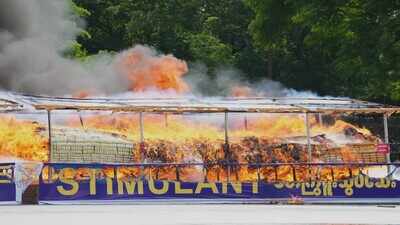
Smoke and flames rise from burning illicit drugs during a demolition ceremony marking the United Nations International Day against Drug Abuse and Illicit Trafficking, on the outskirts of Yangon, Myanmar, Friday, June 26, 2026.
Authorities in Myanmar burned more than 50 tons of confiscated drugs on Friday in a nationwide demolition operation, sending thick black smoke billowing over the outskirts of Yangon. The value of the seizures, which included heroin, opium, ketamine, methamphetamine, crystal meth and marijuana, was about $600 million, according to the Associated Press.The demolition ceremony was held in Yangon to mark the United Nations International Day against Drug Abuse and Illicit Trafficking, with similar events being held in Mandalay and Taunggyi, the capital of Shan State – an area that has long been the center of Myanmar’s drug production networks.Police Lt. Colonel Aung Myat Swe of Yangon’s anti-narcotics police force told reporters that the value of drugs destroyed this year was more than double last year’s figure.
In Yangon alone, authorities burned about $321 million worth of 31 different types of illicit drugs, the Associated Press reported.Myanmar, also known as Burma, has been one of the world’s largest producers of heroin and methamphetamine for decades. Much of the production is linked to instability in border regions, where armed groups, militias and criminal networks operate amid protracted conflict and weak state control.
The country’s drug trade is largely centered around the Golden Triangle, a mountainous region where Myanmar meets Laos and Thailand that has historically been a major center for the production of opium and synthetic drugs.The situation has become more complex since the military seized power in 2021, sparking a nationwide conflict between the military government, pro-democracy forces and armed ethnic organizations.
Experts say that the unrest contributed to creating conditions that allow the expansion of drug production and trafficking. In January, Myanmar’s military government announced what it described as the country’s largest-ever seizure of illicit drugs and drug-making equipment.
Authorities said the raids targeted 12 suspected production sites in northern Shan State, an area where several armed groups are active.Myanmar authorities have repeatedly accused ethnic armed groups of using drug profits to finance their activities.
The government said some groups are avoiding peace negotiations because they benefit from the illegal drug economy. Several armed organizations have been linked to drug trafficking at various points, although involvement varies between groups. Some also carried out their own anti-drug operations in the areas they control.The Tang National Liberation Army, an ethnic armed group active in northern Shan State, announced a separate destruction of seized drugs worth approximately US$5.5 million in areas under its control.
This move came after the group agreed to a ceasefire with the army in October after months of fighting.Despite repeated crackdowns, Myanmar remains a major source of illicit drugs flowing into East and Southeast Asian markets. Authorities say the latest destruction is part of efforts to show progress in the fight against drug trafficking, although analysts have warned that wider conflict and political instability remain major challenges to cutting production.