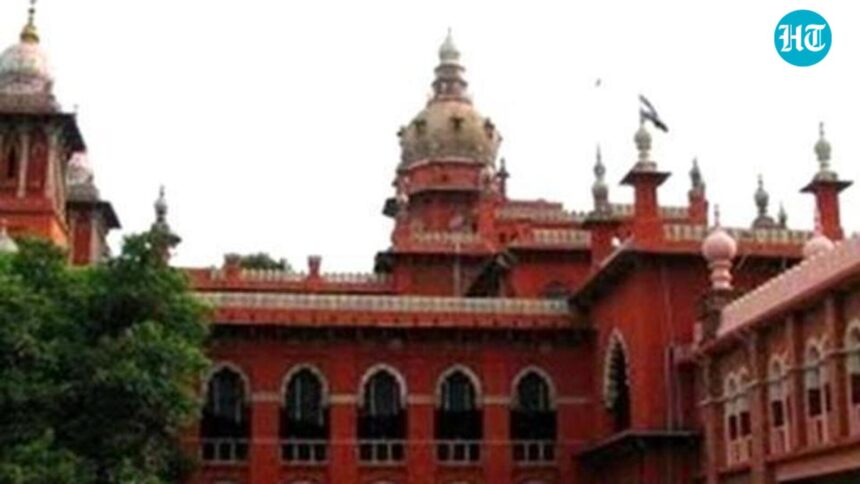
The Madras High Court has set aside an order passed by the Tamil Nadu government allowing people from Backward Classes (BC), Most Backward Classes (MBC), Scheduled Communities (DNC), and Scheduled Castes (SC) who have converted to Islam to continue availing reservation benefits under the Backward Muslim (BCM) category, deeming the order unconstitutional.

In an order issued on Thursday, a division bench of Justices GR Swaminathan and BP Balaji ruled that the Dravida Munnetra Kazhagam (DMK) government’s March 9, 2024, government order cannot override settled case law. The court held that a person who converts to Islam becomes a “mere Muslim” and cannot claim membership in any of the seven notified backward Muslim communities in the state.
“We are of the view that a convert to Islam cannot claim to be a backward class Muslim. He is just a Muslim and that is all there is to it,” the bench said.
The seven communities recognized as backward class Muslims in Tamil Nadu are Ansar, Deccani Muslims, Dubekula, Lapis (including Rother and Marakayar), Mappila, Sheikh and Syed Muslims. These communities were grouped under a separate BCM category through a government order issued in July 2008, and are reflected in the Tamil Nadu Backward Castes, Scheduled Castes and Scheduled Tribes Act.
The 2024 government order had directed that people belonging to the BC, MBC, DNC and SC communities who have converted to Islam will continue to receive reservation benefits by being treated as BCMs. It also allowed the issuance of community certificates identifying such converts as belonging to any of the seven notified BCM communities, making them eligible for reservation under this category.
However, the Supreme Court held that the state’s assumption that a convert could issue a certificate showing membership of one of those communities to an Islamic convert was “legally and conceptually unsustainable”.
The bench referred to a 1951 Madras High Court judgment which held that when a Hindu converts to Islam, the person becomes a Muslim and not a member of any specific Muslim community like Labai, Rother, Marakayar or Syed.
The court said that such societies were based on birth and could not be acquired by conversion.
“As the Madras High Court bench held more than 75 years ago, upon conversion to Islam, a person becomes a Muslim. The bench used the expression ‘mere Muslim’. He cannot be classified into any particular caste or community and that can only be done by virtue of his being born into it,” the court observed.
The case arose out of a petition filed by Sameer Ahmed, who was born into a Hindu family, converted to Islam in 2015 and later sought a community certificate identifying him as a Labai Muslim.
His application was rejected by the local Tahsildar in 2022 on the grounds that he was a convert to a religion and not to a caste or community. And then he approached the HC. While his petition was pending, the state issued the 2024 state order.
The court noted that Ahmed’s petition had no legal basis when it was submitted and did not gain importance until after the government order was issued. Instead of granting relief, the bench examined the validity of the order and eventually set it aside.
The Supreme Court also held that the executive cannot overturn or circumvent binding judicial rulings through executive order.
“Islam seeks to establish an egalitarian society. Everyone is equal in the eyes of God. There is no social hierarchy. Be that as it may, for historical reasons, Islamic society is also divided into different communities. One may boldly observe that they are akin to caste in Hinduism. Just as caste is determined by birth, one is a Rother or Markiyar or Deccani Muslim by birth alone. It is ridiculous to suggest that one can be converted into a religious community.” The court said: “Rutter is a Muslim.”
The Supreme Court considered the government’s order to be contrary to established law, declared it unconstitutional and rejected Ahmed’s petition.