

A prehistoric hilltop enclosure in southern Spain has presented archaeologists with two very different moments in history occupying the same place. What first appeared to be the remains of an ancient fortified settlement dating back some five thousand years, soon revealed something far less unexpected beneath its stonework.
Buried inside the abandoned complex was the skeleton of a man from the Roman era, who was separated from the original builders of the castle by nearly 2,500 years, according to UNN. This discovery has raised a new set of questions, not because the burial itself is unusual, but because of the place where it occurred. Sites that were abandoned thousands of years ago are sometimes reused by later societies, yet each such case carries its own story.
The Spanish excavations offer a rare opportunity to study how a single site served very different purposes across distant chapters of European history.
inside 5000 year old castle In Spain it was built during the Copper Age
The remains were uncovered during archaeological investigations conducted prior to construction work associated with the solar energy project. Located on high ground near Almendralejo in the Extremadura region, the site has escaped attention despite its size.
Once the excavations expanded, the outlines of the carefully planned enclosure began to emerge. Dating suggests that the castle was built around 3000 BC, during the Copper Age, when societies across Europe began adopting metal alongside ancient stone tools. Rather than just a simple defensive wall, the structure appears to have been designed with great thought, reflecting organized construction on a large scale.The fortification reportedly extends across approximately 77 meters and follows a deliberate geometric arrangement. Round, fort-like protrusions stand at each corner, allowing anyone defending the enclosure to observe the approach from several directions.Within the outer walls are smaller protected sections arranged around a central open space. Defensive ditches added another layer of security, suggesting that the settlement was intended to resist threats rather than simply mark off territory.
Universal design refers to a society capable of coordinated planning, work organization, and engineering knowledge that is often associated with later periods.
Throughout the Iberian Peninsula, prehistoric fortified settlements have been documented for decades, yet the site of Extremadura remains distinctive due to its size and the complexity of its construction.
A Roman-era burial ground is hidden inside the 5,000-year-old castle
The most puzzling discovery appeared near the middle of the abandoned enclosure.
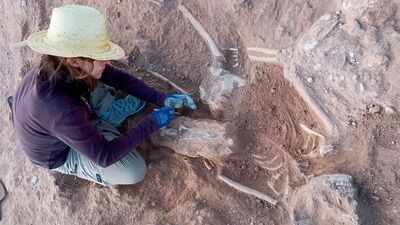
Archaeologists have discovered the remains of an adult man who was buried thousands of years after the castle ceased to function.The examination indicates that the individual was most likely between 25 and 35 years old at the time of his death. Next to it was a short dagger associated with Roman military equipment, placing the burial within the Roman period rather than the prehistoric occupation of the site. The time gap is striking.
By the time this man was buried, the castle had been abandoned for about two and a half thousand years.
Why was a Roman soldier buried there?
The man’s identity remains uncertain. Although the weapon suggests a connection to the Roman army, it does not answer whether he served as a member of the legion, traveled with the auxiliaries or simply carried military equipment.No obvious skeletal injuries indicating a violent death were identified.
Current thinking leaves open the possibility that illness or natural causes could have ended his life. If so, the abandoned enclosure at the top of the hill may have simply provided a suitable burial place during a journey through the area.Roman societies are known to reuse ancient ruins for a variety of purposes, including burial. Ancient structures often remained visible in the landscape long after their original function had faded from memory, making them familiar landmarks for later generations.
Forensic work may reveal more of his story
Specialists continue to analyze human remains in hopes of learning where the man came from, how healthy he was during his life, and whether his diet reflected military service or civilian life.Scientific tests can also determine whether he spent his early years in another part of the Roman Empire before arriving in Hispania. Such evidence may help explain why his final resting place ended up inside a castle built about 3,000 years before his life.