India called for those who target schools and children with impunity to be held accountable, stressing that protecting children without accountability is incomplete.

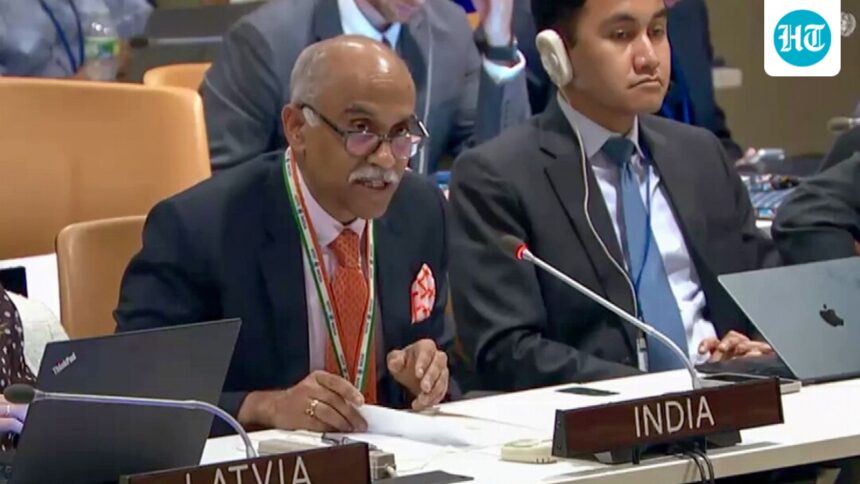
India’s Permanent Representative to the United Nations, Ambassador Harish Parvathanini, said, “Education is a right that must continue in times of conflict. It is a right whose realization is among the most powerful contributions to lasting peace. India remains steadfast in its commitment to protecting children in armed conflict and supporting their right to learn, grow and achieve their full potential.”
He was addressing the UN Security Council open debate on “Strengthening prevention and protection of education for children affected by armed conflict: from normative obligations to effective implementation” here on Wednesday.
“Protection without accountability is incomplete. Those who target schools and children with impunity must be held accountable,” Parvathanini stressed.
The UN Secretary-General’s latest report on “Children and Armed Conflict” said that in 2025, violations against children in armed conflict will reach “shocking levels”, with an unprecedented number of children affected.
The United Nations verified 38,558 grave violations, affecting 24,174 children in 2025 (15,493 boys, 7,990 girls, and 691 of unknown gender), which is the highest number of children affected by grave violations since the beginning of the mandate.
The number of children exposed to multiple grave violations continued to rise from 3,137 in 2024 to 3,176 in 2025.
“Parties to the conflict failed to fulfill or proactively undermine their obligations under international humanitarian law and international human rights law, and continued to commit grave violations with almost complete impunity, resulting in excessive humanitarian consequences for civilians and civilian objects, disproportionately affecting children and the facilities and services on which they depend,” the report said, adding that government forces were responsible for the majority of grave violations and were the primary perpetrators of killing and maiming children, attacks on schools and hospitals, and preventing aid access. Humanity.
India noted that the Secretary-General’s 2025 annual report on children and armed conflict provides “alarming statistics” – attacks on schools have risen by a staggering 44 per cent in one year.
Nearly 473 million children – more than one in six globally – are living in or fleeing conflict areas, and more than 85 million of them have no access to education at all, Parvathanini said.
He added, “These numbers are a damning verdict on humanity’s collective failure to translate commitments into reality on the ground.”
Emphasizing that protecting children’s education is protecting the nation’s future, Parvathanini said that governments bear the primary responsibility for fulfilling their obligations to protect and promote children’s rights.
He noted that the right to education in India is a fundamental right enshrined in the Constitution, which guarantees free and compulsory education up to the age of 14 years. In order to ensure access to quality education for all, India launched DIKSHA (Digital Infrastructure for Knowledge Exchange) – the national digital platform for school education that has democratized access to quality learning through interactive content and AI-powered tools across multiple languages.
“Our domestic commitment to ensuring access to quality and affordable education also shapes our engagement on this issue at the international level,” he said, adding that India has leveraged digital technology as a vital enabler of access to education, especially in regions and during times when physical education is disrupted such as during the Covid pandemic.
“Our experience has convinced us that access to digital learning can be the bridge that helps children access education during conflicts,” he said.
Furthermore, he emphasized that investing in education for those who bear the brunt of war is imperative.
“India has made sustained investments in facilitating education for refugees and displaced communities from across our region, recognizing that continuity of learning is among the most powerful tools to enhance resilience and recovery.”
He said India has also invested in rebuilding education infrastructure, including building schools and vocational training centres, in various countries including our neighbourhood.