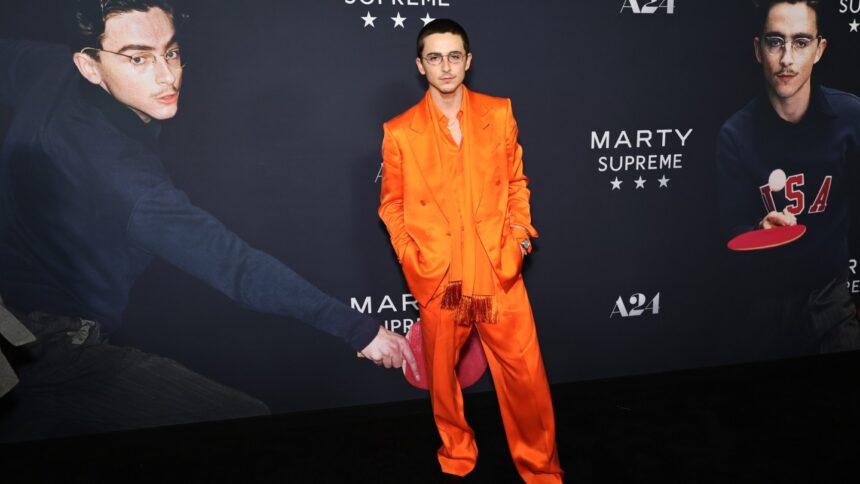
Cool is a slippery thing. One minute you have it, the next minute it’s out of your hands like a water balloon.
For the older generation, Marty Scorsese embodied cool. This wasn’t the case for a while – I would say sometime after that The Wolf of Wall Street And before the third period of drama in a row. When he closed a deal a few weeks ago with an AI startup and got excited about how it would be used in a comic, it only reminded him of the coolness he no longer had, even as he tried to use his well-earned legendary credibility to boost the company.
For the younger generation, A24 was cool for a while. That may still be the case, but the somewhat surprising Google DeepMind partnership it announced on Monday has undoubtedly cost it some — you don’t take $75 million from the world’s largest tech company in the name of wacky gadgets and maintain your counterculture credibility for long. That became clear just a day later, when the company’s trailer for Jesse Eisenberg’s completely unrelated (non-AI) film about community theater brought a pile of roasting about the technology. (“Why would I pay and support a company that doesn’t support or believe in the power of human creativity?” and “a24 was so great that it was sold to AI monoliths for a few monopoly dollars” are among the nicest ones). I suspect A24 will eventually recapture some of that cool, but let’s hold off on that for a second.
What can be easy to forget in all this is that technology itself It used to be great, and was probably the core of the model — when it was just starting out You see This appeared when Steve Jobs made a cinematic entrance at the Apple WWDC conference to talk about the iPod and iPhone, and when he appeared for the second time… You see This appears again in all the stories of the early founders in their garages and the popular cultural works that starred them. The age of technology over these decades has combined two of the things Americans love most – a good introductory story with playable games, and who can’t embrace that?
The technology was still cool in late 2022 when OpenAI released ChatGPT and everyone giddily started rewriting Taylor Swift’s lyrics into Shakespearean sonnets.
But from that moment the whole atmosphere subsided. We live in a post-hardware age where technology is defined not by the machines we use but by the specter that lives in them, and we increasingly look at it and realize it’s not Casper. The invisible threat has come to take our jobs and our lives, and in some cases I believe we already are Underestimation Although we overestimate the risks in other ways, this fundamental shift in the world of technology – from something fun to hold in our hands to something intangible that billionaires will use to control us – has been at the heart of the tide. (New book this summer from Financial Times Journalist Sarah O’Connor intelligently examines these angles.)
OpenAI, which had that final moment of tech extravaganza, is now the primary driver of its own loss. Transforming your non-profit into a money-making enterprise will do just that; So do your leader’s series of platitudes about the future. To pundits, this downfall became apparent about a year later on the day of ChatGPT’s release when aforementioned leader Sam Altman dismissed a coup of safety-concerned executives and board members with some backstabbing and throwing a whole group of well-meaning, security-minded players out the door (including the wife of Joseph Gordon-Levitt, who incidentally kept his cool).
For more casual followers, the cold one escaped a year later, when Altman, Jeff Bezos, Tim Cook, Mark Zuckerberg, and Sundar Pichai attended and donated to Donald Trump’s inauguration. At that moment, the water balloon not only slipped, but exploded and fell into the front row. (Elon Musk, which may actually be hard to remember He was He’s quietly back in Tesla’s early days, having missed it a lot earlier when he destroyed Twitter, but he made doubly sure that it would stay out of his entire DOGE adventure.)
Many of these AI entrepreneurs are allegedly bragging about them! -It will make us unemployed and also help in getting rid of the cold. Ironically, Apple, the most ubiquitous of the tech giants, has remained quiet even if it has barely come up with popular new products simply by staying out of the AI game. But then, Jon Stewart was also fired because he asked some questions about AI and China on his show, and you can’t fire Jon Stewart and keep calm. The past few years have also seen a growing awareness of the dangers of smartphones and social media, with the inevitable legislative responses sealing the deal.
(The last great tech company, Anthropic, is surviving because Dario Amodei stared down Pete Hegseth, synonymous with cool, and because Claude does so much better than ChatGPT. But how long will that last? Maybe not long. The cheers Claude receives at ChatGPT’s expense will fade as Claude becomes more dominant and people realize that the billion-dollar automation vendor can only square the circle in so many ways.)
There are advantages to being a technology company that wasn’t all that great in the first place. That’s why Amazon can rely on its hyper-capitalist image so completely – “Let’s make a friendly deal with Melania!” “Let’s drop a movie criticizing Sam Altman!” -And don’t miss a second of sleep.
This reversal in Altman price, which occurred a few days ago, was a missed opportunity. Amazon’s planned release of Luca Guadagnino’s film, which chronicles exactly what survived a 2023 boardroom coup, presented an opportunity for the Bezos-led company and even technology as a whole to regain a little calm. But the company decided to drop the film and the ball. Of course, when you want to sell your cloud technology to OpenAI — or just sell toothbrushes at scale — coolness is a secondary concern.
with industrial The decline and lack of subsequent recovery, including incidentally from A24, led to a realization (how much more do we need?) of the toxic effects of mixing Hollywood and Silicon Valley. Many of us have long understood that putting your country’s main creative engine inside a technology-dominated machine probably won’t produce good results at all in terms of creativity. (One personal mark came in 2020 when none of the streamers were able to catch Bryan Fogel’s excellent doc Maverick About the Saudi role in the killing of Jamal Khashoggi, for fear that Mohammed bin Salman will be deterred from making deals.) But the universe keeps reminding us of that over and over again anyway. Hollywood now won’t touch the time Sam Altman squandered the splendor of technology, which seems so symbolic – the entertainment industry that once defined the country’s splendor actively sides with the people who know best how to lose it, so deep down they refuse to even release a film about the moment it happened.
This kind of complicity is how wonderful it is to lose. This is of course also what happens in government media, not always with government takeovers, but with an industry that is so powerful at the executive level that your biggest platforms are declining in their presence.
Which brings us back to A24. The company was supposed to stand against all of this – in the age of 21st century capitalism it took the 1970s back; In the era of factory filmmaking, it embraced Ari Aster, Greta Gerwig, Barry Jenkins, Ty West and Josh Safdie; In the era of button sequels, everything was applied to Kane Pixels. Just a month ago, the headlines weren’t just about how awesome A24 was, they were about how much that awesomeness was outpacing Star Wars’ profits. Now she is receiving threats of boycott. (And the main driver of A24’s revenue is its cool factor, which makes this an even bigger deal.) That’s the power of big tech companies: They can make things uncool with the same intensity they once made them otherwise.
By the way, the DeepMind deal is surprising, not because it wasn’t A24 should try AI, but because they pitched the trial completely wrong: they should have waited until they had something good (assuming they did), launched it and silenced the naysayers/validated the partnership that way, rather than announcing an enterprise deal with nothing to show for it but trust in us – a strategic decision that seems to have been driven by the same corporate mentality we thought A24 had here. To fight.
I think the anti-A24 vibe will change – to some extent – not because the Google partnership will necessarily lead to a great moment of Oscars or hipster glory, but because our attitudes towards AI and creativity will change. Yes, right now, Guillermo del Toro and Vince Gilligan are great at avoiding AI, and Scorsese and Jim Cameron are not so great at embracing it. But these are artists we know to be great through their work before artificial intelligence, and we are no more likely to imagine or rejoice in their greatness using a video generator than to applaud Dudamel for his use of a vocoder.
But a homegrown group of AI artists who will differentiate themselves with the technology will almost certainly emerge (there are already hints of that). And so, while there will certainly be a lot of studio work and money grabbing that even a supercomputer can’t account for, we’ll land in the middle thanks to real artists using technology to produce something interesting that they couldn’t have produced before, either financially or technically. “Someone is going to make a scary horror movie using this technology. Someone is going to make a really funny comedy using this technology. Like a really funny movie that couldn’t be made — that’s original,” says Matt Stone, and when it comes to the subject of iconoclasm, I tend to believe him. After the age of technology as the epitome of splendor and the age of artificial intelligence as the epitome of evil, we will end up in a more Hegelian place that allows us to achieve a rational balance between the two, perhaps not just in creativity but in society as a whole.
None of this helps A24 at present. Right now, the once-best studio is a test case and a tragic lesson for a truth Silicon Valley has known for years: It takes many years to build a great studio. And just one embarrassing business maneuver to give up.
THR Newsletters
Sign up to get THR news straight to your inbox every day
Subscribe subscription