The debate in the Maharashtra Legislative Assembly over issues affecting Muslim women has escalated into a political controversy, with ruling Nationalist Congress Party (NCP) leader Sana Malik facing criticism from BJP and Shiv Sena leaders over her comments on polygamy and references made during the debate.

The controversy stems from a debate held on Tuesday about the atrocities faced by Muslim women due to the practice of triple talaq. During the conversation, Malik seemed to indicate that India would welcome the practice, as she talked about how it would be implemented in Pakistan.
However, she later said that the BJP MLA mentioned Pakistan during the discussion and she was only objecting to it.
Malik says her comments were misunderstood
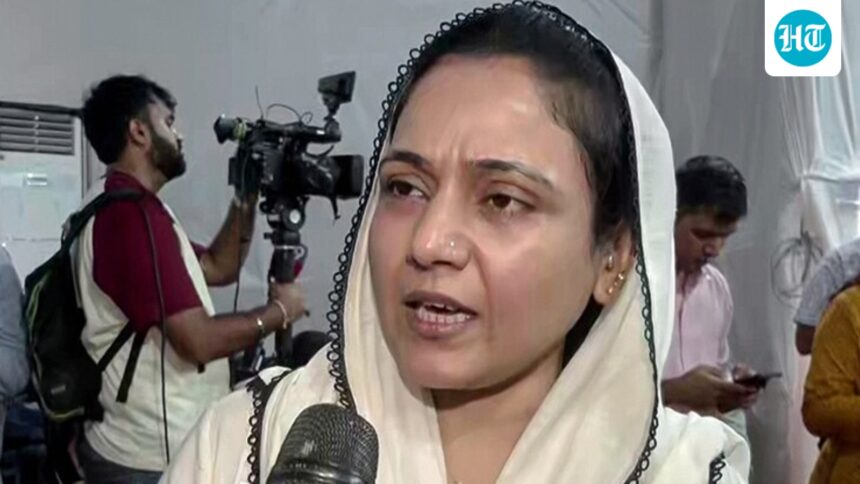
Responding to the criticism on Thursday, Malik said that she neither advocates nor promotes polygamy, and that her intervention in the House of Representatives is being interpreted incorrectly, news agency PTI reported.
“I am not even defending or supporting polygamy. I was informing the House about the ways of polygamy. However, BJP’s Devayani Varandhi raised the issue citing references to Pakistan, which I objected to,” Malik told reporters on Thursday.
Read also | The NCP is pushing for a return of funding, and the BJP is unlikely to budge
She said discussions on laws and practices in India should not be based on examples from Pakistan.
“Why should we use a practice in Pakistan as a reference point to decide something here in India? Pakistani laws are based on the Quran. If any reference is needed, it can be taken from the Holy Quran. The Constitution of Bharat has given us the ways of life and livelihood. The Constitution has even given us the right to follow our religion,” she said.
Controversy over polygamy and religion
Further clarifying her position, Malik said that her statements aim to highlight that polygamy is not an issue limited to one community.
Read also | The buzz about the merger between the Congress and the Nationalist Congress Party (SP) is getting louder.
“My question was whether only Muslim men practice polygamy. Isn’t it true that other men indulge in it too?” I asked.
She also stressed that women’s issues should not be viewed through a religious lens.
The MLA further said that she objected to what she termed as praise for Pakistan during the Assembly debate.
“People are asking me to go to Pakistan, but the first person to mention this country was a BJP MLA,” she said.
She added: “I am a daughter of Maharashtra, and I will not go just because someone asked me to go to Pakistan.”
How did the controversy start?
During the discussion, BJP MLA Devayani Farande referred to Pakistan while talking about polygamy. According to Frandi, this practice is followed by only 1% of men in Pakistan, and requires obtaining permission from the authority before a second marriage.
In response, Malik said: If anything is mentioned in the Qur’an and if it is implemented in Pakistan, we demand that it be brought here as well.
This statement quickly sparked criticism from leaders of the ruling coalition.
BJP and Shiv Sena leaders react
Despite belonging to the NCP faction of the NDA alliance, Sana Malik’s statements were criticized by leaders from her allies – Shiv Sena and RJD.
Shiv Sena leader Shaina NC accused Malik of engaging in vote bank politics and questioned the message her comments sent to women. “On the one hand, you have Prime Minister Narendra Modi who has given Muslim women respect through triple talaq (legislation), and here is Sana Malik making this controversial statement about polygamy.”
“Statements like these show you that you are just trying to vote on the bank’s policies. I would request Sana ji to consider what she said as this is disrespectful to the women of India,” she said.
BJP MLA Manisha Chaudhary also criticized Malik’s statements and stressed that the Constitution remains the guiding framework for the country.
“India is governed by the Constitution, not the Quran. If one wants to live in India, he must follow the Constitution,” she said.
(With inputs from PTI)