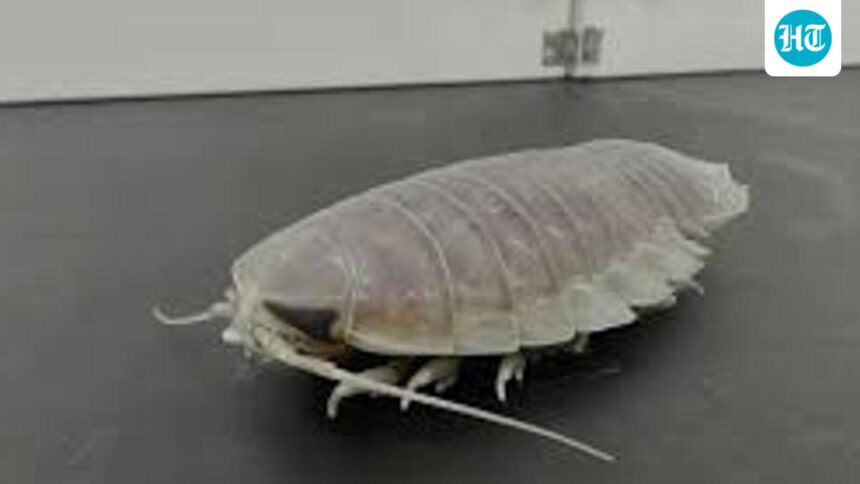
What if I told you that there was an animal about the length of your forearm, living at the bottom of the deep ocean, that could live for five years without eating a single meal?

I read a lot of scientific papers looking for topics for this column. Sometimes, even as a biologist, I come across a description of a life form that astonishes me. A new paper in the journal Cell, by Jianbo Yuan and colleagues at the Institute of Oceanography of the Chinese Academy of Sciences, tells us more about the deep-sea isopod, a scavenger crustacean with a flat, segmented body, fourteen jointed legs, and a hard outer shell that can survive for years without eating.
How do these animals achieve this feat? It turns out there is no one trick. The animal survives with a whole host of features that suit it in one of the harshest environments on Earth.
Deep-sea isopods live on the seafloor across the Atlantic, Pacific, and Indian Oceans. Their world is wide, dark, cold, and almost completely devoid of reliable meals.
The deep sea is the largest living space on the planet and one of the least tolerant. At these depths, sunlight no longer helps microbes make food. Food is scarce and unpredictable, and most of it sifts in the form of marine snow, the slow drift of dead plankton and other organic matter that falls through the dark water. Every now and then, something larger like a dead fish or a whale carcass lands, and for a while it enjoys the sea floor. Then famine returns.
Read also: Scientifically: Plastic is inside us, but we can reduce our exposure to it
The researchers compared two species of isopods that live at two different depths. The animal that lives at the greatest depths has a huge stomach, distended to fill almost two-thirds of the body. When the rare opportunity to eat comes, he gorges himself, filling that stomach in preparation for a long wait. Chop one up after a meal and you’ll find a dense, almost completely digested paste the consistency of clay.
Bodies often differ between species in ways that suit their environments. But there are other, more clear results in the latest paper.
The deep-sea isopod also significantly lowers its metabolism, putting its body into standby mode. The researchers found a group of bacteria called chlamydia, known to cause disease, and are linked to fat storage. The bacteria may help store energy in the animal for slow use.
Strangest of all is a gene called ND1, which seems out of place in the isopod genome. It appears to have come from bacteria. The researchers argue that an isopod ancestor picked it up from a microbial source about 16 million years ago.
Step back and think about this for a moment. Inheriting genes from parents is normal. Animals borrowing genes from unrelated microbes is extremely rare. In fact, no one had heard of it until a few decades ago.
This begs the question: What does a microbial gene do inside a deep-sea animal?
Read also:Scientifically speaking: Microplastics are inside us, but we can reduce our exposure to them
Well, it seems that inside the isopod, ND1 helps regulate how the animal expends energy. To test this, the researchers genetically inserted the gene into other animals, including fish, to watch it work. At normal temperatures, this gene sped up metabolism and left the fish less able to withstand starvation. But under cold conditions that were meant to mimic the deep sea, they reversed course, increasing their starvation survival rate by 37 percent.
We scan distant planets for alien life, but on our own planet, our oceans contain strange and wonderful creatures that most of us will never see.
Imagine this then. Somewhere at the bottom of the dark sea, an armored scavenger lies dormant waiting for a meal that may not come for years. He will not die of hunger, because his biological makeup makes him suitable for this wait.
Anirban Mahapatra is a scientist and author. His latest book is When Medications Don’t Work. The opinions expressed are personal