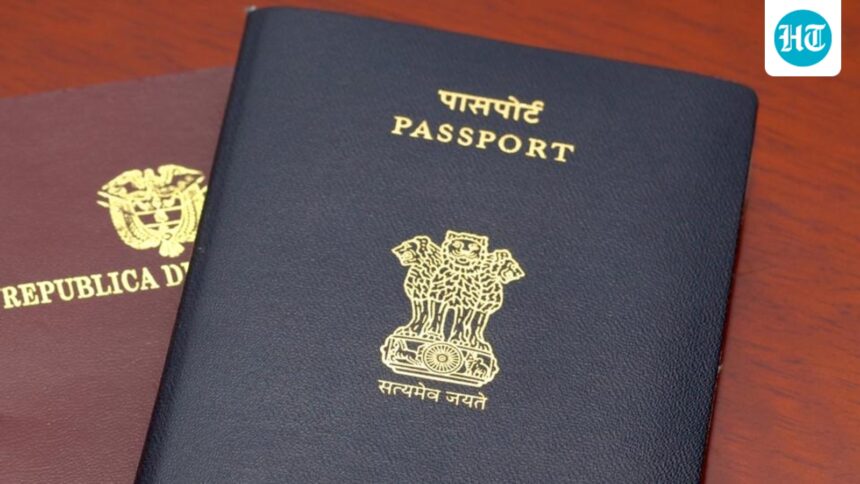
The Center on Thursday sought to calm the controversy over whether an Indian passport can be treated as proof of citizenship, stressing that the position is neither new nor a recent shift in policy.

“It was not decided yesterday that a passport is not proof of nationality. No decision has been made even in the past 12 years,” a government official said, adding that the legal situation has been in place for decades.
This clarification comes a day after the Ministry of External Affairs (MEA), during a detailed briefing on Passport Seva Divas, said that a passport is primarily a travel document and should not be treated as conclusive proof of citizenship. These statements sparked criticism from opposition leaders and sparked wider controversy on the Internet.
The government cites the law and court rulings
The government defended its position by pointing to existing laws and court rulings, arguing that the passport had never been treated as conclusive proof of nationality.
“A passport has never been a proof of citizenship. The Passport Act, 1967 stipulates that passports can be issued to non-citizens. The 2013 Bombay High Court rulings have made it clear that a passport is not a proof of citizenship,” an official said, explaining the rationale.
MENA also referred to Section 20 of the Passports Act of 1967, which allows the central government to issue passports or travel documents to non-citizens in certain cases if it deems it to be in the public interest, news agency ANI reported.
This clause states that the government may issue a passport or travel document to “a person who is not an Indian citizen” if it deems that such a step is necessary in the public interest.
The dispute erupted after Middle East Airlines’ statements
The controversy began on Wednesday when the MEA, while unveiling the benefits of chip-enabled e-passports, said that a passport should not be considered conclusive proof of citizenship.
The clarification revived a long-standing legal question: If a passport is not conclusive proof of nationality, then what is the document that proves nationality?
The remarks quickly gained traction on social media, with users asking why a document that enables international travel, secures consular protection abroad, and is accepted by immigration authorities around the world is not considered proof of citizenship.
What the law says
The government’s clarification also highlights a broader fact: India does not issue a single document that automatically serves as conclusive proof of citizenship for every citizen.
In fact, when asked in Parliament in February 2020 whether documents like Aadhaar, passport, voter ID, PAN card or birth certificate could be accepted as conclusive proof of citizenship, the Home Office did not authenticate any single document.
Read also | Amid the MEA passport statement row, what constitutes proof of citizenship in India?
Instead, it said matters of citizenship are determined under the provisions of the Citizenship Act 1955 and the rules made thereunder.
Under the law, Indian citizenship can be acquired by birth, descent, registration, naturalization or land incorporation.
As a result, citizenship is determined based on an individual’s circumstances and supporting records and not through a single nationally issued citizenship card, which India has never adopted.