India once again strongly rebuked Pakistan at the UN Security Council meeting, accusing Islamabad of “politicizing” the international forum and reiterating that Jammu and Kashmir is an “internal” part of India.

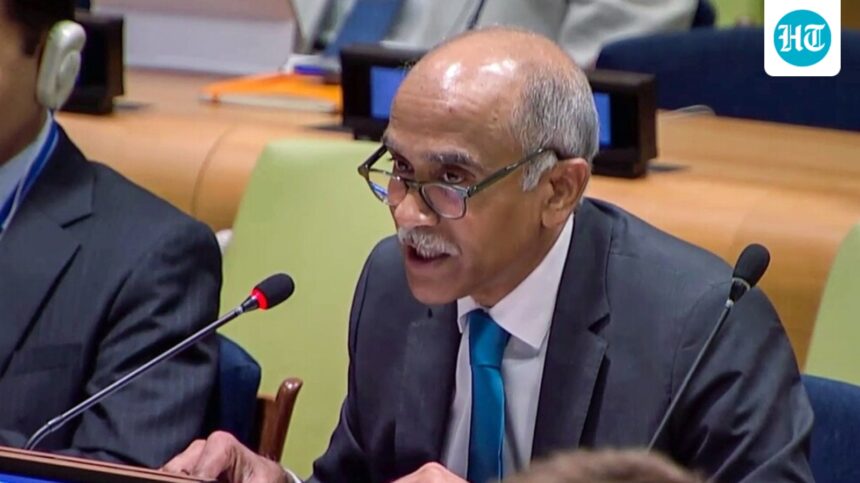
In response to the statements made by Pakistan’s representative during the meeting, India’s Permanent Representative to the United Nations, Harish Parvathanini, said that these statements were “unjustified.”
“I also refer to the unwarranted statements made by the representative of Pakistan. It is unbelievable that a co-chair who is expected to be balanced and impartial in conduct has chosen to politicize this forum,” Harish said, according to news agency ANI. The Indian envoy to the United Nations reiterated the position that New Delhi has affirmed several times in the past.
“I would just like to briefly emphasize that the Union Territory of Jammu and Kashmir is completely internal to India, it has always been so and it will continue to be so,” Harish added.
Pakistan had previously made several statements at the forum regarding India and Jammu and Kashmir, statements which New Delhi has repeatedly denied and condemned. India maintains its position that Jammu and Kashmir is an unequivocal part of the country.
Read also | ‘Covering up its failures’: India rips apart Pakistan’s ‘will go to war’ statements on Indus Waters Treaty
“Targeting innocent civilians”
This is the second time in a month that New Delhi has criticized Pakistan’s statements in the UN Security Council. Earlier this month, India criticized Islamabad for its “long-tainted record of genocide” and its support for cross-border violence that has claimed the lives of civilians in Afghanistan.
In his response after Pakistan’s statements on Jammu and Kashmir, Harish Parvathanini said: “It is hypocritical for us to embrace the lofty principles of international law while targeting innocent civilians in the dark.”
The Indian envoy referred to the findings of the UN Assistance Mission, saying that the mission documented the killing and injury of 750 civilians in Afghanistan in the first three months of 2026 due to “cross-border armed violence committed by Pakistani military forces.” India also accused Pakistan of carrying out an airstrike on Umaid Addiction Hospital in Kabul during Ramadan earlier this year.
The agency quoted Harish as saying: “According to the United Nations Assistance Mission in Afghanistan, this cowardly and unconscionable act of violence claimed the lives of 269 civilians and injured 122 others in a facility that can in no way be justified as a military target.”
Meanwhile, New Delhi also criticized Pakistan at the 62nd session of the Human Rights Council over its “terror policy”, referring to it as an “example of a Frankenstein state”.
“This is a country where the current Defense Minister brags about hosting, training and propagating terrorist policies, and yet Pakistan describes itself as a victim of terrorism, which is indeed an irony that only Pakistan can bear. It is a living example of a Frankenstein state that is shocked when its monster strikes back,” said Anupama Singh, First Secretary at the Permanent Mission of India to the UN.