

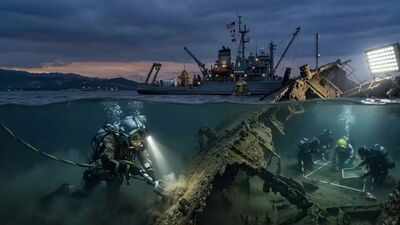
In the shallow waters off the Philippine coast, a long-forgotten war story has been pulled back into the scene, not through ceremony or on-the-ground excavation but through the slow, patient work of sonar scanning and archival digging.
What began as a search guided by scattered wartime records ended with the identification of a Japanese transport ship believed to have been carrying more than a thousand Allied prisoners during the final phase of the Pacific War. The ship, known as the Hofuku Maru, had virtually disappeared amid conflicting reports and uncertain coordinates for decades. Its rediscovery is at the heart of a televised investigation involving underwater teams, historians and divers, with footage captured for an upcoming broadcast season on the Discovery Channel.
This discovery is framed not as a spectacle but as a restoration of site and context, a fixed point in a history that has drifted for eighty years.
The 1944 sinking of the ship became an archival mystery that has endured for decades
The ship itself was part of the so-called “Hellship” network, a grim wartime system in which cargo ships and passenger liners were redirected to transport prisoners across the Japanese wartime domain. Conditions were extremely harsh, but moreover, documents were often fragmented, destroyed, or simply misrecorded in the chaos of the final war years.
The Hofuku Maru slipped into that gap.As stated by the Naval History and Heritage Command, she was recorded sinking in September 1944, after being bombed during an Allied attack on a convoy, but her exact burial place remained uncertain. Different wartime accounts placed the wreck in slightly different positions, enough of a discrepancy to send subsequent searches far from the target. Over time, assumptions turned into accepted facts, even as certainty quietly eroded.The turning point was not underwater, but in filing rooms and digital military archives. Researchers working with the Hellships Memorial Foundation began verifying Japanese convoy records and reports of Allied attacks. In doing so, they revealed details indicating that the ancient coordinates were far apart by a large margin.
Confirmation of the Hofuku Maru beneath 160 feet of silence and seafloor sediments
The search team was eventually able to reach an unidentified wreckage located at an altitude of approximately 160 feet as reported by WARNER BROS.
Discover press release. At first it was just a distorted outline, half-buried in sediment and marine growth. Then a clearer structure appeared: a structure divided into sections, the masts collapsing in a way that suggested sudden violent force rather than gradual decay.Divers confirmed what the sonar had hinted at. The ship’s dimensions matched the wartime plans associated with the Hofuku Maru, right down to the cargo proportions and deck design.
Photogrammetry was used to align the wreck with historical charts, with repeated comparisons narrowing the uncertainty until only a small room for doubt remained.Among the wrecks, human remains were also observed, a detail that turned the discovery away from purely marine archaeology into a much heavier category of war graves recovery.
Inside the modern search for the forgotten Hell
Josh Gates led the fieldwork in front of the camera, working alongside underwater photography specialists and marine archaeologists who have spent years mapping submerged wartime shipwrecks across the Pacific.
Their role was not simply to locate the site, but to verify it in layers: structural form, material decomposition, and positional consistency with archival data.Much of the technical confirmation has relied on modern imaging systems, including high-resolution mapping of the seafloor and 3D reconstruction of broken portions of the wreck. The fact that the ship appeared to be divided into two main pieces is consistent with historical descriptions of its destruction, adding another point of intersection between record and reality.The work is depicted as part of an unknown expedition, which increasingly moved towards historically grounded searches that blended exploration with archival investigation.
Filipino Deepening role in Hellship recovery operations
The Naval History and Heritage Command reports that learning about the Hofuku Maru does not occur in isolation. Parallel efforts continue in other parts of the Philippines, where agencies such as the US government’s POW/MIA Accounting Agency have been involved in locating and recovering remains from similar shipwrecks, including the Orioco Maru in Subic Bay.These ships, which often transported prisoners in conditions that were not well documented at the time, have become focal points for modern recovery efforts. Each confirmed location adds another fixed coordinate to the wartime map that was either intentionally obscured or later lost due to inconsistent record keeping.