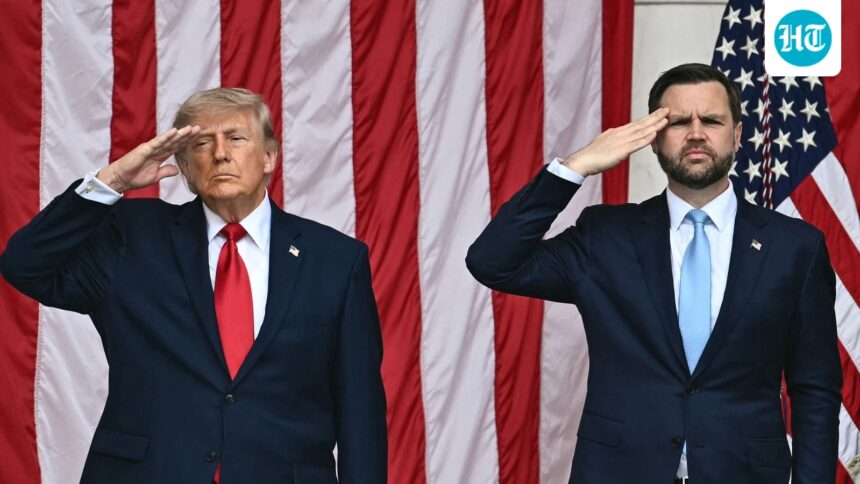
US Vice President JD Vance suggested that Indian troops be part of a peacekeeping mission in Ukraine to help ensure a ceasefire in the war with Russia during an Oval Office meeting on January 30 last year, just 10 days after US President Donald Trump’s inauguration, according to a newly published book.

The book, Regime Change: Inside Donald Trump’s Imperial Presidency, by New York Times journalists Maggie Haberman and Jonathan Swan, covers the first 14 months of Trump’s second term in office.
A plan to end the Russian-Ukrainian war
According to the book, retired Army Lt. Gen. Keith Kellogg, whom Trump appointed as special presidential envoy for Ukraine and Russia, held a meeting in the Oval Office 10 days after the inauguration.
The goal was reportedly to determine the “commander’s intent” and determine what role the United States should play in ending the war in Ukraine.
During the discussion, Kellogg presented a proposal titled “The America First Plan: Trump’s Historic Peace Deal for the Russia-Ukraine War.”
Aside from Trump, the meeting was reportedly attended by Vance, Secretary of State Marco Rubio, Defense Secretary Pete Hegseth, White House Deputy Chief of Staff Stephen Miller, National Security Advisor Mike Waltz, and Treasury Secretary Scott Besent.
As part of the proposal, the United States would not formally recognize Russia’s claims over occupied Ukrainian territories. However, she noted that Ukraine would not try to regain lost territory through military action.
The plan called for the stationing of peacekeeping forces from France, Britain and the Netherlands in Ukraine to supervise the ceasefire, according to the book.
Vance objects and suggests deploying Indian troops
At this point, Vance raised concerns about the use of forces from NATO member states. He said the presence of NATO forces in Ukraine could provoke Russia and increase the risk of the United States being drawn into the conflict.
Notably, a month later, Russian Foreign Minister Sergei Lavrov announced during a meeting with Rubio in Saudi Arabia that the deployment of forces from NATO countries would remain “unacceptable” for Russia, even if they operated under the European Union or its national flags.
Vance then asked: “Are there forces from other countries that could serve this purpose?” Waltz said it would be better to get support from countries outside Europe.
This is when Vance allegedly dropped the India name. The book states: “Vance suggested Saudi Arabia or India. Trump laughed.”
The authors write that Trump responded by saying, “The Indians wouldn’t do that. They wouldn’t pay for something like that.”
Trump reportedly said that Prime Minister Narendra Modi had a good relationship with him. “Prime Minister Modi really liked it and wanted to visit it, but Indians never pay for anything,” the book said.
He also said he had no objection if Britain or France chose to deploy their forces in Ukraine, as long as the United States was not involved.
Trump: Zelensky is a bad negotiator
During the same meeting, Trump repeatedly interrupted Kellogg to talk about how much he “hated” Ukrainian President Volodymyr Zelensky, the book says.
“He’s a bad negotiator, and he destroyed his country. But he was really good at getting things from the Biden administration,” he said.
As Kellogg continued to advance his plan, Trump repeatedly made critical comments about Ukraine. At one point, he described it as the most corrupt country in the world.
This chapter, and much of the book, discusses how Trump’s second presidency differs from his first. During the meeting, he instructed Kellogg not to deal with Russian officials and prohibited him from having any contact with Moscow.
Trump added: “No one on your team can talk to these people, because we are working to reach an agreement.”
The book says that Kellogg did not know who Trump meant by “we,” and was not aware of the deal being discussed.
According to the authors, Trump entered his second term relying heavily on his own instincts and making decisions accordingly. Without informing Kellogg, he had already handed over responsibility for the matter to someone else.
Trump on tariffs on India
In another chapter of the book, Trump mentions India again while discussing tariffs.
Days after tech billionaire Elon Musk, who was working as a “private government employee,” clashed with government ministers, the White House hosted a meeting of the Council of Technology CEOs on March 10.
Attendees in the Roosevelt Room included the heads of several major technology companies, including IBM, Dell, HPE, HP Inc., Qualcomm and Intel.
US Commerce Secretary Howard Lutnick asked the executives: “What do we need to do to get you to commit to building new factories in the United States?”
During this meeting, Trump talked down India while discussing tariffs, claiming that the country had imposed 175% tariffs on American goods.
“Those who won’t build here are going to have to pay huge tariffs… Not 20 percent, like 100 percent… We’re being treated unfairly. China is putting tariffs on us over 150 to 200 percent, and India is 175 percent,” Trump said, according to the book.
The book was released on Tuesday (June 23).