Accommodating new political dissidents is one factor, with emphasis on the Raghav Chadha-led group that came from the AAP, and the TMC rebel group led by Kakoli Ghosh.

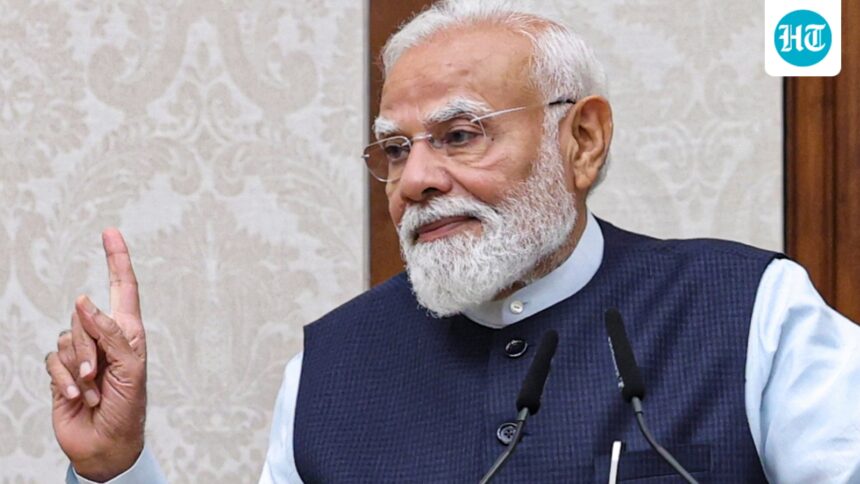
Prime Minister Narendra Modi called on President Draupadi Murmu at Rashtrapati Bhavan on Tuesday, a day after Union Minister George Kurian resigned after the expiration of his Rajya Sabha term amid buzz in Delhi that the cabinet may see a cabinet reshuffle soon.

Kurian, who served as Union Minister of State for Minority Affairs as well as for Fisheries, Animal Husbandry and Dairying, was not renominated by the BJP for the June 18 Rajya Sabha elections. His term in the Rajya Sabha ended on June 21.

In fact, two Union ministers – Ravneet Singh Bittu and Kurian – have not been renominated for the Rajya Sabha elections scheduled for June 18. Beto has not yet officially submitted his resignation. Under the law, he can remain a minister without serving as an MP for six months after the end of his term, but must be renominated within the six-month period to continue after December 21.
But he said that he was now heading to Punjab, and announced his intention to delve deeper into the state’s politics. “Now, I want to serve Punjab and will contest the Vidhan Sabha elections scheduled for early next year,” Bittu told reporters, noting that he has already “packed his bags” to focus entirely on the state after 17 years in parliamentary politics. He is likely to be nominated from the Ludhiana (Central) Assembly constituency under the Ludhiana Lok Sabha segment, which he represented as a Congress member in the past but lost in 2024.
Two more Union ministers are reportedly facing the “one man, one post” principle that often governs BJP appointments.
Harsh Malhotra, who was recently appointed Delhi BJP president, is Union Minister of State for Road Transport and Corporate Affairs. Pankaj Chaudhary – who in December 2025 took over as party chief in Uttar Pradesh, where elections are scheduled to be held along with Punjab – is the Finance Ministry. Party precedent indicates that they will have to step down from their ministerial positions.
The Federal Cabinet is scheduled to meet at 11am on June 24, although it is not clear whether the reshuffle announcements will be made over the next 24 hours or gradually. Modi’s regime has largely operated by surprise and stealth, making the speculation even riskier.
3 political calculations shape the cabinet reshuffle
However, three general considerations are seen to dominate the discussions. This includes harboring new political dissidents such as the Raghav Chadha-led group that came from the AAP, or the TMC rebel group led by Kakoli Ghosh Dastidar, the latest dissident MPs from Uddhav Thackeray’s Shiv Sena party.
Then there is the arithmetic ratio to obtain a two-thirds majority in Parliament.
In addition, there are political situations ahead of the upcoming Assembly elections in Punjab, a Sikh-majority state, where the Hindutva-led Bharatiya Janata Party is trying to make a mark on its own after playing second fiddle to the Shiromani Akali Dal for decades.
The “merger” of seven Rajya Sabha MPs from the Aam Aadmi Party with the Bharatiya Janata Party in April gave rise to potential contenders for the ministerial posts, led by Raghav Chadha, who has since praised Modi so loudly that he has edged him out over India’s first prime minister, Jawaharlal Nehru.
Then came the dramatic split in the Trinamool Congress (TMC) over the past two weeks. Next came Uddhav’s MPs turned NDA Shiv Sena member Eknath Shinde.
This has expanded the pool of potential new faces for the BJP-led NDA in the Cabinet.

The AAP defectors, besides Chadha, include former cricketer Harbhajan Singh, former AAP strategist Sandeep Pathak, and business tycoons Ashok Mittal, Rajinder Gupta and Vikramjit Sahni – all six of them from Punjab. Swati Maliwal came from Delhi.
In West Bengal, 20 rebel TMC MPs announced their merger with the shadowy Nationalist Citizens Party of India (NCPI) and announced their support for the NDA. In the wake of the mass defection, Kakoli Ghosh indicated that the move was intended to avoid legal complications: “We will merge with the National Citizens of India Party and support the NDA.” Among them, Kakoli Ghosh and Sudip Bandyopadhyay are the names doing the rounds.
These dissidents bring numbers beyond the Cabinet as well.
Account demarcation
The main motive behind the defections is the BJP’s desire to obtain a two-thirds majority in Parliament, HT reported. The government may relaunch its delimitation drive – mobilized as necessary to give effect to the Women’s Reservation Bill passed in 2023 – once it secures the two-thirds majority required for the constitutional amendments.
The delimitation bill — which aims to expand the Lok Sabha from 543 to 850 seats and redraw constituency boundaries — was defeated in April because the government did not have the special majority needed to make a constitutional amendment.
Recent defections have brought the National Democratic Rally close to this threshold, but the calculations remain tight. Therefore, every incitement by the dissident narrows the gap.
Punjab parking
At least one vacancy after Bittu’s imminent exit from the Cabinet opens up the question of representing Punjab. The BJP has already played the Jat-Sikh card by appointing businessman and former Congress member Kewal Singh Dhillon as its Punjab unit chief. It may now need to balance this by bringing in Hindu faces.
Among the names circulating is Raghav Chadha, the youngest-ever Rajya Sabha MP and the main organizer of the AAP’s victory in Punjab in 2022 before he defected to the BJP in April. However, former BJP president in Punjab, Sunil Jakhar, another Congress member, is at least one more Hindu name in the mix.
Among the old members of the saffron party, Ersa was appointed Tarun Chugh was recently elected to the Rajya Sabha by the BJP from Madhya Pradesh. A native of Amritsar and the party’s national general secretary, he has been active in Punjab in recent weeks with an anti-drug campaign, even posing for photos drinking lassi with Punjabi singer Honey Singh, who spoke about his personal struggle with addiction.
Punjab also became a center of urgency when BJP national president Nitin Nabin, who is set to form his new team soon, broke off his three-day high-level organizing tour to the state on Monday, and he and Chadha returned to Delhi.
At a state-level meeting in Ludhiana, Chadha shared the stage with Nabin in his first major public appearance with the BJP high command in Punjab since his defection from the AAP. Nabin even went beyond his planned itinerary to Chandigarh. Instead, he met Punjab Governor Gulab Chand Kataria briefly at Halwara Airport in Ludhiana before returning directly to Delhi.

Arish Chhabra is an associate editor on the Hindustan Times online team, where he writes news reports and explanatory features, as well as overseeing the site’s coverage. His career spans nearly two decades across India’s most respected newsrooms in print, digital and broadcast. He has reported, written, and edited across formats—from breaking news and live election coverage, to analytical long-reads and cultural commentary—building a body of work that reflects editorial rigor and a deep curiosity about the community for which he writes. Areesh studied English Literature, Sociology and History along with Journalism at Punjab University in Chandigarh, and began his career in that city, eventually moving to Delhi. He is also the author of Little Big City: What Life is Like from Chandigarh, a collection of critical essays originally published as a weekly column in the Hindustan Times, which examines the culture and politics of a city that is much more than just its famous architecture – and in doing so, holds up a mirror to modern India. During his stints at BBC, The Indian Express, NDTV and Jagran New Media, he has worked across formats and languages; Mainly English, as well as Hindi and Punjabi. He was part of the crack team for the BBC Explainer project which was replicated around the world by the broadcaster. At Jagran, he developed editorial guides and trained journalists on integrity and quality content. He has also worked at the intersection of journalism and education. At the Indian School of Business (ISB) in Hyderabad, he developed a website to streamline academic research in management. At Bennett University’s Times School of Media in Noida, he taught students the craft of digital journalism: from newsgathering and writing to social media strategy and video storytelling. Having moved from small town to larger town to megalopolis for education and work, his intellectual passions lie at the intersection of society, politics, and popular culture—a perspective that guides his writing and worldview. When he’s not working, he’s constantly reading long-form journalism or watching cerebral content, sometimes both at the same time.Read more