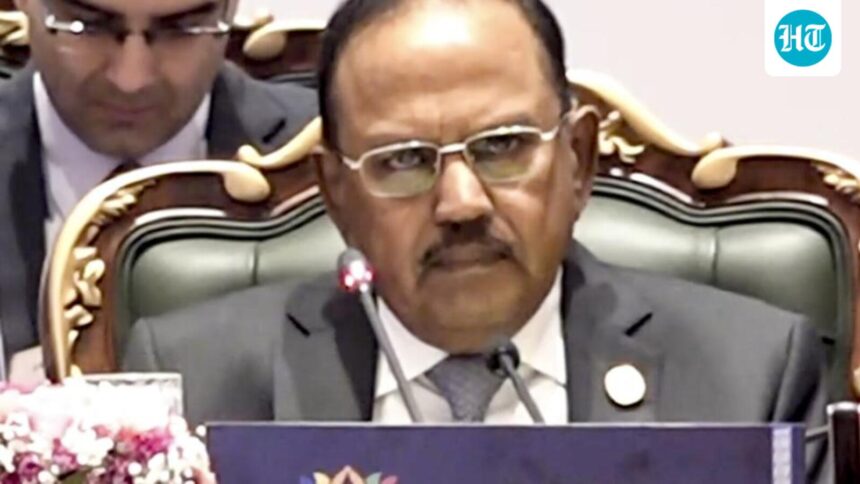
India on Tuesday welcomed the understanding between Iran and the United States on cessation of hostilities in West Asia, which National Security Advisor Ajit Doval said had the potential to ensure energy security, restore freedom of navigation and remove supply chain bottlenecks for essential goods.

Meanwhile, Duval highlighted non-traditional threats such as disruptive technologies and new forms of terrorism while addressing a meeting of national security agencies and senior security officials of BRICS member states. The meeting hosted by India was attended by Chinese Foreign Minister Wang Yi, who also serves as the National Security Agency, and Russian Security Council Secretary Sergei Shoigu.
Read also:Duval meets Chinese Minister Wang Yi and holds “constructive, forward-looking discussions”
“India welcomes the Memorandum of Understanding reached between the US and Iran. We are cautiously optimistic and hopeful that it will work. It will help in energy security and the opening of the Strait of Hormuz is a very welcome development. It will remove supply chain bottlenecks and many shortages in the area of fertilizers and chemicals. [overcome]Duval said at the beginning of the meeting.
He said the meeting was being held at a “very turbulent time”, as the world grappled with military conflicts, complex security problems, geopolitical uncertainties, economic pressures and disruptive technologies. He added that while the threats are worsening, the institutional tools and mechanisms to deal with them are increasingly insufficient.
“We need to be aware of new security threats and challenges,” Duvall said. “Non-traditional threats have transcended national borders and developed defeat systems against conventional responses. Innovative disruptive technologies, more subtle types of terrorism, and cyber threats in an increasingly digitized world – all pose important threats to us.”
As at the BRICS foreign ministers’ meeting in May, there were disagreements between representatives of Iran and the UAE at the meeting of national security agencies, according to a post on social media by the Iranian embassy.
Read also:NSA Ajit Doval meets with a senior Iranian security official and reviews the situation in West Asia
During deliberations that took place behind closed doors, Ghadir Nezamipour, deputy secretary of Iran’s Supreme National Security Council, displayed a poster of children killed in a raid on a school in the Iranian city of Minab “on the first day of aggression… by the United States,” and said that part of the attacks against his country were launched from bases in the United Arab Emirates.
Nezamipour also rejected the allegations made by the United Arab Emirates representative against Iran, according to his posts on social media. The exact nature of the allegations could not be immediately confirmed, although Emirati officials have accused Iran of targeting energy facilities and other infrastructure.
Nizamipour said: “The whole world has witnessed that America and the Zionist entity were the initiators of the aggression and crisis in the Strait of Hormuz. Part of these attacks were launched from bases located on the territory of the United Arab Emirates.”
“However, instead of condemning these hostile actions, the UAE directly participated in the aggression and allowed its territory to be used as a platform for attacks against civilian infrastructure, schools and hospitals in Iran.”
Nezamipour said that Iran hopes that the UAE, “instead of engaging in propaganda and adventurism, will respect the principles of good neighborliness and choose the path of peace, stability and regional cooperation.”
The Iranian official presented four proposals to enhance cooperation among BRICS member states, including establishing an “institution for crisis management and resilience enhancement” to coordinate national capabilities and enhance collective preparedness in the face of emerging threats and crises, and establishing an “integrated network for monitoring, early warning and exchange of security information” among national security bodies to facilitate timely identification and coordinated response to hybrid and transnational threats.
Nizamipoor also called for expanding strategic and comprehensive cooperation within the framework of BRICS to confront unilateralism, prevent external interference in the internal affairs of sovereign states, and strengthen the multilateral system. He suggested that the “BRICS Technology Innovation and Artificial Intelligence Union” could facilitate the development of domestic capabilities and digital sovereignty, reduce technological dependence, and counter monopolistic practices in advanced technologies.