

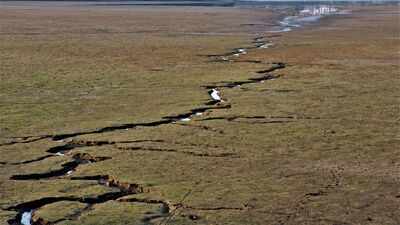
For most people, earthquakes are something that happens relatively close to the Earth’s surface. They penetrate the Earth’s crust, shaking towns and cities, and leaving behind faults that geologists can map.
It is generally believed that the deeper parts of the planet behave differently. Under the extreme pressures and temperatures beneath the Earth’s crust, rocks are expected to deform slowly rather than suddenly break.This assumption is why a cluster of earthquakes beneath northern Utah and southwestern Wyoming has attracted such attention. Some of these events originate tens of miles below the Earth’s crust, in a part of the Earth where conventional earthquake theory suggests seismic ruptures should be extremely difficult.
A series of recent studies have confirmed that these unusual tremors are not measurement errors, but rather real earthquakes occurring deep in the western United States.
Deep earthquakes under Utah and Wyoming date back to a 1979 mystery
The story begins with a magnitude 3.8 earthquake recorded near Randolph, Utah, on February 24, 1979. At that time, the estimated depth of the quake immediately became apparent. Data indicate that the event originated at a depth of about 94 kilometers below sea level, which places it well below the crust and deep within the upper mantle.
It was difficult to accept such a position. Continental earthquakes almost always occur within the Earth’s crust, where cold temperatures allow rocks to fracture brittlely. At these depths, mantle rocks would generally be expected to flow and deform rather than suddenly rupture.This debate has continued for decades. According to a study published in Geophysical Research Letters, titled “Upper-mantle earthquakes along the margin of the Wyoming Craton,” a new examination of seismic records has confirmed that the 1979 quake was not an isolated anomaly.
After reviewing regional earthquake catalogs and re-evaluating depth estimates, researchers identified nine confirmed mantle earthquakes along the edge of the Wyoming Craton, including a 1979 event.
Scientists confirm nine deep mantle earthquakes beneath Utah and Wyoming
The research, led by Sean J. Hutchings, examined earthquakes recorded between 1979 and 2023 in Utah and Wyoming. By comparing earthquake depths with fourteen independent models of crustal thickness, the team concluded that all nine events occurred beneath the Moho, the boundary that separates the Earth’s crust from the mantle.Eight of those earthquakes occurred at a depth of more than 15 kilometers below that boundary. The deepest quake, the 1979 Randolph earthquake, occurred about 60 kilometers below the Moho River itself. According to the study, these events represent some of the clearest evidence of continental mantle earthquakes outside of regions such as the Himalayas and Tibet, where deep continental earthquakes have been documented before.The quakes ranged from small tremors to a 4.8-magnitude event beneath Wyoming’s Wind River Range in 2013. Despite their differences in magnitude, they share one striking characteristic: They all appear to originate within mantle material rather than the crust that covers it.
Scientists have identified a rare earthquake in the mantle beneath Utah in 2025
Interest in this phenomenon increased again after another deep earthquake struck northeastern Utah on September 10, 2025.In a paper published in The Seismic Record, titled “September 10, 2025, 4.1 Mw earthquake in northeastern Utah, USA: A typical continental mantle event,” a magnitude 4.1 earthquake was reported near Macer, Utah.
Multiple seismic techniques have placed the event approximately 65 to 70 kilometers below the surface. Previous studies estimated the thickness of the Earth’s crust in the region at only 40 to 45 kilometers.That earthquake left it about 20 to 25 kilometers inside the continental mantle. The researchers described it as a “typical continental mantle event” and noted that it shares many features with previous deep earthquakes identified in Utah and Wyoming.Unlike many shallow earthquakes, the masser event did not produce any obvious foreshocks or aftershocks. Its seismic waves also contain unusually strong high-frequency energy, another feature previously observed in mantle earthquakes from the region.
Why do deep earthquakes cluster near the Wyoming craton?
One clue may lie in the location of earthquakes. Both studies found that the events cluster near the western edge of the Wyoming Craton, an ancient block of continental lithosphere that forms part of the geological core of North America.According to the study, all nine mantle earthquakes occurred within approximately 100 kilometers of the craton’s lithosphere boundary. The area represents a transition between thick, stable craton rocks and the surrounding mantle, which appears to be more dynamic and structurally complex.The researchers suspect that mantle flow may play a role. As mantle material slowly moves around the solid cratonian root over millions of years, stresses can build up along the boundary. According to the study, enhanced strain rates associated with mantle convection near the edge of the craton may help create conditions that allow earthquakes to occur at depths where rocks are expected to gradually deform. Earthquakes in a surprisingly hot environment
How do earthquakes occur in mantle rocks with temperatures exceeding 700 degrees Celsius?
According to the study, it is estimated that eight of the nine mantle earthquakes occurred in areas where temperatures exceeded 700 degrees Celsius.
Some of them were associated with temperatures approaching or exceeding 1000 degrees Celsius. Under these conditions, conventional brittle failure becomes increasingly difficult.To explain this, the researchers suggested that more than one mechanism could be at work. Some earthquakes may involve brittle failure near the crust-mantle boundary, while deeper events can be linked to a process known as thermal escape. In this scenario, the deformation becomes localized within a narrow region, generating a rapid release of energy even though the surrounding mantle behaves in an elastic manner. The studies also leave open the possibility that fluids within the mantle may contribute to this process, although the exact role remains uncertain.