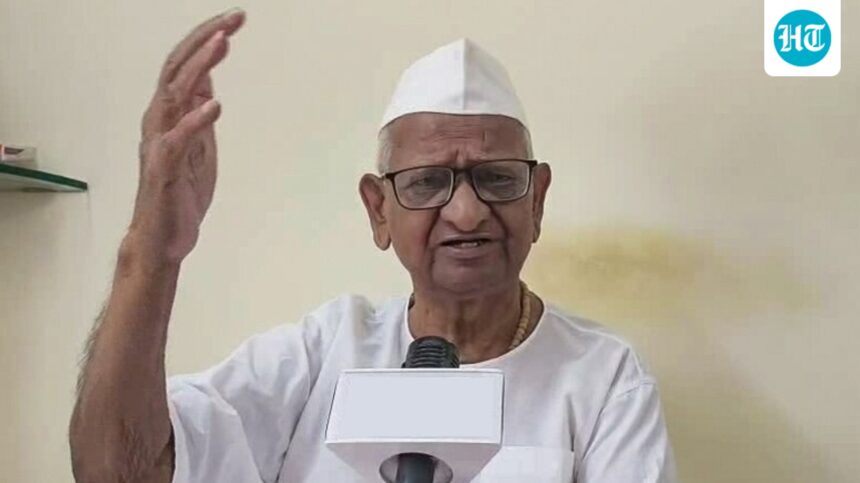
Social activist Anna Hazare on Tuesday warned against agitation against the Maharashtra Right to Information Rules, 2026, which are scheduled to come into force from July 5, alleging that the amended provisions weaken the transparency law and distance citizens from information.

Hazare threatened to launch an indefinite hunger strike from July 5 if the Maharashtra government does not immediately withdraw the “illegal” amendments to the Right to Information rules.
Read also | ‘For selfish needs…’: Anna Hazare slams BJP’s Raghav Chadha move, cites Constitution
Anna Hazare decides to go on hunger strike
Hazare said that the decision on the future course of action will be taken after discussions scheduled for June 24.
“All decisions will be taken at 4 pm the day after tomorrow. If the intention was not to weaken the law, then why were such ridiculous laws passed? I launched RTI agitation in 1998, 2001, 2004 and 2006… If we get a solution to our issues in the discussions the next day, the fast will be cancelled, otherwise there will be unrest,” Hazare was quoted as saying by ANI.
Earlier, Hazare wrote to Maharashtra Chief Minister Devendra Fadnavis requesting withdrawal of the Maharashtra Right to Information Rules 2026.
The rules, notified on June 12, bring sweeping changes to the RTI regime, including higher fees and additional procedural requirements.
Read also | ‘Now that the court has given…’: What Anna Hazare said in the court’s relief to Kejriwal
What changes have been made to RTI?
1) RTI application fee has been increased from $10 l $30.
2) Applicants must provide proof of identity with applications.
3) Submissions are a maximum of 150 words.
4) Introduction to the “one topic, one application” rule.
5) Applicants must state the purpose of the information request.
6) Preventing legal representation during Information Authority hearings.
7) The appeal may be rejected in the event of the applicant’s absence during the hearings.
8) RTI applications and appeals will be automatically closed upon the death of the applicant.
9) Authorities authorized to reject repeated requests.
10) Changes made to penalties for officers who fail to provide information.
Anna Hazare’s letter to Maha CM
In his message, Hazare said that he had dedicated his entire life to serving the community and the nation, and recalled his long association with the RTI movement.
“I have dedicated my entire life to serving the community and the nation. To bring about transparency, I had previously conducted public awareness drives across Maharashtra in 1998, 2001, 2004 and 2006 for Right to Information,” he said, according to news agency PTI.
“Now, 20 years later, the provisions made on June 12, 2026, appear to dilute the bounds of this law, keep citizens away from information, and weaken the fundamental principles of the right to information as enshrined in the Maharashtra Right to Information Rules, 2026, published by the Maharashtra government,” he added.
Read also | Why did activist Anna Hazare announce fasting until death starting next month?
What are the objections?
Hazare opposed making proof of identity mandatory, arguing that Section 6(2) of the RTI Act does not require applicants to disclose personal details or reasons for seeking information. He was quoted as saying that such a requirement puts whistleblowers and activists at risk.
The anti-corruption activist also criticized the “one subject, one request” rule, calling it unnecessary and burdensome, and said that a clause allowing authorities to summarily close repeated requests would prevent access to complete or up-to-date information.
Other objections raised by Hazare included requiring applicants to disclose the purpose of the information request, rejecting appeals if the applicant remains absent, automatic closure of cases upon the death of the applicant, and denying legal aid during hearings before the Information Commission.
Hazare said the rules shift the burden on citizens instead of fixing systemic failures. He pointed out that Section 4 of the RTI Act, which provides for proactive disclosure by public authorities, remains poorly implemented, forcing people to file applications.
“If the June 12 amendments are not rescinded immediately, I will begin my fast on July 5 at Yadav Baba Temple, Raligan Siddhi, even if it costs my life,” the letter read.
The activist urged the state government to withdraw the rules and promote proactive disclosure instead of imposing new restrictions on applicants.
(With inputs from ANI and PTI)