Control of the Trinamool Congress (TMC) from Mamata Banerjee in Bengal, six of nine MPs from Uddhav Thackeray’s Shiv Sena (UBT) going to Eknath Shinde’s Sena in Maharashtra, seven MPs from AAP switching to BJP in Delhi and Punjab – defections are unfolding in almost all regions of India simultaneously. The most likely case to determine who will avoid the anti-defection law is from the beach state of Goa, which is pending in the country’s Supreme Court.

All this unrest in the opposition parties, Taking dissidents to Prime Minister Narendra Modi’s NDA-led BJP comes with the same question of constitutional law. That is, what are the exceptions to the anti-defection law in the Tenth Schedule of the Constitution?
In April, seven of the AAP’s ten Rajya Sabha MPs, led by Raghav Chadha, switched to the BJP. Poll results in May gave the BJP its first government in West Bengal, and now 20 of the TMC’s 28 Lok Sabha MPs have announced a merger with the obscure nationalist Citizens of India Party (NCPI) as per consultations with BJP.
Around the same time, six of the nine Lok Sabha MPs from the Shiv Sena (UBT) moved to defect to the Shinde-led Shiv Sena.
In each case, the fate of the rebels becomes questions that the courts have been able to resolve only partially, at best.
Merger exception
The anti-defection law was introduced in India in 1985. It outlaws any legislator who voluntarily renounces party membership or defies the whip (direction) of the party. He originally allowed two escapes: “split” and “Merger.” The split exception was deleted in 2003 after it was routinely abused.
Only merger under Paragraph 4 of the Tenth Schedule remains. This paragraph consists of two parts.
- (Sub) Paragraph 4(1) protects the legislator where “ An original political party… merges with another political party.”
- (Sub) Paragraph 4(2) then says, “For the purposes of subparagraph (1) of this paragraph, a merger of the original political party of a member of the House shall be deemed to have occurred only if at least two-thirds of the members of the legislative party concerned approve of such merger.”
The battle is largely over whether these two parts should be read together or separately.
Read together, the parent political party must first merge with another party, and only two-thirds of the legislative party (i.e. MPs or MPs) has to confirm this.
If read separately, a two-thirds vote of representatives is sufficient in itself to create a merger, without requiring a decision from the parent party.
What the Goa case complicated
The Bombay High Court, in the Goa defection case, read it separately. In 2019, 10 out of 15 Congress MLAs in Goa crossed over to the BJP. This means two-thirds of Congress Legislative party. Congress and BJP never merged Political partiesAs we know.
The Goa State Assembly Speaker accepted the mere movement of MLAs as a valid merger. When the matter reached the Supreme Council, it supported the decision of the Speaker of the House of Representatives.
Constitutional experts say that the Supreme Committee read (sub) Paragraph 4 (2) in isolation. “This reading is incorrect,” PDT Achary, former general secretary of the Lok Sabha, told HT.com. Constitutional commentator Surya Gopal Mukherjee wrote that the second part of paragraph 4 actually begins with the phrase “for the purposes of subsection (1)”. This means that both conditions must be met – the political party must merge, and two-thirds of its members or representatives (legislative party) must agree to this as well.
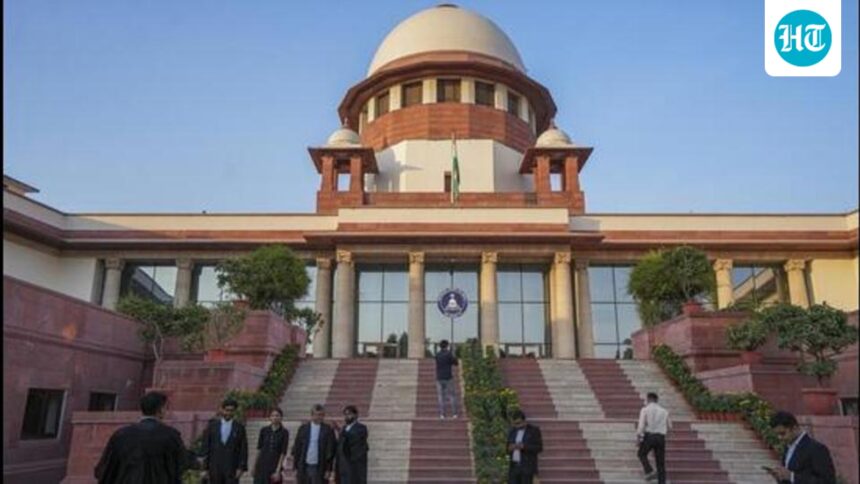
The appeal against the decision of the SC in the Goa matter – “Girish Chodankar v. Speaker of the Goa Legislative Assembly” – is now before the House SC.
SC has addressed the issue: is this enough?
The Supreme Court spoke on this topic in another case, Subhash Desai v. Principal Secretary, Governor of Maharashtra in 2023, in the Constitutional Court judgment on the Shiv Sena’s original split between Uddhav Thackeray and Eknath Shinde.
This case did not involve a merger claim per se, because the Shinde faction claimed to be the real Shiv Sena itself. (It later obtained the name and symbol from the Election Commission as well).
but The Supreme Court ruling, written by then CJI DY Chandrachud, spoke of a broader principle, that legislators alone are not the entire party.
“To read the term ‘political party’ as ‘party of the Legislative Council’ would be contrary to the clear language in the Tenth Schedule,” the report said. He also warned that “this is not the system of government envisaged by the Constitution. In fact, the Tenth Schedule protects against precisely this outcome.”
What remains to be settled
The problem is that the Subhash Desai case involving the Shiv Sena officially only covers the appointment of whips and leaders, not the issue of merger. The Supreme Court’s observations on Section 4 and the merger are part of its reasoning for the judgment, but are not a direct ruling on the issue.
However, former LS Secretary General Ashari is categorical that no further clarification is needed.
He said the language of the law is clear in itself: The first step is for the leadership of a political party to decide to merge with another party; The second step is that MPs and members of Parliament (legislative party) must agree to approve the merger.
“Members of Parliament or MPs alone cannot merge with another party. This is the constitutional provision,” he told HT.com. He also said that the Speaker of the House concerned – for example, the Lok Sabha Speaker in the event of a TMC or Sena-UBT revolt – should follow this “well-established principle”.
The embattled TMC also recorded exactly this argument in a letter to LS spokesperson Om Birla. Party general secretary Abhishek Banerjee cited the Subhash Desai 2023 ruling to argue that the TMC is a “single, indivisible political party” and that its legislative party in the Lok Sabha exists only as an “spin-off” of the parent organisation.
Similar questions about mergers and diversions have emerged over the past two months at the assembly level in Bengal and Tamil Nadu.
As the focus remains on Parliament, the shadow of rebellion has allegedly also fallen on the Samajwadi Party, another major component of the Congress-led India bloc.
UP CM Keshav Prasad Maurya of the BJP claimed that “about 25-26 MPs from the Samajwadi Party are ready to secede”. Party president Akhilesh Yadav rejected the allegation. The SP has 37 Lok Sabha MPs, meaning 25 of them will meet the two-thirds threshold.
But can they act alone?
The question goes back to the Goa matter pending in the Supreme Court.
The parties affected by the recent defections also expressed their hope that a solution would be reached through the constitutional courts.
Why numbers matter
The issue of two-thirds is not limited to dissident MPs. The BJP-led NDA needs a two-thirds majority in both the Lok Sabha and Rajya Sabha to amend the Constitution.
The NDA has hit a wall on this front recently.
On April 17, the Modi government’s Constitution (131st Amendment) Bill – which sought to expand the Lok Sabha and implement delimitation or (redrawing) of constituencies, as a prerequisite for 33% reservation for women – was defeated because the NDA did not have a two-thirds majority. She received 298 votes against the required 352 votes. Every representative who now switches to the National Democratic Rally narrows this gap.