

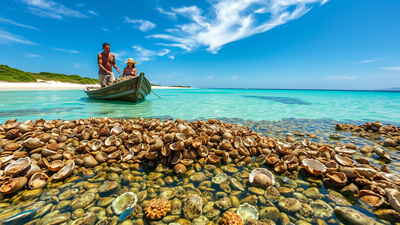
Before European settlers arrived on Australian shores, vast reefs of oysters and mussels stretched across the southern half of the country all the way north to the edges of the Great Barrier Reef.
These shell reefs filter seawater, feed fish populations, stabilize sediments, and protect beaches from wave damage. Then, over the course of a century, they were almost completely eradicated. Commercial dredging, pollution, coastal development, and disease have destroyed more than 90% of it. Today, less than 10% of Australia’s natural coral reefs remain. A restoration effort led by The Nature Conservancy and supported by the Australian Government and the United Nations Environment Program is now trying to change one recycled shell at a time.
How Australia’s coral reef restoration program is recycling shells to rebuild lost marine habitats
The method is deceptively simple. Conservationists collect used oysters and mussel shells from restaurants, fish markets and seafood processors, shells that would otherwise end up in landfills, and return them to the ocean. Once deposited on the sea floor, they form a solid base on top of existing rubble. Baby oysters, known as larvae, need exactly this kind of hard surface in order to attach themselves and begin to grow.
Without it they cannot establish. Through it, coral reefs can begin to rebuild themselves from almost nothing.“What we’re really doing is kind of kick-starting the recovery process,” said Simon Brannigan, marine restoration lead at The Nature Conservancy Australia. “Since 2014, we have recycled nearly 150,000 wheelbarrows of shells.”This number, 150,000 wheelbarrows, equates to approximately thousands of tons of shell material redirected from waste streams into ecosystem restoration. The program, known as the Reef Builder Initiative, was a $20 million partnership between The Nature Conservancy and the Australian government, running between 2021 and 2023.
This project has built on restoration trials conducted by TNC since 2015, and has expanded the project to include 13 geographic regions across Western Australia, South Australia, Victoria, Tasmania, New South Wales and Queensland.
Fish species richness and water purification: what restored oyster reefs actually offer
Restored reefs are already showing results far beyond what would be expected for sites still in the early years of their recovery. According to the United Nations Environment Programme, the areas rebuilt so far add an estimated 50 tons of fish to local stocks each year, a number that could double by 2030 as more coral reefs mature.
Researchers monitoring the sites have recorded about 250 species of fish and mobile invertebrates on the restored reefs, compared to 175 species in nearby unrestored areas.
This includes crabs, sea stars and a wide range of native fish that depend on the complex structure of coral reefs for food and shelter.The benefits of water quality are just as important. The restored coral reefs filter up to 125 billion liters of seawater each year and remove up to 14 tons of nutrient pollution in the process.
Excess nutrients from agricultural runoff, stormwater, and sewage are a major driver of harmful algal blooms, which can suffocate marine life and make waters unsafe. Oysters are among the most effective natural filters on the planet, and on a large scale, they can significantly reduce this problem.As published in npj Ocean Sustainability, coral reef ecosystems provide what the authors call “huge biodiversity benefits” relative to their physical size: fish production, nutrient removal, sediment stabilization, and shoreline protection, all from a relatively small footprint of restored habitat.
The IUCN Red List and the goal of making Australia the first country to restore an endangered marine ecosystem
The goal that the program works to achieve is unusually specific and unusually ambitious. The goal is to restore coral reefs across 30% of the bays and estuaries they once dominated, which means 60 reef systems in total, covering 300 hectares across 60 sites by 2030.If this target is reached, it will trigger a formal reassessment of the status of the coral reef ecosystem on the IUCN Red List of Ecosystems, which currently classifies the coral reef ecosystem of southern and eastern Australia as critically endangered.
Achieving reclassification to a less threatened category would, in effect, make Australia the first country in the world to officially restore an endangered marine ecosystem.As of April 2024, 21 oyster reefs have been restored at sites across the country, covering an area of 62 hectares. Meanwhile, the South Australian Government has begun delivery of 26 recycled coral reefs across Eyre Peninsula, Yorke Peninsula, Kangaroo Island and Largs Bay in 2026, with plans to create a large-scale limestone reef of around 16 hectares in St Vincent Bay.
Economic benefits of coral reef restoration: jobs, fisheries, and coastal resilience
Marine restoration is not usually viewed in economic terms, but the benefits here are tangible enough to be counted. UNEP estimates that the program could create thousands of jobs, support hundreds of local businesses, and generate approximately 14 million Australian dollars, or about 10 million US dollars, in ongoing annual economic benefits. The Reef Builder project alone generated 425 new jobs for local communities during the 2021-2023 delivery phase, more than doubling the original employment target.The communities that stand to gain the most are those along Australia’s southern coast, fishing towns, coastal tourism operators, indigenous communities with deep cultural connections to oysters, and local businesses that depend on healthy marine environments. “They may not be as famous as Australia’s Great Barrier Reef, but these ecosystems are just as important for keeping our oceans healthy,” said Natalia Alexeeva from UNEP.
“This initiative shows that when nature is given a helping hand, it can come roaring back, for itself and for us.”Reef Builder was named a UN Global Restoration Leader in 2025, only the third project in the award’s history to receive this designation, and the only Australian conservation project ever recognised.What makes this program worth watching isn’t just the science or the size. It stands to reason that the shells piling up outside seafood restaurants are also the raw material for rebuilding one of Australia’s most productive and long-lost marine habitats. The waste stream and restoration efforts are the same thing, quite literally. This is the kind of closed loop that is hard to argue with.