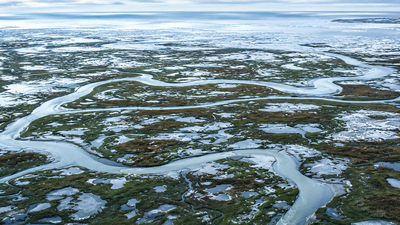
The Arctic is warming much faster than the rest of the planet, and a new study published in the journal Science Advances suggests that this warming could transform one of Earth’s largest natural carbon stores sooner than scientists previously thought.
The researchers say that northern soils warmer than 30 degrees north, including large areas of permafrost, may shift from absorbing carbon to releasing carbon around the 2050s when deep frozen carbon is taken into account. These findings challenge a key assumption in many climate models, which currently only consider the top layers of soil and ignore vast amounts of ancient carbon buried deeper underground. Scientists say this hidden carbon could make the Arctic a much stronger contributor to climate change in the coming decades.
Why Earth’s frozen carbon stores may not absorb carbon dioxide forever
For many years, climate models assumed that the boreal would continue to act as a giant carbon sponge for much of this century. Although higher temperatures can thaw frozen ground and release greenhouse gases, they can also encourage plants to grow faster and absorb more carbon dioxide from the atmosphere. Overall, many models suggest that these regions will remain net absorbers of carbon.But the new study says the picture is incomplete. The researchers argue that current models largely ignore huge stores of ancient carbon buried deep underground in peatlands and edamame deposits, a type of ice-rich permafrost found mainly in Siberia, Alaska and parts of Canada.
The authors write that these omissions “lead to an underestimation of the extent of permafrost and high-latitude carbon stocks” and hinder understanding of how permafrost melt will affect future carbon release. They noted that carbon-rich peat can extend to about 10 meters below the surface, while Ydoma deposits can reach depths of about 20 metres.
What researchers have changed
To address this problem, scientists updated the Earth’s surface model ORCHIDEE-MICT.
In simple terms, they taught the model how to reconstruct how carbon accumulated underground over thousands of years.The new version simulates the formation of deep Yadoma deposits since the last Ice Age and the evolution of northern peatlands during the Holocene, a geological period that began about 11,700 years ago. It includes more realistic estimates of carbon buried underground north of 30 degrees north latitude.The researchers then ran historical simulations covering the period from 1900 to 2014 and projected future conditions from 2015 to 2100 under three common socioeconomic trajectory scenarios, which climate scientists widely use to represent different possible futures.
They compared these results to older versions of the model to see how including deep carbon changed the predictions.
Main result
The updated model showed that northern soils actually stored much more pre-industrial carbon than standard models had previously suggested. But it also means there is more carbon available to escape as the Arctic warms.As the permafrost thaws deeper into the soil, microbes begin to break down organic matter that has remained frozen for thousands of years.
This decomposition releases carbon dioxide and other greenhouse gases into the atmosphere.Simulations show that the Arctic’s ability to absorb carbon has been steadily weakening throughout this century. By around the 2050s, northern lands could start emitting more carbon than they absorb, effectively switching from climate helper to climate amplifier.In previous versions of the model, this shift was expected to occur later, after mid-century.
What drives change?
According to the study, much of the additional carbon loss comes from deeper permafrost layers, especially Ydoma deposits. As temperatures rise, the “active layer” – the top layer of soil that thaws each summer – becomes progressively thicker.Think of it as slowly opening a giant refrigerator. The deeper the thaw reaches, the more ancient organic material becomes exposed to microbes, which begin to decompose it and release greenhouse gases.Explaining the results, the researchers wrote:“This high soil carbon loss in the updated simulations is primarily due to the gradual degradation of carbon in deep permafrost, especially from the Yadoma deposits, which became increasingly exposed as the thickness of the active layer deepened more rapidly after the mid-2000s.”They also stressed that the missing deep deposits “hinder our understanding” of how the thickness of the active layer will affect carbon decomposition in the future.
Why the result may still be conservative
The researchers caution that their estimates may underestimate the problem because many important processes are not fully included in the model.One example of this is a sudden thaw. Instead of thawing gradually, some permafrost can collapse suddenly, exposing large amounts of ancient carbon to decomposition.Another process involves thermokarst lakes. These lakes are formed when ice-rich land melts and creates depressions that fill with water.
Because water transfers heat more effectively than frozen soil, the surrounding permafrost thaws faster, creating a feedback loop that can release more greenhouse gases.Forest fires, vegetation shifts, nutrient cycles, and land ice dynamics were also not fully represented. All of these factors could increase emissions in the future.The vulnerable carbon stores are located “more than three meters deep,” first author Yi Shi told Scientific American, highlighting how much carbon lies beneath the area that many climate models currently take into account.
Why are scientists concerned?
Permafrost areas are often described as giant natural freezers that preserve dead plants and animals that have accumulated over thousands of years. As long as the ground remains frozen, carbon remains locked away.But once the frozen soil begins to thaw, microbes begin breaking down organic matter and releasing carbon dioxide and methane into the atmosphere.This creates a self-reinforcing cycle. More warming leads to more melting, which releases more greenhouse gases, which leads to more warming.
Scientists refer to this as a positive feedback loop.The Arctic is already warming two to four times faster than the global average, and some parts of the region are starting to show signs of becoming carbon sources rather than carbon sinks.
Abstract of the study
The authors say realistic climate projections must include carbon deep buried beneath permafrost and peatlands.They write:“These results are crucial for predicting future permafrost carbon climate feedbacks, because they highlight the importance of including deep carbon dynamics when assessing carbon balance in boreal soils.”The researchers add that the approach they developed for the ORCHIDEE-MICT model can also be used in other models of the Earth system.In other words, scientists may be ignoring a large portion of Earth’s frozen carbon stock. Correcting this blind spot suggests that the Arctic may stop helping to slow climate change and start adding to it much sooner than previously thought.