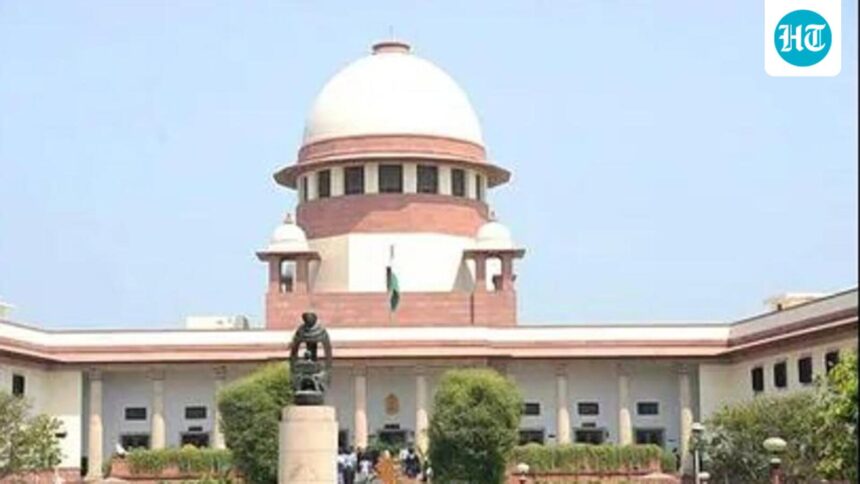
The Supreme Court on Tuesday refused to grant urgent hearing on a petition challenging the West Bengal government’s orders allegedly linking welfare benefits to exclusions from electoral rolls after the Special Intensive Review (SIR) process, and instead asked the petitioner to approach the Calcutta High Court.

A bench of Justices B V Nagrathna and Joymalia Bagchi observed that the challenge raised an independent cause of action with regard to eligibility for welfare schemes and public distribution benefits, making the Supreme Court the appropriate forum to consider the issue in the first place.
This plea was stated by advocate Prasanna S on behalf of the agricultural workers union Paschim Banga Khet Majoor Samity, which had challenged the June 4 order of the West Bengal Food and Supplies Department and the May 19 notification of the Women, Child Development and Social Welfare Department.
According to the petition, both measures link beneficiary status under the Public Distribution System (PDS) and the Annapurna Yojana to classifications created during the exercise of SIR, including categories such as “dead,” “converted,” “deleted,” and “absentee” voters. The petitioner claimed that the linkage could render between 35 lakh (3.5 million) and 60 lakh (6 million) ration cards inactive if implemented mechanically by the state government.
Seeking an urgent listing, Prasanna asserted that the Supreme Court had recently upheld the legality of the SIR exercise in the RDA case and that similar attempts to link SIR findings to welfare entitlements had begun to emerge in other states as well. The issue therefore has ramifications beyond West Bengal, he said.
But the bench was not convinced.
Read also:Did SIR exercise win West Bengal for BJP?
In questioning the maintainability of the petition under Article 32 of the Constitution, the bench observed that a grievance before the court was different from a challenge to the practice of the SIR itself. The report indicated that the real issue is whether individuals excluded from electoral lists can be deprived of food benefits or excluded from social welfare plans.
“Why did you submit this under Section 32?” he asked the jury, noting that the petition raised a separate cause of action regarding the continuation of welfare and PDS benefits.
When Prasanna argued that the issue had national-level implications and deserved consideration by the Supreme Court, the bench reiterated that the challenge concerned state actions affecting welfare benefits and should first be examined by the apex court.
Referring to the reopening of the Calcutta High Court after the summer vacation, the court told the petitioner: “Please take the matter to the Calcutta High Court.”
The petition argues that the impugned orders violate Articles 14 and 21 of the Constitution because exclusion from the electoral rolls under the SIR process neither establishes loss of citizenship nor determines economic vulnerability, both of which are irrelevant to eligibility for food security benefits.
It further asserts that the action taken by the State amounts to the impermissible use of data collected for one legal purpose – reviewing electoral rolls, for a completely different purpose – determining entitlement to social welfare schemes.
This challenge is based in part on observations made by the Supreme Court itself while upholding the practice of SIR, where it made clear that exclusions from electoral rolls have consequences limited to the electoral process and fall short of a final determination of citizenship status.
This petition comes weeks after the Supreme Court, in a May 27 ruling, upheld the constitutional validity of the Election Commission’s SIR exercise.
In a 124-page ruling by a bench led by Chief Justice of India Surya Kant and Justice Bagchi, the court dismissed a batch of petitions challenging the legality of the SIR process that was first conducted in Bihar and later extended to all parts of the country.
The court held that this practice could be traced back to Section 21(3) of the Representation of the People Act 1950, read with Section 324 of the Constitution, and was intended to further the constitutional objective of holding free and fair elections.
The body rejected arguments that the Election Commission had exceeded its authority, ruling that the poll body had the constitutional authority to conduct a limited citizenship inquiry for electoral purposes. At the same time, she stressed that any conclusions reached during this exercise would only have consequences for electoral participation and would not amount to a binding determination of citizenship under the Citizenship Law.
The court further clarified that removal from the electoral rolls does not negate an individual’s claim to citizenship and cannot replace judicial adjudication by the authorities authorized under the Citizenship Act of 1955.
It directed that persons whose names were removed from the electoral rolls on suspicion of being non-citizens by the Election Commission should be referred to the competent authority under the Nationality Law within four weeks to decide on their matter after notification and hearing.
Petitioners in the SIR challenge included the Association for Democratic Reforms, the People’s Union for Civil Liberties, and political leaders Manoj Kumar Jha, KC Venugopal, Mahua Moitra, and activist Yogendra Yadav, who argued that the practice led to widespread disenfranchisement and effectively transformed the Election Commission into an authority to adjudicate citizenship. The Supreme Court rejected these claims while limiting the commission’s powers and maintaining the distinction between electoral eligibility and citizenship determination.