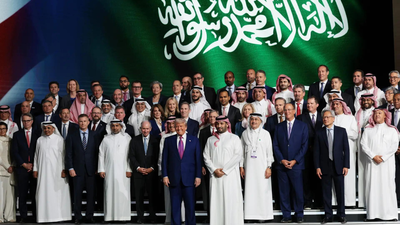
Ambiguity about who will pay Iran $300 billion (Getty)
As US Secretary of State Marco Rubio heads to the Gulf to defend Washington’s proposed peace deal with Iran, one provision has emerged as a major source of concern among America’s Arab allies – Tehran’s planned $300 billion Reconstruction and Development Fund.
While critics in the United States have portrayed the proposal as a massive US boost to Iran, the Trump administration insists that the money will come largely from Gulf states and private investors rather than US taxpayers.The controversy stems from a draft memorandum of understanding between Washington and Tehran that stipulates a reconstruction and economic development plan worth at least $300 billion for Iran. The provision has drawn criticism in the United States and throughout the Gulf, where many governments fear that a wealthier Iran will expand its regional influence and military capabilities. The provision quickly drew criticism from Democratic lawmakers, who argued that such a huge commitment would be difficult to justify domestically. “With $300 billion, we could end homelessness, fund cancer research for 40 years, and give every child free pre-K for over 7 years,” Senator Amy Klobuchar wrote on X. “Instead, Trump is sending it to Iran.”
But President Donald Trump rejected the claim that Washington would hand over billions of dollars to Tehran.
“The United States did not pay $300 billion to Iran,” Trump wrote on Truth Social on June 18. “This is Fake News! All the United States has is success, low oil prices, and victory.”
Who will finance $300 billion?
While questions remain about the fund’s final structure, administration officials’ statements indicate that the money is expected to come largely from foreign governments, private investors and international companies rather than the U.S. government. Vice President J.D. Vance said there is great interest from Gulf countries and beyond to invest in Iran if relations improve and sanctions are eased. Politifact quoted Vance as saying: “There is a great desire from the Arab world and outside the Arab world to actually get involved in Iran if they act correctly.” He cited the United Arab Emirates as an example, saying that Emirati entities could invest in projects such as power plants if US sanctions no longer prevent such investments. Vance also suggested that private capital would play an important role, although he stressed that any investments would depend on changes in Iranian behavior and implementation of the broader agreement.
The Gulf countries may finance the plan
While US officials have indicated that Gulf states could play a major role in financing Iran’s proposed Reconstruction and Development Fund, this possibility raises unease among many of Washington’s Arab allies. Vice President J.D. Vance cited the United Arab Emirates as an example of the type of regional investor that could participate if sanctions were eased, arguing that countries in the Arab world are interested in investing in Iran if it changes its behavior.However, a Reuters report said that officials in several Gulf Cooperation Council countries were secretly surprised by the terms of the US-Iranian understanding, especially the proposed $300 billion reconstruction fund.
Some regional governments fear that a large influx of capital will bolster Tehran’s military capabilities and expand support for allied groups across the Middle East.Nearly half of the proposed fund has already been committed through a private investment vehicle that does not include any government grants, the report said. Investments are expected to come from companies in the United States, Gulf Arab states, Asia, South America and Africa, although no participating entities have been publicly identified yet.