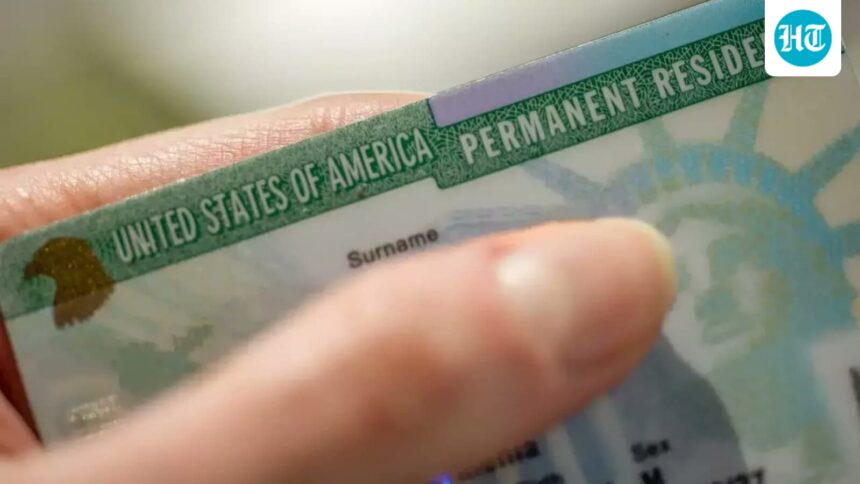
The Trump administration has proposed a new rule to significantly increase the cost of filing the form required for immigrants to apply to become naturalized U.S. citizens. If the rule goes into effect, it will likely make green cards more expensive — an effect that will be felt by Indians in the United States as well.

According to the rule proposed by the Department of Homeland Security, the cost of filing Form N-400 (Application for Naturalization) by paper would increase from $760 to $1,330 — a 75 percent increase. Meanwhile, the cost of filing the form online will rise from $710 to $1,280, an 80 percent increase.
The naturalization model for those with household incomes below 400 percent of the federal poverty guidelines remains at $380, with no proposed change. The reduced fee option form is only available for paper filing, the DHS document states. However, the new rule proposes eliminating the reduced fee for Form N-400 and application fee waivers.
This new rule was proposed under various sections of the Immigration and Nationality Act and the Homeland Security Act of 2002.
If the rule goes into effect, it could affect hundreds of thousands of legal permanent residents of the United States and make green cards much more expensive. However, the DHS proposal indicates that the new rule would not go into effect for at least 60 days after its publication, as it must first go through a public comment period.
Among those immigrants and non-US citizens who successfully obtain green cards every year are Indians. Let’s take a look at how the Trump administration’s proposed new rule will impact Indians:
What could this mean for Indians
According to data from the Indian Ministry of External Affairs, there are about 6.7 million Indians in the US – 60,79,221 to be precise – as of January 2026. Of these, 37,67,737 are people of Indian origin, and 23,11,484 are non-resident Indians.
While there was no known data on how many Indians obtained legal permanent residence, i.e. a green card, in the US, data released by the Office of Homeland Security Statistics for 2024 reveals that 66,800 Indians successfully obtained a green card.
The number may seem huge given the recent H-1B visa tensions and chaos, but it’s actually down more than 50 percent compared to 2022.
In 2022, about 1,27,010 Indians will become permanent legal residents of the United States. This number drops further in 2023, when only 78,070 Indians will be granted green cards. In 2024, the rate drops to 66,800.
Despite the lower numbers, DHS’s proposed changes to naturalization application fees could still significantly impact Indians. High prices may prompt Indians to consider other ways to reside or settle in the United States legally.
What is the H-1B visa class?
US President Donald Trump raised the H-1B visa application fee from an average of $2,000 to $100,000 in September last year. Employers who wanted to sponsor skilled immigrants to work in the United States were to pay the fee.
The H-1B program is for employers seeking to “hire non-immigrant aliens as workers in specialized occupations or as models of outstanding merit and ability,” a path that has enabled many Indians to work in the United States.
The Trump administration believed its “America First” slogan had been damaged by the H-1B program, which prompted it to impose the huge fees.
However, a federal court in Boston, Massachusetts, threw out Trump’s $100,000 visa fee, calling it “unlawful.”
This ruling came as a relief to many Indian immigrants on H-1B visa, who are working in the US.